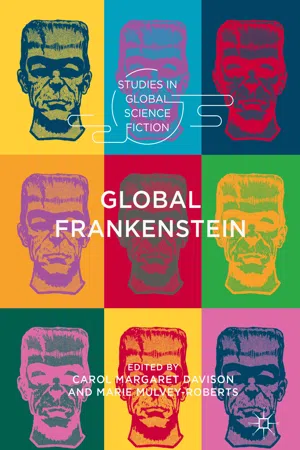
Consisting of sixteen original essays by experts in the field, including leading and lesser-known international scholars, Global Frankenstein considers the tremendous adaptability and rich afterlives of Mary Shelley's iconic novel, Frankenstein, at its bicentenary, in such fields and disciplines as digital technology, film, theatre, dance, medicine, book illustration, science fiction, comic books, science, and performance art. This ground-breaking, celebratory volume, edited by two established Gothic Studies scholars, reassesses Frankenstein's global impact for the twenty-first century across a myriad of cultures and nations, from Japan, Mexico, and Turkey, to Britain, Iraq, Europe, and North America. Offering compelling critical dissections of reincarnations of Frankenstein, a generically hybrid novel described by its early reviewers as a "bold," "bizarre," and "impious" production by a writer "with no common powers of mind", this collection interrogates its sustained relevance over two centuries during which it has engaged with such issues as mortality, global capitalism, gender, race, embodiment, neoliberalism, disability, technology, and the role of science.
eBook - ePub
Global Frankenstein
- English
- ePUB (mobile friendly)
- Available on iOS & Android
eBook - ePub
Global Frankenstein
About this book
Information
© The Author(s) 2018
Carol Margaret Davison and Marie Mulvey-Roberts (eds.)Global FrankensteinStudies in Global Science Fictionhttps://doi.org/10.1007/978-3-319-78142-6_11. Introduction: Global Reanimations of Frankenstein
Carol Margaret Davison1 and Marie Mulvey-Roberts2
(1)
Department of English Language, Literature and Creative Writing, University of Windsor, Windsor, ON, Canada
(2)
Department of Arts and Cultural Industries, University of the West of England, Bristol, UK
Carol Margaret Davison (Corresponding author)
Marie Mulvey-Roberts
A global event brought Frankenstein; or, The Modern Prometheus into being. In 1815, Indonesia’s Mount Tambora erupted with thunderous detonating sounds, its effects ricocheting on more distant coastlines with devastating tsunamis. It was, and remains, one of the largest eruptions in recorded history. The veil created by the spreading ash, in combination with the release of toxic gases infiltrating the stratosphere, had a worldwide effect, as would Mary Shelley’s Frankenstein, the novel it helped to birth. The resulting extreme climate change had fortuitous literary aftershocks for it forced the visitors at Lord Byron’s summer home, the Villa Diodati on the shores of Lake Geneva, to remain indoors and entertain themselves by recounting ghost stories . Thus were the seismic conditions that saw the genesis of Mary Shelley’s Frankenstein set in motion.A book is a dead man, a sort of mummy , embowelled and embalmed, but that once had flesh, and motion, and a boundless variety of determinations and actions. I am glad that I can, even upon these terms, converse with the dead, with the wise and the good of revolving centuries. (William Godwin, Fleetwood , 1805)
In the same way as the volcanic eruption upset the eco-system, blasting human and geographical boundaries, so too did the novel upset religious sensibilities while unsettling assumptions about science and technology . As Muriel Spark argued over 70 years ago, Shelley’s singular novel was pioneering. This first work of science fiction (1951: 133) paved the way for a new domain of literary speculation and adventure.1 Frankenstein was also ‘a new and hybrid fictional species’ (128), Spark argued, that engendered distinctive and long-term literary aftershocks: marking ‘the apex’ of an old-school Gothic fiction, it signalled a new speculative species combining the supernatural and the scientific. This bold, innovative departure in Gothic literature conjured up a compelling narrative recipe: the traditional setting of feudal antiquity was rejected in favour of a more contemporary scene with its distinct fears and anxieties; the malevolent monk of earlier Gothic novels was supplanted by an overreaching scientist; the traditional villain’s castle was replaced by a laboratory; the identification of the villain was confounded; and the putative ‘monster ’ granted a sympathy-inducing sensibility and eloquence.
Perhaps most radically, Shelley’s first novel reached back to such classics as Shakespeare’s Hamlet and Milton’s Paradise Lost whilst addressing contemporary Enlightenment debates about nature, human nature, being, scientific experimentation, socio-political institutions, and the psychological problem of evil to stake out new territory later classified by critic Robert Hume as ‘metaphysical Gothic’ (1969: 290). Like other works of Romanticism but in what Hume claims was a less coherent and articulate fashion, Frankenstein meditated on existential, ontological, and epistemological questions. In so doing, it inspired and paved the way for such meditative Gothic works as James Hogg’s The Private Memoirs and Confessions of a Justified Sinner (1824), Emily Brontë’s Wuthering Heights (1847), and Herman Melville’s Moby Dick (1851). Despite Percy Bysshe Shelley’s attempts in the Preface to the anonymously published first edition to disassociate Frankenstein from the Gothic, the work told a very different story,2 its author later underscoring in the Preface to her 1831 edition her objective of crafting a ghost story that ‘would speak to the mysterious fears of our nature and awaken thrilling horror—one that would make the reader dread to look round, to curdle the blood, and quicken the beatings of the heart’ (1994b: 195).
Frankenstein certainly met its affective objectives, the predominant response to the novel highlighting its spine-tingling terror in combination with its evocation, particularly in the opening creation scenes, of the horrifyingly grotesque. Fittingly, given the spectacular and sublime creature at its centre, Shelley’s novel, first published anonymously, received several mixed reviews whose rhetoric mirrored the composition of her ‘hideous progeny’ (1994b: 197). Assuming, like many, that the author was male, of the Godwinian school, and possibly Percy Bysshe Shelley, Sir Walter Scott described Frankenstein in his Edinburgh Magazine review as a ‘new species of novel’ at once ‘unnatural, even impious’ (qtd. in Wolfson 2006: 370) that was both ‘wildly imaginative’ and ‘realistic’ (371). Another contemporary reviewer in The British Critic deemed the novel a ‘bizarre’ production that monstrously combined ‘horror’ and ‘absurdity’ (qtd. in Wolfson 2006: 388–9), crafted by a writer ‘with no common powers of mind’ (389). Just a few years in advance of the publication of Thomas de Quincey’s The Confessions of an English Opium-Eater (1821), the British Critic reviewer, as if still in the throes of distress, described the powerful effects of the tale developed from Mary Shelley’s ‘waking dream’ (Shelley 1994b: 195) to be opiate-like: ‘we feel ourselves as much harassed, after rising from the perusal of these three spirit-wearying volumes, as if we had been over-dosed with laudanum, or hag-ridden by the night-mare’ (qtd. in Wolfson 2006: 387).
It is noteworthy that several positive critical assessments of Frankenstein—once the author’s true identity was known to the public—such as that published in 1831 in the London Literary Gazette declaring the novel to be ‘one of the most original works that ever proceeded from a female pen’ (qtd. in Wolfson 2006: 398; emphasis added), included qualifying statements, for better or for worse, about the author’s sex and age. ‘It is a wonderful work,’ Byron (obviously aware early on about the author’s true identity) wrote to his publisher, ‘for a girl of nineteen’ (Schoene-Harwood 2000: 27; emphasis added), an assessment Shelley herself echoed in her reference to her novel as a ‘juvenile effort’ in a thank-you letter to Sir Walter Scott (qtd. in Wolfson 2006: 378). Notably, and in keeping with the popular rhetoric deployed against Mary Shelley’s parents—Mary Wollstonecraft and William Godwin—the response to Shelley as a woman writer also conjured up the trope of the monster.3 Such commentary remained in evidence in the twentieth century after Frankenstein had suffered 130 years of critical neglect. Even Muriel Spark, whose critical biography Child of Light: A Reassessment of Mary Wollstonecraft Shelley (1951) is often credited with placing Shelley on the public and academic radar, deemed her not to be ‘well acquainted with her own mind’, something Spark says enhanced Shelley’s story artistically because it tended towards ‘the implicit utterance’ as opposed to the explicit (1951: 129).
The idea of a monstrously mindless woman writer who, like her novel’s protagonist, lacked control over her creation, took hold in the popular critical imagination. As Ellen Moers has noted, the tendency was to regard Shelley, based on both her ‘extreme youth’ and her sex, ‘not so much as an author in her own right as a transparent medium through which passed the ideas of those around her’ (1976: 94). In the words of Mario Praz, for example, in a passage hearkening back to traditional Victorian ideals about female passivity, ‘[a]ll Mrs. Shelley did was to provide a passive reflection of some of the wild fantasies which were living in the air about her’ (1951: 114; emphasis added). Ironically, this passage disparagingly comparing Frankenstein with Percy Bysshe Shelley’s The Cenci (1819) directly contradicts Percy’s own assessment of Mary’s novel, as published in the Athenaeum in 1818, as ‘one of the most original and complete productions of its day’ (qtd. in Wolfson 2006: 399). Even George Levine and U. C. Knoepflmacher , self-confessed ‘closet aficionados of Mary Shelley’s novel’ and the editors of The Endurance of Frankenstein: Essays on Mary Shelley’s Novel (1979) who offhandedly remark in their Introduction that they ‘half-jokingly’ (xi) undertook the first collection of scholarly essays devoted to Frankenstein, were motivated, they said, by such ‘valid’ q...
Table of contents
- Cover
- Front Matter
- 1. Introduction: Global Reanimations of Frankenstein
- Part I. Frankenstein: Science, Technology, and the Nature of Life
- Part II. Frankenstein and Disabled, Indecorous, Mortal Bodies
- Part III. Spectacular Frankensteins on Screen and Stage
- Part IV. Frankensteinian Illustrations and Literary Adaptations
- Part V. Futuristic Frankensteins/Frankensteinian Futures
- Back Matter
Trusted by 375,005 students
Access to over 1.5 million titles for a fair monthly price.
Study more efficiently using our study tools.
Frequently asked questions
Yes, you can cancel anytime from the Subscription tab in your account settings on the Perlego website. Your subscription will stay active until the end of your current billing period. Learn how to cancel your subscription
No, books cannot be downloaded as external files, such as PDFs, for use outside of Perlego. However, you can download books within the Perlego app for offline reading on mobile or tablet. Learn how to download books offline
Perlego offers two plans: Essential and Complete
- Essential is ideal for learners and professionals who enjoy exploring a wide range of subjects. Access the Essential Library with 800,000+ trusted titles and best-sellers across business, personal growth, and the humanities. Includes unlimited reading time and Standard Read Aloud voice.
- Complete: Perfect for advanced learners and researchers needing full, unrestricted access. Unlock 1.5M+ books across hundreds of subjects, including academic and specialized titles. The Complete Plan also includes advanced features like Premium Read Aloud and Research Assistant.
We are an online textbook subscription service, where you can get access to an entire online library for less than the price of a single book per month. With over 1.5 million books across 990+ topics, we’ve got you covered! Learn about our mission
Look out for the read-aloud symbol on your next book to see if you can listen to it. The read-aloud tool reads text aloud for you, highlighting the text as it is being read. You can pause it, speed it up and slow it down. Learn more about Read Aloud
Yes! You can use the Perlego app on both iOS and Android devices to read anytime, anywhere — even offline. Perfect for commutes or when you’re on the go.
Please note we cannot support devices running on iOS 13 and Android 7 or earlier. Learn more about using the app
Please note we cannot support devices running on iOS 13 and Android 7 or earlier. Learn more about using the app
Yes, you can access Global Frankenstein by Carol Margaret Davison, Marie Mulvey-Roberts, Carol Margaret Davison,Marie Mulvey-Roberts in PDF and/or ePUB format, as well as other popular books in Literature & European Literary Criticism. We have over 1.5 million books available in our catalogue for you to explore.