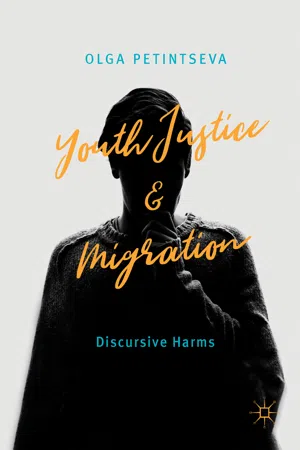
This book examines the implications of the professional and judicial discourses on migrant youth in the Belgian youth justice system. Drawing on a detailed study of 55 court case files and in-depth interviews with over forty youth justice professionals, the book explores the problematisations of migrant Roma and Caucasian young people in the youth justice system to argue that they result in 'discursive harms'. It discusses the assumptions and the effects of explanations of deviant behaviour, ambiguities in representations of young people's agency and responsibility, differing assumptions about the moral potential of Roma and Caucasian families, and the reframing of assessments in school-based reports as signals of delinquency. The book reflects on how to address the 'discursive harms' identified and calls for a review of protection practices and ideals from a fundamental rights perspective. This book contributes to a topic that will have increasing significance for youth justice practice in Belgium as well as the rest of Europe.
- English
- ePUB (mobile friendly)
- Available on iOS & Android
eBook - ePub
About this book
Information
© The Author(s) 2018
Olga PetintsevaYouth Justice and Migrationhttps://doi.org/10.1007/978-3-319-94208-7_11. Introduction
Olga Petintseva1
(1)
Department of Criminology, Criminal Law and Social Law, Ghent University, Ghent, Belgium
Although human migration is hardly a new phenomenon, its nature and extent have changed significantly in the postindustrial era (Aas & Bosworth, 2013; Maly, Blommaert, & Ben Yakoub, 2014). Alongside the ‘traditional’ migration movements (such as labour migrations, migrations from former colonies, etc.), so-called ‘new migrations’ became prominent (Koser & Lutz, 1998). These migrations are dense, highly diverse and entail diffuse motives and paths. Furthermore, the situation of many people in the country of immigration is precarious and turbulent. Among other issues, many of these ‘new’ groups cannot count on the presence of a profound social network, and numerous institutional contexts are structurally unadjusted to the needs of these newly arrived immigrants (Martiniello, Rea, Timmerman, & Wets, 2010; Portes, 2010). Transnational migration (aside from the ‘mobility ’ of highly educated professionals, migration for educational purposes, etc.) has been problematised in various instances. This framing has equally been subject to shifts throughout the past decades. To date, particularly asylum applicants, illegalised immigrants, people presumably migrating for economic reasons and Roma are positioned high on the political agenda. Additionally, claims of failed socioeconomic and cultural integration and the ‘naive’ ideal of multiculturalism are quite prominent (Maly et al., 2014). The ways in which these groups are framed and handled in institutional contexts that are, in principle, unrelated to migration and integration as such, remains an underexplored area.
This research speaks to debates about interactions and expectations in institutional contexts and commonsensical discriminatory or otherwise harmful practices therein. At the heart of this contribution are the understandings and interpretations of complex situations, through institutional discourse production and use. Specifically, this study is focused on how deviant behaviour and broader background situations of migrant youth are problematised in the practice of youth justice, and how such discourses are enacted.
Quite differently from adult criminal justice (cf. the work on crimmigration (e.g. Aas & Bosworth, 2013; João Guia, van der Woude, & van der Leun, 2013), this institutional sphere is not directly related to migration; yet, in practice, migration background, culture, ethnicity and class are influential for how deviant behaviour, personality and milieu of the young people are understood. The analytic gaze of this book is turned on the definitional processes, problematising activities, expectations, circularity of information and modes of communication in the practice of youth justice in Belgium while handling migrant youth.
Youth justice is a fascinating context for such a study, for it is characterised by a large discretionary space, the ‘best interests’ doctrine and constant negotiations between protecting, responsibilising and sanctioning. All of this makes this practice social (i.e. driven by human understandings), rather than a mere mechanical application of laws. Despite the introduction of some retributive elements and principles of accountability, the Belgian youth-justice model retains its emphasis on the youth-centred protection ideal (see Chapters 2 and 8 for discussion of the international context).
This research addresses how understandings of behaviour and the broader situation of young people are linked to migration (in a broad sense), how certain elements of migration and cultural background come to constitute youth-justice profiles, how these problematisations ‘travel’ throughout various stages of youth-justice processing and across institutional spheres, which aspects play a role in the constitution of a case file and, ultimately, judicial reaction.
One of the central propositions is that the judicial (and by extension, societal) reaction cannot be seen separately from one’s social position(ing). The central question of the current study is how this occurs in the field of youth justice. The focus is directed at the social conditions of (re)production of youth’s profiles and backgrounds in their youth-justice trajectories: the reconstruction, translation and formalisation of the events and the situation into case-file documents and into professionals’ understandings. In other words, the decision outcomes are not abstracted from their production and not focused on as a separate entity (cf. disparity research discussed in Chapter 2). Rather, I am interested in how youth-justice professionals understand and constitute people, events and the desirable ‘solutions’.
Of particular interest is how the aspects of migration, culture and ethnicity become relevant and come to play a role in youth-justice problematisations and assessments (i.e. how such positioning is constituted, assigned meaning and negotiated, and what this means for youth-justice practice). To this end, I focus on the origins, shapes and roles of problem definitions while handling a case, which result in often inconspicuous shifts in attributions of causes of crime, assumptions about the agency of the youngster, about the ‘appropriate’ attitude and background context; eventually contributing to shifts in the goals of the (preferred) interventions.
Specific groups were chosen as instances of ‘new’ migrants: on the one hand, youngsters born in the Northern Caucasus (Chechnya, mainly) , and on the other hand, young people born in Slovakia and the Czech Republic residing in Belgium. The former case concerns asylum seekers and refugees who mostly came to Western Europe at the beginning of the 2000s in the aftermath of the Chechen wars. The latter case deals with intra-European migrants (mostly moving to Belgium after the EU-enlargement in 2008) who largely consist of Roma minorities and who became popularly known as economic migrants. Both groups of people are positioned in particular ways outside the ‘walls’ of youth-justice institutions, at times with references to distinctive crime patterns and specifically causing concerns about youth crime (Delforge, 2008; Farcy, 2006; Siegel, 2013). Next to representations, the choice of the cases was pragmatic: given the limited digitalisation and non-registration of ethnicity in Belgian youth justice, the cases had to be selected based on birthplace. Moreover, the selection was personal. Having lived in the former Soviet Union and in the Czech Republic myself, I was confronted with very profound exclusionary practices and stereotyping to which the respective groups of people are subject in the countries of origin (see also Chapter 2).
The minors I focused upon in my research were formally suspected of having committed an offence. After having previously studied experiences of migrant young people with police and criminal-justice institutions (Petintseva, 2009), I now chose to zoom in on the institutional side (see also Duchateau, Van Poeck, & Hebberecht, 2004; Foblets, Djait, & Pieters, 2005). This resulted in the current focus on the positioning of Caucasians and Roma Slovak and Czech youngsters in the daily practice of youth-justice institutions.
From the very beginning, it was clear that possible discriminatory practices were a sensitive and rather subtle matter (see also Terrio, 2008, 2009). Hence, my goal was to understand the everyday interactions and practices, focusing on how these young people are defined, assessed and processed. Therefore, I discuss how they are discursively positioned in the practice of youth justice, paying attention to the notions of migration, culture and ethnicity. I outline how these narratives function in specific interactions, I discuss the situatedness of such positioning, how it is maintained or renegotiated, alongside the impact it has on the judicial trajectory. In other words, the goal is to reconstruct how ‘new’ groups of youth, their actions and the broader situation are being defined and problematised throughout their youth-justice trajectories, and to find out which actors contribute to these (de)constructions and from what knowledge and discourse they draw their views.
This is accomplished by examining the assumptions underlying discourses constituted throughout youth-justice trajectories. Central markers, negotiations, discursive conflicts, concept recycling, contradictions, discursive strategies and the linguistic resources mobilised reveal how problematisations (as ‘truth’) are being shaped (Foucault, 1969).
The central question addressed here is: When assessing and judging young people who are formally suspected of having committed an offence (i.e. referred to the youth court in delinquency cases), what issues are problematised throughout youth-justice trajectories? Specifically, what representations can be found of the causes and nature of the offences? Of youth’s personalities and responsibility? Of their home backgrounds and school situations?
For each of the themes, I was interested in the expression of the discourses elicited. For instance, to what extent they are ‘culturalised,’ ‘ethnicised’ or ‘migrationised’ and with which underlying assumptions/connotations? To what kind of groups are the young people assigned? Which potentially important elements are left unproblematised? How is positioning legitimised (e.g. differences, practical constraints, suitability, best interests, etc.)? Also the constitution of problematisations was of interest: Who produces such discourses? How are various voices represented? How is this knowledge maintained and disseminated? Are there alternative reports, counter-stories and negotiations? On what kind of inferences is this discourse based (specific examples, expertise or convictions)?
Furthermore, the operationalisation of these discourses within the judicial field (Fairclough, 2010), and hence their discursive and non-discursive effects, are highlighted. In that sense, I attempt to assess the impact of problematisations on further definition, assessment and decision processes. This is undertaken by looking at what becomes central in the institutional discourses, what gets lost, whether the discourse follows a straight line (e.g. certain problem representations remain fairly stable and result in an intervention expected in the line of the problematisation) or whether there are disruptions. Based on accounts of youth-justice professionals, I also discuss what these problematisations mean for their practice (e.g. this could mean desirable or actual decision making but also the justification or requirement of some specialised approach to migrant youth).
Aside from the particular contexts and cases studied, this research speaks to broader debates concerning: (1) the issues of discriminatory ethnicisation, culturalisation and ‘migrationisation’, where I specifically bring in the concept of ‘discursive harm’ ; and (2) the definition of ‘best interests’ in the mixed protection-based youth-justice models, which increasingly come under pressure and become replaced by rights approaches.
With regard to practice, the book offers an exploration of the ways in which expectations are projected and perpetuated. It is not my ambition to offer a ready-to-use solution on how to approach migrant...
Table of contents
- Cover
- Front Matter
- 1. Introduction
- 2. Working Premises and Methods: Discriminatory Practices of Youth Justice as Epistemology
- 3. War-Torn Children and Criminal Vagabonds
- 4. Age, Agency, Responsibility
- 5. Living Up to ‘Good Family’ Ideals
- 6. The Significance of School-Based Reports
- 7. Discursive Harms
- 8. Practising Youth Protection
- 9. Conclusions
- Back Matter
Trusted by 375,005 students
Access to over 1.5 million titles for a fair monthly price.
Study more efficiently using our study tools.
Frequently asked questions
Yes, you can cancel anytime from the Subscription tab in your account settings on the Perlego website. Your subscription will stay active until the end of your current billing period. Learn how to cancel your subscription
No, books cannot be downloaded as external files, such as PDFs, for use outside of Perlego. However, you can download books within the Perlego app for offline reading on mobile or tablet. Learn how to download books offline
Perlego offers two plans: Essential and Complete
- Essential is ideal for learners and professionals who enjoy exploring a wide range of subjects. Access the Essential Library with 800,000+ trusted titles and best-sellers across business, personal growth, and the humanities. Includes unlimited reading time and Standard Read Aloud voice.
- Complete: Perfect for advanced learners and researchers needing full, unrestricted access. Unlock 1.5M+ books across hundreds of subjects, including academic and specialized titles. The Complete Plan also includes advanced features like Premium Read Aloud and Research Assistant.
We are an online textbook subscription service, where you can get access to an entire online library for less than the price of a single book per month. With over 1.5 million books across 990+ topics, we’ve got you covered! Learn about our mission
Look out for the read-aloud symbol on your next book to see if you can listen to it. The read-aloud tool reads text aloud for you, highlighting the text as it is being read. You can pause it, speed it up and slow it down. Learn more about Read Aloud
Yes! You can use the Perlego app on both iOS and Android devices to read anytime, anywhere — even offline. Perfect for commutes or when you’re on the go.
Please note we cannot support devices running on iOS 13 and Android 7 or earlier. Learn more about using the app
Please note we cannot support devices running on iOS 13 and Android 7 or earlier. Learn more about using the app
Yes, you can access Youth Justice and Migration by Olga Petintseva in PDF and/or ePUB format, as well as other popular books in Social Sciences & Criminology. We have over 1.5 million books available in our catalogue for you to explore.