eBook - ePub
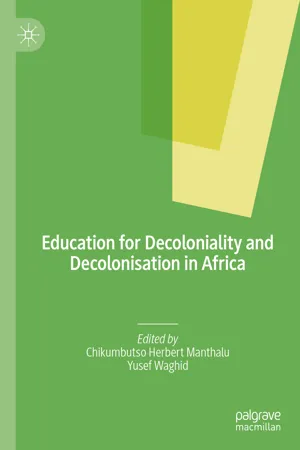
Education for Decoloniality and Decolonisation in Africa
- English
- ePUB (mobile friendly)
- Available on iOS & Android
eBook - ePub
Education for Decoloniality and Decolonisation in Africa
About this book
This book focuses on understandings of higher education in relation to notions of decoloniality and decolonization in southern Africa. The volume draws on a range of case studies in multiple politico-cultural contexts on the African continent, and examines some of the challenges to be overcome in order to achieve education for decolonization and decoloniality. Acknowledging that patterns of exclusion, inequality and injustice are still prevalent in the African higher education landscape, the editors and contributors proffer bold attempts at democratizing education and examine how to cultivate just, equal and diverse pedagogical relations. Featuring case studies from South Africa, Zambia, Malawi, and Zimbabwe, the authors and editors examine how higher education can be further democratized and transformed along the lines of equality, liberty and recognition of diversity. This hopeful and bold collection will be of interest to scholars of decoloniality and decolonization in higher education, as well as higher education in southern Africa more specifically.
Information
Topic
EducationSubtopic
Comparative Education© The Author(s) 2019
Chikumbutso Herbert Manthalu and Yusef Waghid (eds.)Education for Decoloniality and Decolonisation in Africahttps://doi.org/10.1007/978-3-030-15689-3_11. African Philosophy (of Education) and Decolonisation in Post-apartheid South African Higher Education
Thokozani Mathebula1
(1)
School of Education, University of Witwatersrand, Johannesburg, Johannesburg, South Africa
Introduction
In 2015, the #RhodesMustFall and #FeesMustFall campaigns at South African universities brought about renewed calls for the decolonisation (and Africanisation) of the content and pedagogies in higher education. So, what does it mean to decolonise South African universities from the primary role from the universities’ point of view, that is, in terms of the promotion of scholarship? More importantly, do philosophers of education have anything to offer to the decolonisation of higher education in post-apartheid South Africa in particular and the world in general? As a starting point, building on African philosophy as an academic discipline and not as collective, spontaneous and unconscious beliefs, the author maintains that the clarification of general (every day), often vague (ill-defined), uncritical and unargued (collective singular) concepts like decolonisation that idle in our minds is a categorical imperative. The author shows that decolonisation is not only compatible with but also intimately and reciprocally linked to the notion of endogeneity—knowledge of Africans, generated by Africans and for Africans in higher education institutions. The author calls for a continual struggle by (or for) students against colonial neo-liberal universities in South Africa and beyond. In the end, I argue that education for decolonisation that fosters ‘knowledge democracy ’ is not only feasible and desirable—but realistic in the context of South Africa’s constitutional democracy.
African philosophy is an academic discipline that “clarifies concepts, for the purpose of b) the critical evaluation of [general] beliefs” (Raphael 1990, 8).
As an epistemic project, decolonialisation “evokes the origin of the kind of knowledge identified as an internal product”—“an autonomous, self-reliant tradition of research and knowledge that addresses problems and issues directly or indirectly posed by African [scholars]”. (Hountondji 1990, 1, 1997, 17)The contemporary university has turned into springboard for neo-liberal ideology, governance, and policies “hence the increasing calls for the decolonisation of our universities” (Hall and Tandon 2017, 7) this is “the next stage of struggle … whose battle must be waged [by African scholars]”. (Gordon 2016, 177)Education for decolonisation that fosters “knowledge democracy” is feasible, desirable and realistic “in post-1994 South Africa universities and the world at large”. (Jansen 2017, 162–171)
It is clear that neo-liberalism—and by implication a neo-liberal university—is the ‘new demon’ (Torres 2009, 2) of modern-day societies. Against this background, the decolonisation of universities has become “a necessary task that remain[ed] unfinished” (Ndlovu-Gatsheni 2013, 1). It is not difficult to understand why this is so, as “the celebration of juridical-political decolonisation obscure[d] the continuities between the colonial past and coloniality” (Ndlovu-Gatsheni 2013, 6). The struggle for decolonisation and decolonisation of universities is “fought for, won, lost, and won again” (Christie 2010, 6). If one thinks in these terms, the struggle for decolonisation of universities calls for the thorniest theoretical questions that account for the reality of coloniality on a global scale. It is therefore reasonable to say that, if African philosophy is conceived as an academic discipline, asking for the meaning, defence and justification of decolonisation as an epistemic struggle is its subtext. I submit that South Africa’s anti-apartheid struggle that gave rise to diverse knowledge systems in higher education is now out of view. In this chapter, the author argues that:
- decolonisation is first and foremost a knowledge project rooted in African philosophy as a self-conscious discipline;
- decolonisation is tied to endogeneity,1 that is, knowledge of the people, by the people and for the people;
- decolonisation is part of the ongoing struggle by decolonialist scholars against colonial neo-liberal universities in post-apartheid South Africa and
- in the context of South Africa’s constitutional democracy, the appropriate concept of education for decolonisation—philosophically, epistemologically and politically—would be ‘knowledge democracy’ that goes beyond ‘narrow provincialism’ and ‘Western triumphalism’.
What Is Philosophy? What Is Western Philosophy? What Is African Philosophy?
As a point of departure, the term ‘philosophy’ comes from the ancient Greek words philo meaning love and sophia meaning wisdom—the love of wisdom (Akinpelu 1987, 1; Kanu 2014, 87; Lacey 1976, 59; Plato 1994, 190; Runes 1960, 234; Scruton 2007, 522). The concept is attributed to Pythagoras (575–495 bc), a Greek philosopher, scientist and religious scholar. In Plato’s dialogue, Protagoras (1991), Socrates describes Protagoras to his friend as “the wisest man alive” (1991, 1). Socrates’ friend concurs, “he is the only man who is wise … one who is knowledgeable in learned matters” (1991, 2–4). Protagoras’s love for wisdom is neatly encapsulated in this Pythagorean public statement:
Philosophy is indeed, it seems, is a road … chose that philosophy and that road to wisdom … the philosophy which progresses through immaterial eternal intelligible objects that always remain the same and do not admit in themselves of destruction or change, like its subject-matter, is unerring and firm, producing grounded and unswerving proof. (O’Meara 1989, 42–43)
Interpreting Protagoras’ quote, we can see that philosophy is ‘a kind of agony’ (extreme mental suffering) (Stangroom and Garvey 2012, 76). The above metaphor of philosophy as a road takes one to the “intelligible world of truth postulated by the objects of knowledge, which are perfect, eternal and unchanging” (Dupré 2007, 9). Since then, Protagoras’ philosophy has passed into common usage. Recently, it has been given two meanings: a science of questions (asking wise and foolish questions) and a general set of beliefs (general outlook on the world) (Luthuli 1982, 19; Scruton 2007, 552; Standish 2014, 6; Waghid 2016, 455). As the reader will see in the next section, decolonisation of universities as an epistemic project in post-apartheid South Africa rests on a confusion between the popular (that which we believe), on the one hand, and strict (that which we know), on the other.
For our purpose, Raphael (1990, 8) interprets “the main tradition of Western philosophy as having had two connected aims: the clarification of concepts, for the purpose of the critical evaluation of beliefs”. In trying to clarify general, vague and uncritical concepts, such as decolonisation, three related purposes worth considering are analysis, synthesis and improvement of the word (decolonisation) itself. First, our analysis of decolonisation consists of a conceptual definition and specifying its central features (e.g. one can analyse or define decolonisation as a ‘true democratisation of knowledge’ and specify the elements that make up the concept). Second, our synthesis of decolonisation shows the logical relationships whereby the concept (as a unity of knowledge) implies or is implied by another (e.g. one can show a logical relationship between decolonisation and its obligation to transcend the seemingly particular, opposite and irreconcilable Eurocentred and Afrocentred schools of thought). Third, our improvement of decolonisation involves recommending a definition or use that will assist to clarify the meaning of the concept (e.g. one can recommend, as the author does, that the concept ‘decolonisation’ should be used in a strict theoretical sense, and not in the popular, ideological sense).
Hountondji (1996, 33) defines African philosophy as “a set of texts, especially the set of texts written by Africans and described as philosophy b...
Table of contents
- Cover
- Front Matter
- 1. African Philosophy (of Education) and Decolonisation in Post-apartheid South African Higher Education
- 2. Decoloniality as a Viable Response to Educational Transformation in Africa
- 3. Decoloniality as Democratic Change Within Higher Education
- 4. Universities as Sites for Advancing Education for Decolonisation
- 5. In Defence of Education That Embodies Decolonisation
- 6. Decoloniality and Higher Education Transformation in South Africa
- 7. Decoloniality of Higher Education in Zimbabwe
- 8. Towards Decolonisation Within University Education: On the Innovative Application of Educational Technology
- 9. Examining an Education for Decoloniality Through a Senian Notion of Democratic Education: Towards Cultivating Social Justice in Higher Education
- 10. Recasting Cosmopolitanism in Education for Citizenship in Africa
- 11. Leaning into Discomfort: Engaging Film as a Reflective Surface to Encourage Deliberative Encounters
- 12. The Conundrum of Decolonisation and Afrophobia: A Case for South African Higher Education
- 13. Decolonisation as Democratising African Higher Education
- 14. Post-colonial Teaching and Learning with Play
- Back Matter
Trusted by 375,005 students
Access to over 1.5 million titles for a fair monthly price.
Study more efficiently using our study tools.
Frequently asked questions
Yes, you can cancel anytime from the Subscription tab in your account settings on the Perlego website. Your subscription will stay active until the end of your current billing period. Learn how to cancel your subscription
No, books cannot be downloaded as external files, such as PDFs, for use outside of Perlego. However, you can download books within the Perlego app for offline reading on mobile or tablet. Learn how to download books offline
Perlego offers two plans: Essential and Complete
- Essential is ideal for learners and professionals who enjoy exploring a wide range of subjects. Access the Essential Library with 800,000+ trusted titles and best-sellers across business, personal growth, and the humanities. Includes unlimited reading time and Standard Read Aloud voice.
- Complete: Perfect for advanced learners and researchers needing full, unrestricted access. Unlock 1.5M+ books across hundreds of subjects, including academic and specialized titles. The Complete Plan also includes advanced features like Premium Read Aloud and Research Assistant.
We are an online textbook subscription service, where you can get access to an entire online library for less than the price of a single book per month. With over 1.5 million books across 990+ topics, we’ve got you covered! Learn about our mission
Look out for the read-aloud symbol on your next book to see if you can listen to it. The read-aloud tool reads text aloud for you, highlighting the text as it is being read. You can pause it, speed it up and slow it down. Learn more about Read Aloud
Yes! You can use the Perlego app on both iOS and Android devices to read anytime, anywhere — even offline. Perfect for commutes or when you’re on the go.
Please note we cannot support devices running on iOS 13 and Android 7 or earlier. Learn more about using the app
Please note we cannot support devices running on iOS 13 and Android 7 or earlier. Learn more about using the app
Yes, you can access Education for Decoloniality and Decolonisation in Africa by Chikumbutso Herbert Manthalu, Yusef Waghid, Chikumbutso Herbert Manthalu,Yusef Waghid in PDF and/or ePUB format, as well as other popular books in Education & Comparative Education. We have over 1.5 million books available in our catalogue for you to explore.