This book offers a rich ethnographic account of blue-collar workers' everyday life in a central Russian industrial town coping with simultaneous decline and the arrival of transnational corporations. Everyday Post-Socialism demonstrates how people manage to remain satisfied, despite the crisis and relative poverty they faced after the fall of socialist projects and the social trends associated with neoliberal transformation. Morris shows the 'other life' in today's Russia which is not present in mainstream academic discourse or even in the media in Russia itself. This book offers co-presence and a direct understanding of how the local community lives a life which is not only bearable, but also preferable and attractive when framed in the categories of 'habitability', commitment and engagement, and seen in the light of alternative ideas of worth and specific values. Topics covered include working-class identity, informal economy, gender relations and transnational corporations.
Jeremy MorrisEveryday Post-Socialism10.1057/978-1-349-95089-8_1
Begin Abstract
1. Introduction: The ‘Worthless’ Dowry of Soviet Industrial Modernity
Jeremy Morris1
(1)
University of Birmingham, Birmingham, UK
‘… when the old is dying and the new has not yet been born or is too faint to notice. It is a treacherous time to interpret: Is it just before dawn, or just after dusk?’—Lilia Shevtsova, on Gramsci’s interregnum
End Abstract
Entering the Ex-monotown
About 45 minutes after leaving Kaluga city the little bus turns again and passes the large concrete sign ‘Izluchino’. But the town is nowhere to be seen; it lies another six kilometres further on, along the road rutted by trucks and frost, past the prison zone, an orphaned housing scheme and the industrial zones with their chimney stacks, abandoned workshops and parked up fleets of articulated lorries full of gravel and lime. There are also the hills of extracted waste rock and soil and huge quarries with swarming monster vehicles generating enormous quantities of dust. On blasting days, the windows of houses 15 kilometres away rattle from the explosions used to begin the process of turning limestone into aggregates and cement.1
It is twilight and most of the 20 passengers are dozing fitfully as the bus bumps over the pot holes and speed bumps. Some have taken the 3-hour train from Moscow to Kaluga. They are returning from their working week in service industries or construction sites—hairdressers, electricians, plumbers, shop assistants. Others have been working the long day-shift in Kaluga, the region’s capital, in shops, markets and the like. The factory buses from the city and the industrial zones—the ‘promzones’—are full of blue-collar workers. These buses are faster and more comfortable. They overtake us as we bump along, the driver of our propane-powered bus murdering the gearbox and swearing now and again for good measure.
The town’s concrete entry ‘sign’—the word for it in Russian is ‘stela’—appears to live up to its Greek etymology: a ‘stele’ is a stone slab erected as a monument, often for funerary or commemorative purposes. This is pointed out to me at the crossroads out of town by a retired worker as he takes me on his moped around the countryside to a spring where he collects drinking water (‘less polluted than the local stuff from the river’). ‘Look closely,’ says Ivan Ivanych as we get off the bike. ‘What do you see?’ What I see beneath the two-metre-long Church Slavonic-style lettering of the town’s name are the Soviet hieroglyphs of a lost age: a blue dumper truck next to the obligatory hammer and sickle. A coiled up length of plastic piping. An atomic chemical structure schematic (or is it a depiction of moons orbiting a planet?). A gear-wheel. A military badge. A conveyor belt. The ripples of the river. All these glyphs are bordered by a floral pattern. Sometime in the early 1980s, Izluchino was given this sign indicating its importance and illustrating its trades and products. This was at the height of its prominence as an industrial town serving the defence ministry. Along with some metal street furniture celebrating the 1980 Moscow Olympics these are the last signs standing of the prosperous Soviet past.
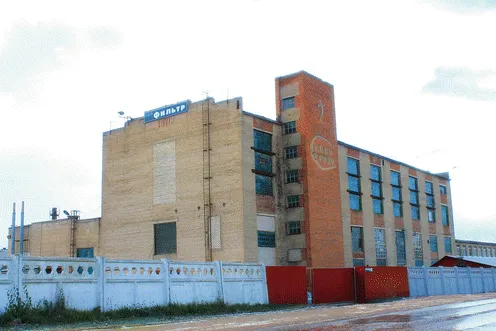
Ivan Ivanych retired last year as a technician from the oil pipeline terminal after having previously left the bankrupt polymer pipe factory in 1995. Between the pipe factory and oil terminal he worked at Geoform, supervising a machine milling industrial talcs and minerals that coat plastic windows. The whole town is in plastics, metals, or bricks and cement—all dictated by what can be extracted locally from the pits. Ivan’s wife stayed at the ‘Polymer’, as everyone calls it. Now, also in her late fifties, she is a shift forewoman at one of the smaller plastic fabricators that split from the original Soviet enterprise. Ivan leans the moped against the bus shelter next to the sign; the abandoned state farm’s fields turned long ago to scrub and stretch away as far as the eye can see. Now the forest is approaching the town once more. ‘I started here,’ he says, pointing to the image of the dumper truck. ‘In the quarries like everyone else. Only later did the Polymer set up.’ Again, he points to the image of the serpentine pipe in the town sign, which represents the work of fabricating steel and plastic pipes. ‘Good times, but who works there now? Just the old guard left. Soon they’ll all retire and the firm will go under’ (Photo 1.1).
Photo 1.1
Galina’s Polymer factory. ‘Glory to Labour’ and date of erection (1971) in brick detail (Image courtesy of Alyona Kudriavsteva)
‘But what about the rolling stock repairshop?’ I point down the road a kilometre to the nearest industrial building next to the 15-hectare prison site. ‘It’s the same there. Most of the young ones have left or nearly left,’ says Ivan, referring to the bus commuters’ peripatetic existence, shuttling between the town and Kaluga, Moscow, or even Sochi, the site of the 2014 Winter Olympics. ‘I’m too old for that, or I’d be doing it myself,’ he adds.
Ivan Ivanych is a stalwart of the old guard of townspeople, accessible due to his frenetic energy yet easy-going manner and friendliness. He is bored by retirement, tired of waiting for grandchildren from his two children (two babies will in fact be born later on during my fieldwork). I am the perfect distraction. We zip around on his moped. He has a garden plot some distance from the town, so has the perfect excuse to get on his bike and ride around the area. As long as he comes back with some kind of produce, his wife is happy.
As a young man who came to the town in the early 1980s after the main factories were set up between the quarries, Ivan views the history of his town through the lens of a wider geopolitical rise and titanic fall of his country. At first glance his and many others’ positions appear one-dimensional: the town grew from nothing, thanks to the workers. It grew to a bustling, proud and relatively wealthy place with excellent ‘social wages’2—social amenities in kind linked to employment and infrastructure. It had the best House of Culture in the area—with theatrical stages and sound equipment better than the district capital’s. The housing was better too once they moved out of the temporary accommodation in wooden barracks. Not to mention the pay, the perks and the enterprise canteen in the centre of town. ‘While our relatives near Moscow had to queue for their meat, we had so much kolbasa sausage we’d let it go green in the fridge and then just chuck it away!’ Although something of an exaggeration, this is a familiar refrain throughout the town among Ivan’s birth cohort. It is true that after 1993 there were major wage arears and employment fell steadily in the main workshops and especially in the branches of the enterprise servicing the main plants.3 There is ample evidence of the outflow of labour in the ghost-like structures the town bus passes as it wends through the promzones.
Ivan’s narrative is partial, however, as he and others admit. ‘What about the other plastic and metals fabricating shop, Steelpipe, run by Felix Saraev?’ I ask. ‘Oh, well, that’s different,’ says Ivan. ‘Felix Grigorievich made something of the leftovers’ (He uses the industrially evocative metaphor ‘opilki’—‘shavings’). Despite what Ivan says, there are plenty of younger workers there in one of the ‘inheritor’ workshops from the Soviet period. Similarly, while many young people travel to Kaluga to work at the new German, French, and Scandinavian automobile plants or to the Samsung monitor assembly an hour towards Moscow, some remain in the quarries, the brick makers, the limekilns and the cement works; the choice is not an easy one to make. But these are hardly ‘leftovers’ or as Elena Trubina has paraphrased Kaika and Swyngedouw (2000)—the ‘worthless dowry’ of Soviet industrial modernity (Trubina 2013). ‘What about the state-of-the-art Siemens water boilers in the town’s district heating plant, unveiled by none other than Anatoly Chubais?’ I ask. Indeed, as Collier (2011) demonstrates, infrastructural inheritances such as centralized heating are not so easy to write off, reform or ‘marketize’. Finally, I remark on the fact that the town’s population is quite a bit bigger even than in 1989 (the last Soviet census date).
During conversations like these, local people switch in an instant from a tale of woe to a grudging acknowledgement of the town’s relative emergence from the turbulent 1990s; with some additional prodding the same individuals will then switch their tone and tack once again. What slowly emerges is not a fierce local pride, but rather an expression of locally here-and-now well-enough-being; a common refrain is that while people don’t have everything they want or need, they have ‘enough’—‘nam khvataet’. What is important to them is the experience of making the town a ‘habitable’, liveable place. People seek meaning in the relative absence of the kind of extreme economic insecurity so characteristic of the 1990s. And if their lives continue to be marked by insecurity (especially since the global financial crisis and the effect of sanctions against Russia), they look in quiet desperation both forward and to the past to ‘better’ times, in a self-positioning of perpetual interstitiality and unhomeliness. Regardless, or perhaps because, of the recent experience of historical crisis, the fraught search for ‘habitability’ among small-town Russians is at the heart of understanding everyday life in this ethnography.
Researching Postsocialism: Accounting for Everyday Habitability
Researchers have been calling for some time for scholars to engage more meaningfully with local actors to bring out the specific meanings of the postsocialist everyday (Flynn and Oldfield 2006; Stenning and Hörschelmann 2008). Efforts in making personal worlds habitable emphasize the agency of ordinary people in the ‘making do’ manner of de Certeau (1984; cf. Caldwell 2004: 29) but do not downplay the importance of ongoing insecurity; in fact, quite the opposite. The striving for mundane comfort and ordinariness—in making an aquarium from scrap materials, stealing diesel fuel from work, drinking to excess with workmates and acquaintances in garage blocks, or the social intercourse of painting neighbours’ nails or cutting hair as a favour—are all telling activities in terms of how people understand and deal with postsocialist reality a generation after 1991.
After Malaby (2002) these can be seen as part of a repertoire of practices based on dealing with ‘contingency’. That is to say, ‘uncertainty should not automatically be perceived as dangerous, problematic or even as a source of anxiety’ (Allen 2006: 215), nor should it mean that analysis is reduced to thinking of people living what appear to ‘us’ as precarious lives, as governed by a deterministic economic rationality we would deny in ourselves. Specifically relating to postsocialist societies, Clarke (1999b: 14) points out various problems with labelling practices as ‘survival strategies’: time is not strategically managed, the different incomes of household members are not coordinated, and employment choice itself does not correlate to a rational income-maximizing strategy. In short, we need other ways of thinking about how uncertainty is understood and integrated into life, over and above a household reproduction strategy approach. This book offers the fraught search for ‘habitability’, not as a master trope, but as an equivocal, ersatz conceptualization of what life is like beyond ‘coping’ with communism’s collapse, but while crisis continues, is normalized, even. ‘Habitability’ as an ersatz, provisional term mirrors people’s fragile, unfinished and improvised forms and practices of life-making in the Russian margins.
Malaby, writing on contemporary Greece, offers the term ‘contingency’ as a way of thinking about how people encounter uncertainty and interpret it, neither as a risk or threat (Honkasalo 2009) nor as something that is conceptualized in terms of control or minimization. This is not an embracing of risk, nor is it ‘edgework’. Instead, it is insecurity somehow incorporated or accommodated within everyday life; ‘contingency’ becomes constitutive of lived experience. When insecurity in everyday life is prolonged, a person is not inured to it, but nonetheless it becomes equally a ‘background’ element which is then incorporated into general practices for making life more than ‘bearable’ or habitable in some way.4 By virtue of everyday insecurity, people rely on equally unpredictable tactics: snatched and meagre practices of gleaning something of value from life.
If uncertainty is a category approaching the normatively neutral in everyday life, what emerges as an equally given is the intersubjective understanding of minor victories in carving out a habitable niche: ‘my habitat’, as Sasha puts it in the next chapter. Thus, despite a lack of generalized social trust, the immediate social sphere as a source of ‘comfort’—whether in drinking and smoking at work and in the male-dominated garage spaces, or arts and crafts at home in a circle of female friends and relations—is integral to successfully developing habitability in the lifeworld. Being for others and being for oneself as well as social practices for their own sake are also part of this sense of making the world habitable (Keat 2000; Morris 2012b).
Contingency and its everyday response are therefore also important in moving analyses of postsocialist selves away from assumptions about Foucauldian governmentality. Looking more closely at the ‘microphysics’ of power requires situated analyses that reveal ‘evasions’ and ‘refusals’, as well as ‘curious’ and ‘unexpected’ alliances that arise out of confrontations (Walters 2012: 14). A good example is how work on the self among working-class men, more often than not, is not directed at moulding the self as an improved subjectivity or as a subject of the neoliberal order. Quite the opposite; comfort and habitability become humble categories of alternative existence in having ‘enough’ to avoid or distort externally imposed self-transformative work. This is both an ‘evasion’, but also an example of an alliance in the formation of postsocialist personhood with older normative values of ‘autonomy’ in work that arose before and during the socialist period. Habitable persons strive to be self-sufficient, not only materially in their livelihood practices, as an insurance policy against generalized insecurity in the present, but also in terms of personhood: ‘having enough’ presupposes a set of values th...
Table of contents
Cover
Frontmatter
1. Spaces and Places
2. Unhomely Presents: Uncertain Futures
3. On Personhoods in Place
Backmatter
Trusted by 375,005 students
Access to over 1.5 million titles for a fair monthly price.
Study more efficiently using our study tools.
Frequently asked questions
Yes, you can cancel anytime from the Subscription tab in your account settings on the Perlego website. Your subscription will stay active until the end of your current billing period. Learn how to cancel your subscription
No, books cannot be downloaded as external files, such as PDFs, for use outside of Perlego. However, you can download books within the Perlego app for offline reading on mobile or tablet. Learn how to download books offline
Perlego offers two plans: Essential and Complete
Essential is ideal for learners and professionals who enjoy exploring a wide range of subjects. Access the Essential Library with 800,000+ trusted titles and best-sellers across business, personal growth, and the humanities. Includes unlimited reading time and Standard Read Aloud voice.
Complete: Perfect for advanced learners and researchers needing full, unrestricted access. Unlock 1.5M+ books across hundreds of subjects, including academic and specialized titles. The Complete Plan also includes advanced features like Premium Read Aloud and Research Assistant.
Both plans are available with monthly, semester, or annual billing cycles.
We are an online textbook subscription service, where you can get access to an entire online library for less than the price of a single book per month. With over 1.5 million books across 990+ topics, we’ve got you covered! Learn about our mission
Look out for the read-aloud symbol on your next book to see if you can listen to it. The read-aloud tool reads text aloud for you, highlighting the text as it is being read. You can pause it, speed it up and slow it down. Learn more about Read Aloud
Yes! You can use the Perlego app on both iOS and Android devices to read anytime, anywhere — even offline. Perfect for commutes or when you’re on the go. Please note we cannot support devices running on iOS 13 and Android 7 or earlier. Learn more about using the app
Yes, you can access Everyday Post-Socialism by Jeremy Morris in PDF and/or ePUB format, as well as other popular books in Social Sciences & Labour Economics. We have over 1.5 million books available in our catalogue for you to explore.