Our planet faces a systemic threat from climate change, which the world community of nations is ill-prepared to address, and this book argues that a new form of ecologically conscious capitalism is needed in order to tackle this serious and rising threat. While the Paris Climate Agreement of 2015 has finally implemented a global climate policy regime, its modest means belie its ambitious goals. Our institutional financial organizations are not equipped to deal with the problems that any credible commitment to a low-carbon economy will have to confront. We will have to go beyond cap-and-trade schemes and limited carbon taxes to cut greenhouse gas emissions substantially in due time. This book offers a way forward toward that goal, with a conceptual framework that brings environmental preservation back into our macro-economic growth and forecasting models. This framework obliges firms to consider other goals beyond shareholder value maximization, outlining the principal tenets of a climate-friendly finance and introducing a new type of money linked to climate mitigation and adaptation efforts.
eBook - ePub
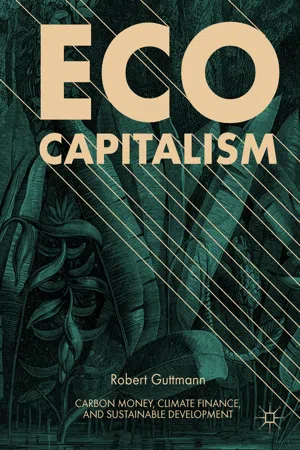
Eco-Capitalism
Carbon Money, Climate Finance, and Sustainable Development
- English
- ePUB (mobile friendly)
- Available on iOS & Android
eBook - ePub
About this book
Information
© The Author(s) 2018
Robert GuttmannEco-Capitalismhttps://doi.org/10.1007/978-3-319-92357-4_11. The Challenge of Climate Change
Robert Guttmann1
(1)
Economics Department, Hofstra University, Hempstead, NY, USA
In December 2015, hundred and ninety-five countries signed the historic Climate Change Agreement in Paris, committing their governments to steady reductions in the emission of greenhouse gases which are heating up our planet. This crucial first step in the right direction has been a long time coming. For nearly a quarter of a century, ever since the 1992 Earth Summit in Rio de Janeiro, the world community had discussed to no avail how to proceed with a common approach to the global problem of a warming planet. Lacking sufficient consensus, we let several initiatives just peter out ineffectively—from the 1997 Kyoto Protocol to the failed 2009 Copenhagen Climate Change Conference. Now that we have secured the Paris Accord, we will have to see how governments will manage to put into effect their promised emission-reduction targets. These will require fairly ambitious policy initiatives some of which will be politically difficult to implement as they hurt vested interests—for example, reducing the role of coal or oil as energy sources for power plants. Nowhere is this question of political will more urgent and problematic than in the USA, the world’s leading emitter of greenhouse gases . Notwithstanding the crucial leadership role of their country in the world, Americans have by and large been quite hesitant to face this challenge. On the contrary, there is a deeply rooted skepticism about climate change which has so far prevented the US government from addressing the issue with measures matching the problem.
The Undue Influence of Climate Deniers
Of the seventeen Republican presidential candidates vying for the party’s nomination in 2016, only one—Ohio governor John Kasich—believed that climate change was a serious problem caused by human activity. All the others denied the existence of the problem as such. Donald Trump, the eventual GOP nominee and surprise victor of the election, had referred to the climate threat alternately as “nonexistent,” “bullshit,” or a “con job” before promising to cancel the Paris Climate Change Agreement of December 2015 if elected president. On several occasions, Trump denounced climate-change mitigation measures, such as the Paris Agreement, as a “tax,” or as an issue solely designed for China to gain a competitive advantage, or as a way to give “foreign bureaucrats control over how much energy we use right here in America.” 1 The Republican party platform of July 2016, after calling the Democrats “environmental extremists” who are committed to “sustain the illusion of an environmental crisis,” went on to “forbid any carbon tax,” promised to “do away with” Obama’s Clean Power Plan, and proposed “to forbid the EPA to regulate carbon dioxide .” The platform also committed the party to boosting domestic oil and coal production by easing the issue of permits, a position strongly endorsed by Trump.
This deeply grounded resistance to take climate change seriously extends to Republican members of the Congress. Jim Inhofe (R-OK), who chairs the Senate’s Environment and Public Works Committee, has regularly described the climate-change issue as a “hoax” and characterized the work of the scientists grouped together in the Intergovernmental Panel on Climate Change as a “Soviet style trial.” 2 A large majority of Republican senators and representatives in the House are adamantly opposed to any meaningful measure of climate-change mitigation. According to research by the Center of American Progress Action Fund (reported in Ellingboe and Koronowski 2016), fifty-nine percent of the Republican caucus in the House and seventy percent of all Republican senators reject the scientists’ overwhelming consensus that climate change is occurring and human activity is its major cause. This strong opposition to climate change among Republicans in Congress made it impossible for President Obama and his allies in the Democratic Party to pass wide-ranging legislation on that issue when he first got elected. Most notably, Obama’s push to pass a nationwide cap-and-trade system under which the federal government would limit the emission of greenhouse gases with the support of a market-friendly incentive approach, the American Clean Energy and Security Act of 2009, failed in the Senate after barely passing in the House. When the Republicans regained majority control of the House in 2010, any chance for meaningful legislation died. At that point, Obama opted to advance climate-change mitigation measures through the regulatory apparatus under his direct control, notably the Environmental Protection Agency’s (EPA) regulation of carbon dioxide aimed specifically at coal-fired plants or setting ambitious fuel-efficiency standards for cars, while at the same time also taking executive action in promotion of international agreements not subject to Senate ratification, as was the case with the aforementioned Paris Agreement of December 2015.
Obama’s unilateral measures swiftly became subject to lawsuits by Republican governors who got sympathetic judges to block some of his key measures. This was especially true for Obama’s ambitious Clean Power Plan of 2015, at the heart of America’s carbon-emission-reduction program he brought to the table in the run-up to Paris. This initiative obliged states to accelerate the use of cleaner power plants using renewables (or gas if swapped for coal) and improve power-generation efficiency. Four days before the death of leading conservative Justice Antonin Scalia in February 2016, the Supreme Court blocked enforcement of the plan in a 5-4 decision until a lower court rules in a lawsuit brought against it by eighteen Republican governors. This was the first time ever the Supreme Court had stayed a regulation before a judgment by the lower Court of Appeals, clear indication how politicized the question of climate-change mitigation had become to engulf the country’s judiciary in such openly partisan fashion. Trump’s election victory in November 2016 prompted in short order his unilateral canceling of Obama’s power-plant initiative, executive orders to boost domestic fossil-fuel production (including coal), plans for other rollbacks of environmental regulation (such as relaxing fuel-efficiency standards for cars), and—in a stunning move defying domestic majority opinion and pleas from other world leaders—the unilateral decision on June 1, 2017, to take the USA out of the Paris Agreement. All these initiatives of Trump and his Republican backers in US Congress jeopardize that treaty’s effective implementation. If the USA as the world’s largest emitter of carbon dioxide per capita backslides, this gives license for other countries to do so as well. We have already seen this happening with the Kyoto Protocol of 1997 which the US Senate never ratified and which consequently failed to meet its initial (decidedly modest) objectives. 3 While the time frame of the Paris Agreement extends beyond Trump’s first term, his reversal of Obama’s initiatives may well endanger that treaty’s long-term viability.
Why is it that Republican leaders are so hostile to the issue of climate change? One might be tempted to place their opposition into the context of the current Zeitgeist. We are living these days through a period of more polemical politics where large pockets of post-crisis anger among the electorate feed a discourse of denigrating elites (and that includes scientists), where emotion often crowds out facts, and where belief in conspiracies often appeals more than any other explanation. Still, one has to wonder why hundreds of the world’s greatest scientists would conspire to invent this “hoax” of the planet’s steady warming if they must know that they are bound to be found out eventually. That does not make much sense. Republican resistance to climate change may also be intimately tied to political influence-seeking by some of America’s most powerful lobbies, notably the gas and oil industry recently rendered even stronger by the oil shale boom of the late 2000s and early 2010s across large parts of the country. Big Oil, by sector the fifth-largest lobby in the USA, typically gives 80% of its political contributions to Republicans. Just take a look at the massive funding of political campaigns and conservative think tanks by the Koch Brothers, who control energy firm Koch Industries and for whom climate-change denial has long been a crucial objective! There is also a widespread feeling among Americans, shared by its political leaders especially on the political Right, that any global governance structure, such as the Paris Agreement of 2015, is automatically a matter of other countries exploiting US generosity and/or international bureaucrats restricting American sovereignty—a paranoid predisposition of wrong-headed “nationalism” that flies in the face of the truth to the extent that most of these global governance structures are profoundly shaped by American policy-makers pursuing the national interest in the global context. Finally, Republicans may also be hostile to the notion of man-made climate change for profoundly ideological reasons. It must not be easy for apostles of the “free” market to recognize such a huge market failure and accept a large role for government policy in combating this problem. 4 But as long as a dedicated minority of climate deniers exercises such a stranglehold on US policy, it will be impossible for the world community to address the issue of climate change effectively. Americans need to understand with a greater sense of urgency what is at stake here.
(In)Action Bias
It is in the very nature of the problem to make it difficult, if not impossible, to address. Climate change is largely invisible, very abstract as a notion, and extremely slow moving. It is hard to imagine, easy to ignore, and lacks immediate urgency for action, hence tempting to set aside for later. Addressing it also has uncertain pay-offs which even in the best of circumstances will only bear fruit much later while initially causing quite a bit of pain. The problem thus requires a long-term, intergenerational vision where the current generation is willing to bear sacrifice for its children and grandchildren. And the problem also depends on collective action, necessitating coordination among many players with divergent interests and requiring enough sanctions in place to discourage “free riders” not willing to do their fair share while benefitting unfairly from the efforts of the others. So when looking at it from all those angles, it becomes clear that doing something meaningful about climate change is a tremendous challenge. Perhaps the climate deniers reflect just a grudging admission that the problem is too difficult to address and hence more easily wished away, especially when there is no convincing reason why this problem should be tackled right now rather than ignored a bit longer.
The climate-change challenge reminds me of the dilemma facing a heavy smoker who is still quite young and thus not yet really worried about his/her health. You know smoking is not good for you and eventually will cause you health problems. But that is later, and right now you are more inclined to enjoy the calming effects of a cigarette. So you keep smoking as long as the habits of today outweigh worries about the future in the back of your mind. This, after all, is addictive behavior and as such takes a lot of effort to break, effort not worth undertaking unless obliged to. Pushing this metaphor one step further, add to this the wrinkle that my partner smokes too which makes it that much harder for me to stop the bad habit. We would both have to stop at the same time to succeed, making it twice as unlikely that this will happen any time soon. Thus, we are more inclined to tell ourselves every day that we will get back to the challenge later, one day for sure, but not now. And who knows anyway whether, when, and how the long-term consequences of smoking will kick in. With all this uncertainty, why bother worrying so much? Better to enjoy the pleasure while it lasts! In this calculation, we subconsciously remove ourselves as actors and instead allow ourselves to be shaped by circumstance, in the hope that nothing too grave will happen in the wake of our inaction. Unfortunately, we no longer have the luxury of such wishful thinking when it comes to climate change !
The Intergovernmental Panel on Climate Change
We are now gradually coming to the point where the threat must be taken seriously. Looking back, we have long suspected that the climate can be subject to large variations playing out over centuries. In the nineteenth-century climatologists became obsessed with timing and explaining the “Ice Age,” and in the process they grew increasingly aware that human activity can also contribute to climate change . In 1896, the great Swedish scientist Svante Arrhenius predicted that the emission of carbon dioxide from the burning of fossil fuel or other sources could, if large enough, raise the air temperature significantly. 5 Arrhenius’ identification of this “greenhouse effect” triggered much debate, and it ultimately required more accurate measurement instruments as well as computers becoming available in the 1950s to validate his prediction. But during the 1960s and 1970s, climatologists focus...
Table of contents
- Cover
- Front Matter
- 1. The Challenge of Climate Change
- 2. Moving Toward an Ecologically Oriented Capitalism (“Eco-Capitalism”)
- 3. The Global Emergence of Climate Policy
- 4. Rethinking Growth
- 5. Pricing Carbon
- 6. Climate Finance
- 7. Carbon Money
- 8. Sustainable Development and Eco-Capitalism
- Back Matter
Trusted by 375,005 students
Access to over 1.5 million titles for a fair monthly price.
Study more efficiently using our study tools.
Frequently asked questions
Yes, you can cancel anytime from the Subscription tab in your account settings on the Perlego website. Your subscription will stay active until the end of your current billing period. Learn how to cancel your subscription
No, books cannot be downloaded as external files, such as PDFs, for use outside of Perlego. However, you can download books within the Perlego app for offline reading on mobile or tablet. Learn how to download books offline
Perlego offers two plans: Essential and Complete
- Essential is ideal for learners and professionals who enjoy exploring a wide range of subjects. Access the Essential Library with 800,000+ trusted titles and best-sellers across business, personal growth, and the humanities. Includes unlimited reading time and Standard Read Aloud voice.
- Complete: Perfect for advanced learners and researchers needing full, unrestricted access. Unlock 1.5M+ books across hundreds of subjects, including academic and specialized titles. The Complete Plan also includes advanced features like Premium Read Aloud and Research Assistant.
We are an online textbook subscription service, where you can get access to an entire online library for less than the price of a single book per month. With over 1.5 million books across 990+ topics, we’ve got you covered! Learn about our mission
Look out for the read-aloud symbol on your next book to see if you can listen to it. The read-aloud tool reads text aloud for you, highlighting the text as it is being read. You can pause it, speed it up and slow it down. Learn more about Read Aloud
Yes! You can use the Perlego app on both iOS and Android devices to read anytime, anywhere — even offline. Perfect for commutes or when you’re on the go.
Please note we cannot support devices running on iOS 13 and Android 7 or earlier. Learn more about using the app
Please note we cannot support devices running on iOS 13 and Android 7 or earlier. Learn more about using the app
Yes, you can access Eco-Capitalism by Robert Guttmann in PDF and/or ePUB format, as well as other popular books in Business & Energy Industry. We have over 1.5 million books available in our catalogue for you to explore.