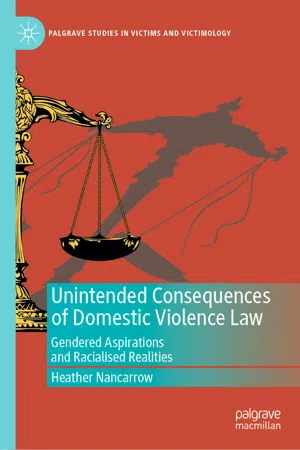
This book addresses the intersection of two current major concerns in Australia: law and justice responses to domestic violence - including harsher punitive measures - and the over-representation of Indigenous Australians in the criminal justice system, which are similar concerns in New Zealand, Canada and the US. Nancarrow re-conceptualises typologies of violence and provides a means of understanding and explaining female use of violence without undermining the hard-won gains of the women's movement. It does, however, argue for a paradigm shift, which has implications for every aspect of the system we have built to stop men's violence against women (law, police policy and practice, counselling and advocacy for victims, and interventions for those who perpetrate violence). The book is based on quantitative and qualitative research and explores the nature of Indigenous intimate partner violence and the types of violence that domestic violence law sought to address.
eBook - ePub
Unintended Consequences of Domestic Violence Law
Gendered Aspirations and Racialised Realities
- English
- ePUB (mobile friendly)
- Available on iOS & Android
eBook - ePub
Unintended Consequences of Domestic Violence Law
Gendered Aspirations and Racialised Realities
About this book
Trusted by 375,005 students
Access to over 1.5 million titles for a fair monthly price.
Study more efficiently using our study tools.
Information
© The Author(s) 2019
H. NancarrowUnintended Consequences of Domestic Violence LawPalgrave Studies in Victims and Victimologyhttps://doi.org/10.1007/978-3-030-27500-6_11. Introduction: The Problem in Context
Keywords
Domestic violence lawFeminist theoryCritical race theoryIntersectionalityNeo-colonialismFirst nations peoplesBreaches of domestic violence ordersCross-applicationsIndigenousPoliceCourtsThe Problem
Police from the Cairns City Beat attended parkland on the Cairns Esplanade following a disturbance viewed on CCTV. A man and a woman, both Aboriginal, were verbally abusive, swearing and making threats towards each other. At one point, the woman was swinging punches at the man: she on one side of a rubbish bin and he on the other. The verbal abuse, swearing and threats continued as the police approached. Both were taken by the police to the Cairns City Beat. The woman was charged with a breach of a domestic violence order, which had been made and served on her by police only a few days before this incident. She told the police she was not aware of the order and did not go to court for it, but she remembered being given some papers about domestic violence.
The event described above refers to one of five occasions on which police charged this woman, whom I call Thelma, 1 with breaching a domestic violence order (DVO). They are among police reports I analysed, seeking to understand the nature of DVO breaches that had been subject to criminal charges. Thelma’s case stands in stark contrast to the scenario imagined in mainstream feminist advocacy that led to specific domestic violence laws, under which she had been charged and convicted. It represents unintended consequences of domestic violence law—women being constructed as perpetrators of “domestic violence”, in response to aggression that has nothing to do with the nature and meaning of violence that 1970s–1980s advocates and legislators sought to address. Thelma’s case also represents the failure of advocacy and legislation to adequately represent the circumstances of Aboriginal and Torres Strait Islander 2 women, specifically.
The crux of the problem is that the law is both male-centric and White-centric . 3 Therefore, it has limitations as a response to men’s violence against women, and unintended consequences for women: especially for Black women. This is apparent in my analysis which compares police and court data for people who had been charged at least once with breaching a domestic violence order. There were four groups, roughly equal in number, within the total 185 of cases that I studied. The groups were: Indigenous men , 4 non-Indigenous men , Indigenous women , and non-Indigenous women . As discussed in the Preface to this book, I felt compelled to undertake this comparative investigation of the application of domestic violence law, inspired by Aboriginal and Torres Strait Islander women with whom I worked for decades in Queensland, Australia.
The male-centric and White-centric nature of the law, and its unintended consequences, are not unique to Queensland. The limitations of the law in meeting women’s needs have been the subject of feminist scholarship elsewhere in Australia (e.g. Douglas & Fitzgerald, 2018; Hunter, 2008; Wangmann, 2009, 2010) and the world. Goodmark (2012, 2018) has raised the same kind of critique as I have here and previously (Nancarrow, 2012, 2016) about civil law , but her analysis concerns the criminal law in the USA. The problem exits across jurisdictional boundaries of both the geographic and legal kind: so does the relevance of my analysis.
Three bodies of thought informed my analysis in the Queensland context: (1) feminist theory , (2) critical race theory and intersectionality, and (3) neo-colonial theory. Critical aspects of each theoretical perspective are explained briefly, below.
Feminist Theory
The relationship between feminism 5 and the state (as articulated through the legal system) is fraught. Two aspects of feminist legal theory are specifically relevant to the analysis presented in this book. They are the male-centric nature of the state and its system of justice, resulting in male power in the law; and appropriation of the feminist law reform agenda by conservative governments.
Male Power in the Law
Law as a site for women’s empowerment has been, and continues to be critiqued by feminist scholars (Douglas & Godden, 2002; Graycar & Morgan, 2002; Hunter, 2006; MacKinnon, 1983, 1987, 1991; Smart, 1989; Wangmann, 2009, 2010; West, 1987) concerned about the male-centric nature of the law and legal processes; and concepts of formal equality (gender neutrality) and substantive equality (special treatment to achieve equality). Each approach measures women against a male standard and, given its relationship to social power, gender inequality has to be understood in terms of a hierarchy of male dominance and female subordination (MacKinnon, 1987, 1991). Rather than failing to recognise women’s equality with men (sameness), the problem is law’s inability to see the differences (West, 1987). Thus, law serves to reinforce, rather than redress gender inequality , and further entrenches male power.
Moreover, and of particular relevance to my analysis, law’s fundamentally male structure, reasoning and processes have resulted in the creation of a male-defined ideal victim, disqualifying women’s real experiences in the criminal justice system (Ferraro, 2006; Smart, 1989). Women who conform to the ideal of traditional gender roles (e.g. passive, submissive and chaste) are both exonerated and stigmatised in legal proceedings (Abrams, 1995), and those who do not conform to the gender role expectations are held responsible for offences against them and likely to find little benefit from the intervention of the male-oriented criminal justice system.
Reflecting on the limitations of an analysis that constructs law as male, Smart (1995) proposed an analysis of law as gendered, to avoid problems, such as “vengeful equity” (Chesney-Lind, 2006, p. 18), associated with strategies of gender neutrality or gender equality. This approach will not avoid, however, the problem of racial neutrality or racial equality that operates within the White male-oriented criminal justice system, which also requires fundamental change (Nancarrow, 2006; Smart, 1995; Stubbs, 1994). Thus, general legal principles based on the realities of women’s lives is needed, rather than legal principles based on abstractions such as positivist, liberal or even feminist jurisprudence (Smart, 1989).
Appropriation of a Feminist Agenda
Strategies of increased criminalisation give the appearance of a commitment to ending violence against women but are much cheaper, and politically easier, than the structural change required to give women the economic and social independence required to address their vulnerability to men’s violence (Ferraro, 1996). Such strategies reinforce the status quo. Feminist scholars such as Coker (2001, 2002), Ferraro (1996), Martin (1998), and Snider (1998) pointed out the appropriation of the feminist law reform agenda—especially increased criminalisation—by conservative governments for their own political purposes. Coker (2001, 2002) and Snider (1998) highlighted that the differential effects of such strategies were particularly detrimental to Indigenous women , immigrant women, and poor women. However, anything other than harsh criminal justice sanctions for violence against women represents leniency and is interpreted as tacit approval for such violence (Daly, 2002; Hudson, 1998, 2002; Lewis, Dobash, Dobash, & Cavanagh, 2001; Stubbs, 1994, 2002), or even collusion with perpetrators.
Critical Race Theory and Intersectionality
While the male-centric nature of law’s structure and processes and the consequent male power in law is a major concern for White femini...
Table of contents
- Cover
- Front Matter
- 1. Introduction: The Problem in Context
- 2. Conceptualising Domestic Violence
- 3. Gendered Aspirations in Domestic Violence Law
- 4. Sex and Race Differences in Law’s Application
- 5. Explanations of Indigenous Violence and Recidivism
- 6. Reconceptualising Typologies of Violence
- 7. Gendered and Racialised Power and the Law
- 8. Conclusions and Implications
- Back Matter
Frequently asked questions
Yes, you can cancel anytime from the Subscription tab in your account settings on the Perlego website. Your subscription will stay active until the end of your current billing period. Learn how to cancel your subscription
No, books cannot be downloaded as external files, such as PDFs, for use outside of Perlego. However, you can download books within the Perlego app for offline reading on mobile or tablet. Learn how to download books offline
Perlego offers two plans: Essential and Complete
- Essential is ideal for learners and professionals who enjoy exploring a wide range of subjects. Access the Essential Library with 800,000+ trusted titles and best-sellers across business, personal growth, and the humanities. Includes unlimited reading time and Standard Read Aloud voice.
- Complete: Perfect for advanced learners and researchers needing full, unrestricted access. Unlock 1.5M+ books across hundreds of subjects, including academic and specialized titles. The Complete Plan also includes advanced features like Premium Read Aloud and Research Assistant.
We are an online textbook subscription service, where you can get access to an entire online library for less than the price of a single book per month. With over 1.5 million books across 990+ topics, we’ve got you covered! Learn about our mission
Look out for the read-aloud symbol on your next book to see if you can listen to it. The read-aloud tool reads text aloud for you, highlighting the text as it is being read. You can pause it, speed it up and slow it down. Learn more about Read Aloud
Yes! You can use the Perlego app on both iOS and Android devices to read anytime, anywhere — even offline. Perfect for commutes or when you’re on the go.
Please note we cannot support devices running on iOS 13 and Android 7 or earlier. Learn more about using the app
Please note we cannot support devices running on iOS 13 and Android 7 or earlier. Learn more about using the app
Yes, you can access Unintended Consequences of Domestic Violence Law by Heather Nancarrow in PDF and/or ePUB format, as well as other popular books in Social Sciences & Criminology. We have over 1.5 million books available in our catalogue for you to explore.