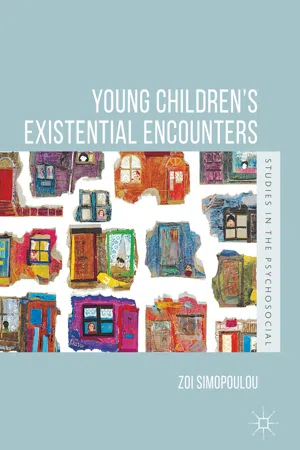
This book is a psychoanalytic observation of five children's existential encounters in their ordinary life at the nursery. It is among the first within psychosocial literature to go beyond adult experiences and explore the existential in young children's lives as it plays out in their everydayness in symbolic and sensory articulations and in relationship with others; including with the author as someone who arrived looking for it. The author offers analysis in the form of a writing inquiry into meaning, by means of an on-going movement between the self and the other, the interior and the exterior, and psychoanalytic and existential-phenomenological ideas. This is illustrated through a kaleidoscopic account of May, Nadia, Edward, Baba and Eilidhs' encounters with nothingness, strangeness, ontological insecurity, death and selfhood as these emerged in the time they spent with the author embodying different forms – from concrete objects to dreams – exemplifying an attunement to existential ubiquity. With its relational ground, this work suggests the potential for adults – including researchers, therapists, trainees, educators and parents – to attune to their own existential encounters as a path to understanding those of children.
- English
- ePUB (mobile friendly)
- Available on iOS & Android
eBook - ePub
Young Children’s Existential Encounters
About this book
Trusted by 375,005 students
Access to over 1.5 million titles for a fair monthly price.
Study more efficiently using our study tools.
Information
© The Author(s) 2019
Zoi SimopoulouYoung Children’s Existential EncountersStudies in the Psychosocialhttps://doi.org/10.1007/978-3-030-10841-0_1In Search of a Space
Zoi Simopoulou1
(1)
School of Health in Social Science, University of Edinburgh, Edinburgh, UK
This writing speaks to the times that I stood by a child gazing silently and taken by the poignancy of what they had just said or done whilst also unable to grasp a meaning of it. This moment moves me and immobilises me. I am moved by the child’s meaningfulness in a manner that feels almost concrete, physical and enlivening. Awakened to something fresh and new, how do I begin to make sense of it? How do I stay true to its newness? How do I stay true to it, capture it without deadening it?
In my work with primary school children I watch them playing out their experiences, their agonies and their pleasures yet sometimes more than others their play struck me as significant. What are these moments made of? They arrive with a captivating meaningfulness: closely located in children’s lives yet existentially nuanced. They play in a manner that feels reflective, almost poetic; a turning inwards to take some of the world in and to make sense of it. Perhaps it is this contemplative quality—capacity—of the children that gives these moments some of their distinctive nuancing: they arrive busily embedded in their everydayness and give in to an attentive silence. A pause that asks me to speak to it. How do I speak to it? How am I present in this moment?
The question of meaning intensified in the course of my training in psychoanalytic observation informed by the theoretical tradition of British Objects relations. Psychoanalytic infant observation was first established in 1948 by Esther Bick as part of the Tavistock child psychotherapy training, as a method of directly observing infants and children in their natural environments in order to understand the nature of their mental processes (Bick 1964; Shuttleworth 1997; Urwin and Sternberg 2012). Drawing on Klein’s (1997) discussion of the analytic playroom as a ‘total situation’ encompassing of both the child’s past and present, in my observations I reflect upon the surrounding subjects as external representations of internal unconscious objects and think of her play largely as a symbolic manifestation of her unconscious workings: her surroundings (peers, carers, observer, objects) as representations of her internal objects and her interactions with them as play-outs of her earliest phantasies (Shuttleworth 1997; Price and Cooper 2012). Unconscious feelings and states of mind are powerfully present similar to the therapeutic room where the child’s play is thought to enact the relations of her internal objects in the light of her phantasies, wishes and fears (Rustin 2012, pp. 14–15). Psychoanalytic observation becomes for me an emotional space that looks at the unconscious dynamics in a meaningful relational matrix by means of transference and countertransference. In this context I think of the child’s play as driven by her unconscious workings—or my imaginings of her unconscious workings.
I feel that I have just found a language with which I can meet her inner worlds embedded in her play—what drives her, what she agonises over, what she wishes—and I begin to wonder about her play as a communication of some kind of expansion, a relationship with the world as she takes more of the world in. Becoming part of something larger, the sizes, scopes, angles of her world are changing. I watch her in her play grappling with herself and I look for words to attend to an emerging existentially laden nuancing in her play. How can I think of her play in the light of her growing awareness of her being in the world, being part of something larger and constantly awakening to it as she finds herself in it by means of her everyday encounters, her experiences and her life as it comes to pass? In what language can I speak of this, how do I name and respond to it?
The main criticism of psychoanalytic observation as a research method comes from within psychoanalysis. The method is challenged as lacking the means for meaning to be confirmed: in psychoanalysis, interpretation is worked through by means of the client’s response, something that is not applicable in psychoanalytic observation (Urwin and Sternberg 2012, p. 5). Sensitised and attuned to the child’s very own language, that is, her play, psychoanalytic observation considers meaning by the very entering into the imaginative world of the child as it unfolds in a dynamic relationship informed by transference and countertransference. Staying longer with this relationship, I look into it for the space to think about the observer as an other who errs, misses or wishes and the child as a knower of her experience; that is, to ponder over the blurred boundary between the child and the observer that is present in the act of interpretation and in the subjective and relational nature of meaning making in psychoanalytic observation. When is the blurred boundary between the self and the other meaningful and when does it become unproductive if not potentially dangerous?
This present work comes from my decision to spend more time with children in order to think more about these questions. That is, to explore the existential in their everyday lives and to think how their play is expressive of both, their inner states and their encounters with the world and its existential givens. I understand that the edges of the inner and outer world are not clearly demarcated and that the outer is always seen through the inner whilst the inner is projected in the outer: I cannot but become aware of transience as an existential given through my encounter with another that comes and passes, revealing a sense of self located in a larger outsideness. My purpose is not to make their boundaries clear—how can I separate the inner from the outer? It is not the experience in itself that is psychoanalytic or existential but my thinking and my language that make it so; the meaning that my words ascribe to it or else the side that they light each time. Playing with different words, I make a meaning—then another; I look at one side pretending for a while that the other is not there. Coming from a specific psychoanalytic place, my purpose is to make a space to accommodate such play, this dialogue between a psychoanalytically informed and an existentially grounded thinking of children’s play. By moving between different spaces, I also look to problematise the notion of myself as an expert and to be present with each child as another who is subject to losses, drives and wishes as well as existential givens. This study explores how the existential is present in children’s lives as well as the possibility of an integrative understanding of children’s existential encounters by means of psychoanalytic observation.
My focus is with preschool children’s relationship with the existential as this is played out in their everydayness. Past work on the existential in children has relied on language as the predominant source of knowing. With the present piece, I look at preschool children’s everyday existential encounters drawing on their play, their encounters as well as the relational dynamics in the course of the observations. My interest lies more with the subjective meanings and the affective qualities of children’s relationship with the existential: how is this relationship present in the child’s play and her ordinary doing? Does it come alive in a word, an object, an image, a movement, an encounter? How does it reveal itself in the child’s relationships with others including myself as someone who arrived in search of it? I use psychoanalytic observation as a methodology that focuses on the child’s interior worlds as they unfold in her play and in the relationship with the observer, but by bringing it into this study I inquire into the space that some of the psychoanalytic thinking has for preschool children’s existential encounters and explore the possibility of an integrative approach towards them, by moving between existential-phenomenological and psychoanalytic ideas. This work explores thus the possibility of an integrative understanding of children’s existential encounters by embodying it.
Taking a relational psychoanalytic turn has allowed the space to explore the existential as fluidly located between the child and myself and our interior and exterior worlds. In the course of our time together, we met each other encountering the existential, playing out these encounters in imaginative ways and symbolic languages. The existential did not emerge as a question per se but was embodied in children’s play and in their stories—in the way they were present and in the relationship that we formed together. It emerged elusive as a quality, a shade or a nuance embedded in a movement, a voice or a gaze. Along with the body, time and space emerged implicated in children’s relationship with the existential.
The succeeding chapter of Part I comprises a review of literature on the topic of the existential in children. It starts with an inquiry into its definition before it looks at education and psychotherapy as those relational practices that share an interest in children’s subjective histories and the meanings they make of these. A lack of attention to preschool children’s existential encounters is identified alongside the need of adults’ (practitioners and researchers alike) readiness to engag...
Table of contents
- Cover
- Front Matter
- Part I. Introduction
- Part II
- Part III. Discussion
- Back Matter
Frequently asked questions
Yes, you can cancel anytime from the Subscription tab in your account settings on the Perlego website. Your subscription will stay active until the end of your current billing period. Learn how to cancel your subscription
No, books cannot be downloaded as external files, such as PDFs, for use outside of Perlego. However, you can download books within the Perlego app for offline reading on mobile or tablet. Learn how to download books offline
Perlego offers two plans: Essential and Complete
- Essential is ideal for learners and professionals who enjoy exploring a wide range of subjects. Access the Essential Library with 800,000+ trusted titles and best-sellers across business, personal growth, and the humanities. Includes unlimited reading time and Standard Read Aloud voice.
- Complete: Perfect for advanced learners and researchers needing full, unrestricted access. Unlock 1.5M+ books across hundreds of subjects, including academic and specialized titles. The Complete Plan also includes advanced features like Premium Read Aloud and Research Assistant.
We are an online textbook subscription service, where you can get access to an entire online library for less than the price of a single book per month. With over 1.5 million books across 990+ topics, we’ve got you covered! Learn about our mission
Look out for the read-aloud symbol on your next book to see if you can listen to it. The read-aloud tool reads text aloud for you, highlighting the text as it is being read. You can pause it, speed it up and slow it down. Learn more about Read Aloud
Yes! You can use the Perlego app on both iOS and Android devices to read anytime, anywhere — even offline. Perfect for commutes or when you’re on the go.
Please note we cannot support devices running on iOS 13 and Android 7 or earlier. Learn more about using the app
Please note we cannot support devices running on iOS 13 and Android 7 or earlier. Learn more about using the app
Yes, you can access Young Children’s Existential Encounters by Zoi Simopoulou in PDF and/or ePUB format, as well as other popular books in Psychology & Educational Psychology. We have over 1.5 million books available in our catalogue for you to explore.