Heather BrownThe Economics of Public Healthhttps://doi.org/10.1007/978-3-319-74826-9_1
Begin Abstract
1. Introduction to Public Health Economics
Heather Brown1
(1)
Newcastle University, Newcastle upon Tyne, UK
Keywords
Economic conceptsEfficiencyAllocativeTechnicalEconomic evaluationPublic health economics
End Abstract
Learning Outcomes:
Distinguish between micro- and macroeconomics
Give an example of technical and allocative efficiency
Identify the four main types of economic evaluation
Define public health economics
Why Do We Need Economics in Public Health?
Non-communicable diseases have surpassed infectious diseases as the leading cause of morbidity and mortality in developed countries. Prevention and treatment of the causes and consequences of lifestyle-related diseases will form an important part of health policy in the twenty-first century. Resources are limited, so we cannot purchase or produce everything that we would like to have. Economics is the study of this scarcity and how we deal with it. There are two main areas in economics. Microeconomics focuses on the decisions taken by individuals, households, and firms, and the way that they contribute to the setting of prices and outputs in the market. Macroeconomics focuses on the interaction of broad aggregates and interaction between different sectors of the economy.
How then does this relate to public health and the health sector? Most treatment options available exceed the budgets of individuals, insurance systems, and governments to pay for everything. A choice needs to be made about which treatments should be purchased and what policy should be enacted. One way in which this choice can be made is by prioritising alternative treatments and policies through an analysis of their cost and benefits.
Health Economics focuses on obtaining the maximum value for money by ensuring that not just the treatments with clinical effectiveness but those that are cost-effective are funded. The basic task of any health economic evaluation is to:
Identify
Measure
Value
the costs and consequences of the alternatives being considered.
Identify: Without systematic analysis it is difficult to identify clearly the relevant alternatives. For example, in deciding to introduce a new screening programme for breast cancer survivors it is necessary to describe existing activities (i.e. annual general practitioner (GP) check-ups) as an alternative programme to which new proposals must be compared.
Measure: What outcomes are we concerned with: life years extended, health improvement, number of cases detected, for example. How can we quantify these outcomes?
Value: Without the measurement and comparison of outputs and inputs we have little upon which to base value for money. The real cost of any programme is not the cost appearing on the programme budget but rather the health outcome achievable in some other programmes which have been foregone by committing resources to the chosen programme.
Health economic evaluation is used to address questions oftechnical and allocative efficiency. Technical efficiency relates to the relationship between resources related to capital and labour and health outcomes. An intervention is technically efficient if the same (or better) outcome could NOT be produced with less of one type of input (either capital or labour). An example of a question addressing technical efficiency is:
‘What is the most efficient way of providing dialysis for patients with chronic renal failure—hospital based or at the patient’s home?’
The question addresses a particular condition (chronic renal failure).
There is a fixed resource (existing budget for treating chronic renal failure).
The question relates to how to best use the given set of resources for kidney dialysis.
Allocative efficiency takes account of how resources are distributed within the community. It also takes account of the productive efficiency for which health care resources are used to produce health outcomes. The societal perspective of allocative efficiency is rooted in welfare economics. It is achieved when resources are allocated so as to maximise the welfare of the community. An example of a question relating to allocative efficiency is:
‘Should we expand the provision of hospital haemodialysis or introduce a screening programme for prostate cancer in men aged over 55 years?’
The question relates to two different conditions (chronic renal failure vs prostate cancer).
There is a proposed change in how resources are used.
The question relates to what intervention is the best use of resources across the entire government budget.
In all economic evaluations, the final result is presented as a ratio of incremental cost andeffects (outcomes).
Incremental refers to a change in costs for a change in benefits/effects/outcomes.
Cost is in the numerator (top half of fraction).
Effects or Outcome are in the denominator (bottom half of fraction).
Costs are always expressed in monetary terms.
How effects are expressed depends on the type of evaluation you are doing. There are four main types of economic evaluation, which are presented in Table 1.1.
Table 1.1
Four main types of economic evaluation
Type of evaluation
Comparison and outcomes
Common unit of measurement of outcome
Cost-minimisation analysis
Single effect of interest common to both alternatives. Outcomes are identical
Money
Cost-effectiveness analysis (CEA)
Single effect of interest common to both alternatives, but achieved to different degrees.
– Life years gained
– Pain reduction
– Cases detected
Cost-utility analysis (CUA)
Single or multiple effects, not necessarily common to both alternatives.
– Quality Adjusted Life Years (QALYs) (generic or condition-specific)
– Healthy Life Years Extended (HYEs)
Cost-benefit analysis (CBA)
Single or multiple effects, not necessarily common to both alternatives.
Money, e.g.
– Human capital
– Willingness to pay
What Makes Public Health Different from the Production of Televisions?
Markets are institutions that bring together buyers and sellers of goods and services. There are two main types of market: free markets, where there is little to no intervention by the government except to enforce contracts or the private ownership of property; andregulated markets, where government directly regulates how goods, services, and labour may be priced, used, and distributed. This is related to how competitive a market is. Market competition is based upon how many firms are willing and able to sell a good or service and how easy it is for firms to enter or exit the market in the long run. Market competition is usually classified as either perfect competition, oligopoly, ormonopoly. Perfect competition is thought of as the gold standard of market types, as it results in an efficient allocation of resources since firms cannot manipulate prices and there is perfect information regarding prices for both consumers and producers. Firms in an oligopoly market and a monopoly market can manipulate price and the number of goods supplied, which can reduce consumer surplus.
Compared with, say, the market for televisions, where there is less of a case for government regulation of the market, even in countries with a relatively lax view towards regulation of markets such as the USA, the market for health care is still regulated. This is because of a number of failures in the health care market and provision of public health in particular. There are the problems of externalities, provision of public goods, and asymmetric information.
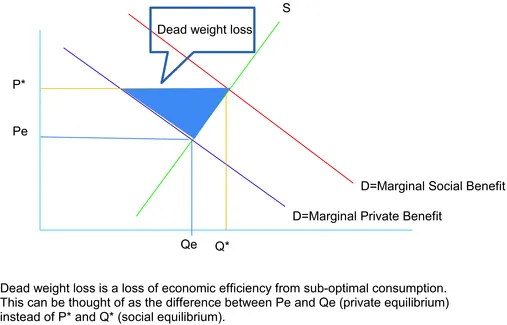
Externalities are when the market does not account for all the costs and benefits associated with the provision of a good or service. A prime public example can be traced back to the MMR scare in the late 1990s. Wakefield et al. 1998 showed a link between the MMR vaccine and childhood autism, and this provoked a decrease in the number of parents vaccinating their children. There are public and private benefits to vaccination, and these are illustrated in Fig. 1.1.
Fig. 1.1
Private and social demand for MMR vaccine. Note: Dead weight loss is a loss of economic efficiency from sub-optimal consumption. This can be thought of as the difference between Pe and Qe (private equilibrium) instead of P* and Q* (social equilibrium)
If the critical number of children are not vaccinated there will not be herd immunity to measles, increasing the likelihood that there will be an outbreak. The economist toolkit can be used to assist policymakers and practitioners in developing policy to incentivise parents to vaccinate their children. We will return to this example in Chap. 3, when we explore how discrete choice experiments can be used to elicit parents’ views on vaccination programmes and what factors influence their decisions to vaccinate their children.
A public good is a good or service that can be consumed simultaneously by everyone and that no one can be excluded from consuming. People may not want to pay for the good or service because they know that once it is provided anyone can consume it (the free rider problem). The provision of health care is not a public good, because if one person receives treatment this excludes someone else from receiving the same treatment. H...
Table of contents
Cover
Front Matter
Part I. Introduction
Part II
Part III. Policy Evaluation
Back Matter
Trusted by 375,005 students
Access to over 1.5 million titles for a fair monthly price.
Study more efficiently using our study tools.
Frequently asked questions
Yes, you can cancel anytime from the Subscription tab in your account settings on the Perlego website. Your subscription will stay active until the end of your current billing period. Learn how to cancel your subscription
No, books cannot be downloaded as external files, such as PDFs, for use outside of Perlego. However, you can download books within the Perlego app for offline reading on mobile or tablet. Learn how to download books offline
Perlego offers two plans: Essential and Complete
Essential is ideal for learners and professionals who enjoy exploring a wide range of subjects. Access the Essential Library with 800,000+ trusted titles and best-sellers across business, personal growth, and the humanities. Includes unlimited reading time and Standard Read Aloud voice.
Complete: Perfect for advanced learners and researchers needing full, unrestricted access. Unlock 1.5M+ books across hundreds of subjects, including academic and specialized titles. The Complete Plan also includes advanced features like Premium Read Aloud and Research Assistant.
Both plans are available with monthly, semester, or annual billing cycles.
We are an online textbook subscription service, where you can get access to an entire online library for less than the price of a single book per month. With over 1.5 million books across 990+ topics, we’ve got you covered! Learn about our mission
Look out for the read-aloud symbol on your next book to see if you can listen to it. The read-aloud tool reads text aloud for you, highlighting the text as it is being read. You can pause it, speed it up and slow it down. Learn more about Read Aloud
Yes! You can use the Perlego app on both iOS and Android devices to read anytime, anywhere — even offline. Perfect for commutes or when you’re on the go. Please note we cannot support devices running on iOS 13 and Android 7 or earlier. Learn more about using the app
Yes, you can access The Economics of Public Health by Heather Brown in PDF and/or ePUB format, as well as other popular books in Business & Management. We have over 1.5 million books available in our catalogue for you to explore.