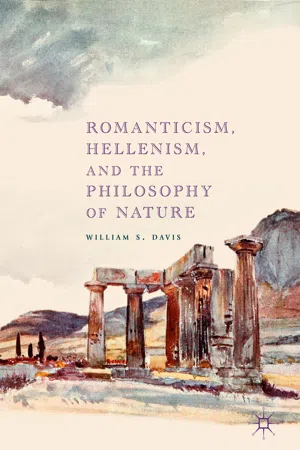
This book investigates intersections between the philosophy of nature and Hellenism in British and German Romanticism, focusing primarily on five central literary/philosophical figures: Friedrich Schelling, Friedrich Hölderlin, Johann Wolfgang von Goethe, Percy Shelley, and Lord Byron. Near the end of the eighteenth century, poets and thinkers reinvented Greece as a site of aesthetic and ontological wholeness, a move that corresponded with a refiguring of nature as a dynamically interconnected web in which each part is linked to the living whole. This vision of a vibrant materiality that allows us to become "one with all that lives," along with a Romantic version of Hellenism that wished to reassemble the broken fragments of an imaginary Greece as both site and symbol of this all-unity, functioned as a two-pronged response to subjective anxiety that arose in the wake of Kant and Fichte. The result is a form of resistance to an idealism that appeared to leave little roomfor a world of beauty, love, and nature beyond the self.
- English
- ePUB (mobile friendly)
- Available on iOS & Android
eBook - ePub
Romanticism, Hellenism, and the Philosophy of Nature
About this book
Information
Topic
FilosofíaSubtopic
Historia del mundo© The Author(s) 2018
William S. DavisRomanticism, Hellenism, and the Philosophy of Naturehttps://doi.org/10.1007/978-3-319-91292-9_11. Introduction: Romantic Hellenism, the Philosophy of Nature, and Subjective Anxiety
William S. Davis1
(1)
Program in Comparative Literature, Colorado College, Colorado Springs, CO, USA
William S. Davis
Keywords
Responses to KantSubjectivismRomantic HellenismPhilosophy of natureConnections between literature and philosophyOnenessBy the final decade of the eighteenth century, the repercussions of Kant’s critiques had extended beyond philosophy proper into wide-ranging forms of cultural expression. Kantianism , now largely out of the hands of the philosopher of Königsberg himself, had become a cultural phenomenon that, however exaggerated or distorted public perception of Kant’s ideas may have been, inspired some and exasperated others. Of those who paid attention to such things, some were fired with passion for the new ideas. Certain young men took up Fichte’s response to Kant, for example, more as a lifestyle of boldly personal freedom than simply as of a system of knowledge—an attitude he encouraged himself.1 Others were less enthusiastic. Goethe in 1794 accused Schiller of being so under the sway of a subject-focused Kantianism that he had come to see nature as a mere “idea.”2 The young Heinrich Kleist suffered a “Kant crisis” in 1801 that plunged him into a dark epistemological depression.3 Fresh from the Tübingen theological seminary in the mid-1790s, three friends and former roommates—Friedrich Hölderlin, Friedrich Schelling, and G.W.F. Hegel—though trained by the state of Swabia for a life in the Protestant clergy, tossed aside all plans for service within the Lutheran church. Inspired by the revolution of the spirit they encountered in the new philosophy (as well as by political revolution in France), all three were caught up in the philosophical issue of their day, and, in their own ways, would devote their lives to coming to terms with it. Schelling, the youngest of the three, framed the central question succinctly in his lectures at the University of Jena in 1797: “How is perception within me possible?”4 How, in other words, am I to understand the relation between myself as a subject here, and the otherness that appears beyond my subjectivity over there?
This book is about a mode of response to this question that emerges at an intersection of philosophy and literature in the years around 1800. From a philosophical perspective, we can view this response to the question of the borders of the self as part of what Frederick Beiser calls “the struggle against subjectivism.” He has in mind discursive strategies against “the doctrine that the subject has an immediate knowledge only of its own ideas, so that it has no knowledge beyond its circle of consciousness .”5 This fear of a lack of reliable knowledge beyond his own “circle of consciousness” is indeed precisely what drove Kleist to distraction in 1801 (more on this “crisis” in Chap. 3). Though some might argue that German idealists, as they responded to Kant, created their own crisis of subjectivity simply by being so idealist, Beiser argues that much of German thought in the years around 1800 was, in fact, creatively engaged in a solution, in finding a way to bridge the gulf between idealism and realism as part of a route beyond the subjectivist conundrum.
In this study, I suggest that we can read one version of an answer to the fear that consciousness might comprise a confining and isolating “circle” in the works of philosophical poets of the period—Hölderlin, Goethe, and Percy Shelley —as well as in the philosophy of nature of a poetic philosopher, Friedrich Schelling. All turn in their ways to metaphors of the one with all as an antidote to subjectivism, exploring the possibility of discovering or creating a restorative unity with what lies beyond the subject. This longing for unity thus forms the primary trope I hope to investigate. As we will see, oneness has epistemological, ontological, aesthetic, as well as erotic dimensions. The desire for love and beauty works against solipsistic isolation. As the poetic narrator of Percy Shelley ’s Episphychidion puts it: “We shall become the same, we shall be one/Spirit within two frames, oh! Wherefore two?”6
This entanglement of art and philosophy heralds the fact that for these writers the answer to the problem of the subject’s relation to the object lies ultimately not in philosophy or theory alone but in an act of the aesthetic imagination. Overcoming subjectivism and dualism (the subject–object split) is possible only through the creative apperception of the beautiful . In order to deploy beaut y as a weapon against the potential solipsism of a subject cut off from the world of objects, the texts I have in mind take advantage of two interconnected cultural forms that were ready-to-hand by the end of the eighteenth century: the philosophy of nature and Romantic Hellenism. I thus argue that much of the Romantic valorization of Greece is intimately intertwined with natural philosophy. Contemporary natural sciences presented scientifically inclined thinkers like Schelling and Goethe with a dynamic view of nature that allowed for vital connections between subject and object. In this vein, Schelling worked out his own Naturphilosophie (philosophy of nature) in the final years of the eighteenth century. Meanwhile, at least since Winckelmann ’s Reflections on the Imitation of Greek Works in Painting and Sculpture (1755), which idealized Greek classical “noble simplicity and quiet grandeur” (“eine edle Einfalt und eine stille Größe”)7 to the detriment of any art that came after it, a reinvented Hellenism was taken up in the discourse of art and ideas as a dominant aesthetic ideal. By the time they were rooming together at the theological seminary in the early 1790s, the notion that an idealized “Greece” lay behind Western culture as a lost form of aesthetic and ontological wholeness was something the Tübinger three could take for granted.
The discursive strategy, however, is not simply to rely on the philosophy of nature and a Romanticized Hellenism as tools in the post-Kantian struggle but to employ both cultural forms as inextricably interconnected, as parts of a single, two-pronged, mode of representation. The dynamic view of nature, which conceives the universe as shot-through with a single life force that Schelling sometimes Platonically calls The World Soul , finds support in the classical ideal. “The classical” in turn cannot exist in the absence of a dynamic conception of nature. That is, were humans not capable of connecting directly and intuitively with nature, Greek art, in the sense that Winckelmann idealizes it, would never have come about. Because of their intuitive and immediate connection with the natural world, a unity now lost for overly self-conscious moderns, these “Greeks” were able to produce works that were at once natural, yet filled with spirit. Goethe thus defines the beaut iful as “spiritually organic (geistig organisch).”8 In this expression we find the two prongs—human creativity (Geist) and organic nature—welded together. Much of this study, in one way or another, is in the service of explaining both terms of Goethe’s adverb/adjective pairing, as well as their interconnection.
It follows from Goethe’s nearly oxymoronic combination of Geist (mind, thought, reason) with organisch (organic, natural, not characterized by reason) that the path towards the beautiful, or the way beyond the circle of one’s own consciou sness, lies in a particular conception of materiality, within a view of the object as vibrantly (geistig) alive. We might indeed characterize all of the literary texts I examine here as texts of the vibrant object.9 With this term I designate an aspect of Schelling’s philosophy of nature that appears in a variety of forms in literary texts of the period, the insistence that natural objects are not dead things, but—organic and inorganic alike—living potentialities, constantly in flux and part of a vast natural process leading from simple matter to the heights of human self-consciousness: “the entirety of nature is at work in each of its products,” as Schelling puts it.10 At the end of his long lyric poem, Epipsychidion, Percy Shelley captures the paradoxical sense of the vibrant object with the metaphor that compares the body aflame with love to a bush that, like the one Moses encountered, is “ever still/Burning, yet ever inconsumable.”11 S...
Table of contents
- Cover
- Front Matter
- 1. Introduction: Romantic Hellenism, the Philosophy of Nature, and Subjective Anxiety
- 2. Intellectual Intuition: With Hölderlin, “Lost in the Wide Blue”
- 3. The Philosophy of Nature: Goethe, Schelling, and the World Soul
- 4. Aesthetic/Erotic Intuition: Hölderlin, Shelley, and the Islands of the Archipelago
- 5. Coda: With Byron on Acrocorinth
- Back Matter
Trusted by 375,005 students
Access to over 1.5 million titles for a fair monthly price.
Study more efficiently using our study tools.
Frequently asked questions
Yes, you can cancel anytime from the Subscription tab in your account settings on the Perlego website. Your subscription will stay active until the end of your current billing period. Learn how to cancel your subscription
No, books cannot be downloaded as external files, such as PDFs, for use outside of Perlego. However, you can download books within the Perlego app for offline reading on mobile or tablet. Learn how to download books offline
Perlego offers two plans: Essential and Complete
- Essential is ideal for learners and professionals who enjoy exploring a wide range of subjects. Access the Essential Library with 800,000+ trusted titles and best-sellers across business, personal growth, and the humanities. Includes unlimited reading time and Standard Read Aloud voice.
- Complete: Perfect for advanced learners and researchers needing full, unrestricted access. Unlock 1.5M+ books across hundreds of subjects, including academic and specialized titles. The Complete Plan also includes advanced features like Premium Read Aloud and Research Assistant.
We are an online textbook subscription service, where you can get access to an entire online library for less than the price of a single book per month. With over 1.5 million books across 990+ topics, we’ve got you covered! Learn about our mission
Look out for the read-aloud symbol on your next book to see if you can listen to it. The read-aloud tool reads text aloud for you, highlighting the text as it is being read. You can pause it, speed it up and slow it down. Learn more about Read Aloud
Yes! You can use the Perlego app on both iOS and Android devices to read anytime, anywhere — even offline. Perfect for commutes or when you’re on the go.
Please note we cannot support devices running on iOS 13 and Android 7 or earlier. Learn more about using the app
Please note we cannot support devices running on iOS 13 and Android 7 or earlier. Learn more about using the app
Yes, you can access Romanticism, Hellenism, and the Philosophy of Nature by William S. Davis in PDF and/or ePUB format, as well as other popular books in Filosofía & Historia del mundo. We have over 1.5 million books available in our catalogue for you to explore.