Since the turn of the millennium, the Arabian Peninsula has produced a remarkable series of adaptations of Shakespeare. These include a 2007 production of Much Ado About Nothing, set in Kuwait in 1898; a 2011 performance in Sharjah of Macbeth, set in 9th-century Arabia; a 2013 Yemeni adaptation of The Merchant of Venice, in which the Shylock figure is not Jewish; and Hamlet, Get Out of My Head, a one-man show about an actor's fraught response to the Danish prince, which has been touring the cities of Saudi Arabia since 2014.
This groundbreaking study surveys the surprising history of Shakespeare on the Arabian Peninsula, situating the current flourishing of Shakespearean performance and adaptation within the region's complex, cosmopolitan, and rapidly changing socio-political contexts. Through first-hand performance reviews, interviews, and analysis of resources in Arabic and English, this volume brings to light the ways in which local theatremakers, students, and scholars use Shakespeare to address urgent regional issues like authoritarianism, censorship, racial discrimination and gender inequality.
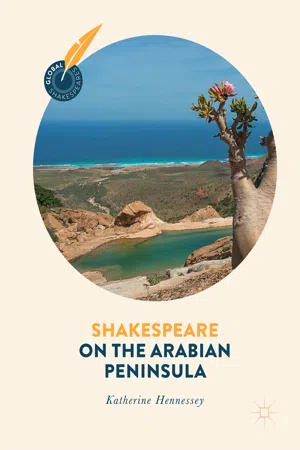
- English
- ePUB (mobile friendly)
- Available on iOS & Android
eBook - ePub
Shakespeare on the Arabian Peninsula
About this book
Information
© The Author(s) 2018
Katherine HennesseyShakespeare on the Arabian PeninsulaGlobal Shakespeareshttps://doi.org/10.1057/978-1-137-58471-7_2Chapter 1. “Abstract and Brief Chronicles”: Shakespeare on the Peninsula in the Twentieth Century
Katherine Hennessey1
(1)
American University of Kuwait, Salmiya, Kuwait
This chapter provides a survey of performances of Shakespeare on the Arabian Peninsula over the course of the twentieth century. I have recorded here all of the productions that I have found documented in reputable sources, in English and in Arabic, though undoubtedly there are other Shakespeare performances which have not left a written record, or which my research has not yet uncovered. Admittedly, what is recorded here is tantalizingly incomplete. In a number of cases, the only available information is a title and a year (sometimes approximate) of performance, and even the more detailed accounts provoke more questions than they answer about language, aesthetics, and the material conditions of performance, not to mention the interpretation and reception of each performance within its particular geographic and historical context.
Even in this fragmentary form, however, the survey serves to illustrate two main—and contrasting—points: first, that Yemen has a surprisingly rich history of Shakespearean performance, stretching back over the course of the twentieth century; and second, that Shakespeare only rarely appears in Gulf repertoires prior to the turn of the millennium. The twenty-first-century flourishing of Shakespeare in the Gulf states is thus unprecedented.
Yet his works do appear on Gulf stages at significant historical moments throughout the twentieth century. Furthermore, across the region, a triptych of Shakespeare’s plays— Othello , The Merchant of Venice, and Romeo and Juliet —are by far the most frequently adapted and staged in this period, while Hamlet , immensely popular over this same time period elsewhere in the Arab World, 1 makes fewer twentieth-century forays into the Peninsula than we might expect. This survey explores the complex reasons behind these choices, and reflects upon the combination of audience expectations, director’s preferences, and local historical context that may have conditioned them.
A Brief History of Shakespeare in Yemen
Yemen may well be the only country on the globe that can lay claim to a history of theatre that begins with a performance of Shakespeare. 2 According to Sa‘id Aulaqi , the foremost historian of Yemeni theatre, the first documented public performance by Yemeni actors was a production of Julius Caesar in Arabic translation , which occurred in 1910 in the port city of Aden . 3
Aden , which possesses a large natural harbor, is situated on the southern coast of the Arabian Peninsula, about a hundred miles east of Bab al-Mandab (the southern entrance to the Red Sea). In the early modern period, it proved a useful stopping point on sea routes to India. In the decades before Shakespeare’s birth, Aden was sufficiently cosmopolitan and flourishing to have piqued the interests of both the Ottomans and the Portuguese, who vied with each other for control of the port over the course of the early sixteenth century. The Ottomans eventually prevailed, and clung to Aden tenaciously from 1548 into the seventeenth century, after which control of the port devolved to a local potentate, the Sultan of Lahj .
In 1839, the British established a base in Aden , to facilitate maritime trade via the Red Sea and to protect that trade against piracy. The initial occupation of Aden took place in the wake of an incident in which looters from Aden and the surrounding coast plundered a sunken British ship, upon which the British Raj dispatched a warship from Mumbai under Commander Stafford B. Haines to demand compensation from the Sultan of Lahj . Failing to obtain a satisfactory response from the Sultan, Haines’s warship bombarded the port, the Royal Marines stormed the town, and the Sultan handed over the territory, for which he was paid an annual sum as compensation.
“Aden Province,” or “Aden Settlement,” as the port and the immediate surrounding area (75 sq. miles in total) were initially known, was governed during that time period as part of the British Raj ; its officials were appointed through the Bombay Presidency, and its currency was the Indian rupee. The history of Aden in the second half of the nineteenth century was, generally speaking, one of slow but tangible economic and cultural development, the pace of which picked up after the opening of the Suez Canal in 1869, when the port assumed increasing importance as a coaling station for British steamships passing through the Red Sea on their way to India.
It is important to remember, however, that Aden’s history had long been one of travel, trade and cultural exchange. For centuries preceding the British occupation, the port had hosted traders of diverse background. The great fourteenth-century Moroccan explorer Ibn Battuta , who visited Aden around 1330, recorded that its inhabitants included both Indian and Egyptian traders; in fact, Ibn Battuta was so impressed with the trading links between Aden and southwest India, and with the arrivals of large ships from Calcutta, Kanbayat (Cambay) and Kollam, that he referred to Aden as marsā ahl al-hind, “the Indians’ port.” 4 Documents from the Cairo Genizah demonstrate the presence of a Jewish community in Aden as far back as the tenth century, and the port also attracted traders from East Africa. The incorporation of Aden into the network of Indian Ocean port cities controlled by the British Empire helped the city’s already existing tendencies towards cosmopolitanism to flourish and, in the early 1900s, helped spur the creation of Yemen ’s first theatrical performances, starting with Julius Caesar .
By 1910, Aden had been under British control for over seventy years. 5 The actors who had taken up the challenge of performing Shakespeare were students at the Government School in the oldest inhabited area of Aden, the neighborhood of Crater, so dubbed because it sits within the cone of an extinct volcano. By 1910, Crater was home to two performance spaces, though these were only rudimentarily equipped: one in a building that later became known as Mr. Hamoud’s Cinema —remarkably, still extant and still hosting live theatrical performances over a century later 6 —and another called the Nātak, later renamed al-Masraḥ al-Malikī (The Regal Theatre/Cinema), both in the Qatia neighborhood. 7 These had been established in 1904 and 1908 respectively, set up by the Indian community of Aden to host performances in those years by visiting Indian theatre troupes—at least one of which was likely a Parsi theatre troupe , for which Aden was only one stop on an extended tour to various cities on the Indian Ocean that had significant Indian communities. 8 These elaborate Indian performances quickly became the talk of the port city, and inspired an enterprising group of young Yemenis to put on their own show. The Yemeni performance, however, took place not within either of the aforementioned performance spaces but in the open air, in a public square, on a small raised stage likely constructed for that purpose and dismantled afterwards.
That fact unfortunately represents the sum total of the historical record of this performance. We do not know what text the Government School students used; their performance pre-dates by two years the publication of Arabic translations of the play by Sami Al-Juraydini and Muhammad Hamdi , 9 so perhaps the students had studied the play in English in school and created their own translation . 10 Nor do we know what prompted them to choose this play, and whether they perceived in it any echo of the socio-political dynamics of their own society. Perhaps, stirred by newfound enthusiasm for theatre after the Indian troupes’ visits, they reached for the theatrical text that was nearest to hand and found Shakespeare’s play in their schoolbooks, not merely available but also pre-validated by their instructors and educational system. Yet, as in other imperial outposts, performances of Shakespeare in south Yemen should not automatically be interpreted as a homage to Britain, or as an attempt by a local population to slavishly imitate its colonial masters. Julius Caesar is, of course, a play which por...
Table of contents
- Cover
- Front Matter
- Introduction: All the Perfumes of Arabia
- Chapter 1. “Abstract and Brief Chronicles”: Shakespeare on the Peninsula in the Twentieth Century
- Chapter 2. Sparking Debate: Shakespeare in the University Classroom
- Chapter 3. Challenging Segregation: Shakespeare in Performance at Gulf Universities
- Chapter 4. Negotiating Censorship: Shakespeare on Tour in the Gulf
- Chapter 5. Creating Communities: Shakespeare and “New Local” Theatre in the UAE and Qatar
- Chapter 6. Respecting Difference: Shakespeare in Oman, Yemen and Saudi Arabia
- Chapter 7. Modeling Inclusion: Shakespeare in Kuwait
- Conclusion: The Peninsula in 2016, the “Year of Shakespeare”
- Back Matter
Trusted by 375,005 students
Access to over 1.5 million titles for a fair monthly price.
Study more efficiently using our study tools.
Frequently asked questions
Yes, you can cancel anytime from the Subscription tab in your account settings on the Perlego website. Your subscription will stay active until the end of your current billing period. Learn how to cancel your subscription
No, books cannot be downloaded as external files, such as PDFs, for use outside of Perlego. However, you can download books within the Perlego app for offline reading on mobile or tablet. Learn how to download books offline
Perlego offers two plans: Essential and Complete
- Essential is ideal for learners and professionals who enjoy exploring a wide range of subjects. Access the Essential Library with 800,000+ trusted titles and best-sellers across business, personal growth, and the humanities. Includes unlimited reading time and Standard Read Aloud voice.
- Complete: Perfect for advanced learners and researchers needing full, unrestricted access. Unlock 1.5M+ books across hundreds of subjects, including academic and specialized titles. The Complete Plan also includes advanced features like Premium Read Aloud and Research Assistant.
We are an online textbook subscription service, where you can get access to an entire online library for less than the price of a single book per month. With over 1.5 million books across 990+ topics, we’ve got you covered! Learn about our mission
Look out for the read-aloud symbol on your next book to see if you can listen to it. The read-aloud tool reads text aloud for you, highlighting the text as it is being read. You can pause it, speed it up and slow it down. Learn more about Read Aloud
Yes! You can use the Perlego app on both iOS and Android devices to read anytime, anywhere — even offline. Perfect for commutes or when you’re on the go.
Please note we cannot support devices running on iOS 13 and Android 7 or earlier. Learn more about using the app
Please note we cannot support devices running on iOS 13 and Android 7 or earlier. Learn more about using the app
Yes, you can access Shakespeare on the Arabian Peninsula by Katherine Hennessey in PDF and/or ePUB format, as well as other popular books in Literature & European History. We have over 1.5 million books available in our catalogue for you to explore.