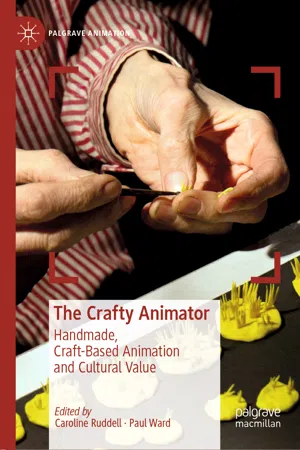
This collection is a study of the value of craft as it can be understood within the study and practice of animation. The book reconsiders the position of craft, which is often understood as inferior to 'art', with a particular focus on questions of labour in animation production and gendered practices. The notion of craft has been widely investigated in a number of areas including art, design and textiles, but despite the fact that a wide range of animators use craft-based techniques, the value of craft has not been interrogated in this context until now. Seeking to address such a gap in the literature, this collection considers the concept of craft through a range of varying case studies. Chapters include studies on experimental animation, computer animation, trauma and memory, children's animation and silhouette animation among others. The Crafty Animator also goes some way to exploring the relationship craft has with the digital in the context of animation production. Through these varied discussions, this book problematizes simplistic notions about the value of certain methods and techniques, working to create a dialogue between craft and animation.
eBook - ePub
The Crafty Animator
Handmade, Craft-based Animation and Cultural Value
- English
- ePUB (mobile friendly)
- Available on iOS & Android
eBook - ePub
The Crafty Animator
Handmade, Craft-based Animation and Cultural Value
About this book
Information
Subtopic
Art General© The Author(s) 2019
Caroline Ruddell and Paul Ward (eds.)The Crafty AnimatorPalgrave Animationhttps://doi.org/10.1007/978-3-030-13943-8_11. Introduction
Caroline Ruddell1 and Paul Ward2
(1)
Brunel University London, Uxbridge, Middlesex, UK
(2)
Arts University Bournemouth, Poole, UK
“Craft” appears to have a straightforward meaning, but it is a term that is rich in historical and cultural connotations. It can be taken simply to mean the doing or making of something, often directly linked to the idea of manual activity, or doing something with one’s hands. There are of course more complex ways in which “craft” can be understood—not least the way in which it is mobilised in the title of this book: The Crafty Animator. “Crafty” on one level suggests misdirection or deception and this connects us to a rich history of magic , witchcraft , sleight of hand and prestidigitation. If someone is being “crafty”, then, they are not only “crafting” something, they are doing so with a view to deceiving or misdirecting.
Central to such connotations is a paradox that underpins much animation—especially the forms of animation that are discussed in this collection of essays—namely, that it simultaneously reveals and conceals its own construction. Peter Lamont’s contention, in his discussion of magic , is that “if you look for the wires and see them, that is bad magic” (2009, 30), but there are many examples of animation that are based on a knowing revelation of the processes, the craft, that went into making it. Animation that “shows us the wires”, or revels in engaging the audience through a self-conscious disclosure of (parts of) the technique as part of its appeal. This does not mean that every animation mechanically talks us through “how it was made”, but rather that the “hand of the artist ”, whether explicitly and literally shown or merely implied, is often fundamental to the form.
The idea that something is crafted or handmade initially appears to be straightforward, therefore, but on further reflection we can see that it raises a number of paradoxes. Perhaps the most prominent of these is that such a handmade object is in some way authentic. Recently, craft has become an increasingly valued phenomenon in contemporary culture, precisely because of its perceived authenticity and connections to the “handmade”. At the same time, however, this notion of the “handmade”, the “authentic”, is used as part of the marketing of products sold by major corporations. One has only to walk down a high street to see signs for handcrafted burgers, handcrafted coffee, or craft beer, or to look online at a website such as Etsy where you can buy “unique, vintage & handmade items” (Etsy 2018). At the time of writing both the Festival of Making and London Craft Week are imminent, and University College London (UCL) have set up the Institute of Making, a research hub for those interested in making. Crafted and handmade products are currently in vogue, then, and ironically are often marketed in ways that emphasises their uniqueness or authenticity . Herein lies the first of many contradictions that craft embodies in late-capitalist culture: namely, that its usefulness as a marketing term stems from how it brands things as unique and handmade—authentic—but at the same time, the relentless march of a culture of mass consumption mitigates against anything being truly authentic. “Handcrafted ”, “handmade”, and other such terms, have simply become shorthand for a certain type of commodified “authentic” experience. The original meaning of the terms—to make something, something unique, with one’s hands—has become co-opted in order to re-brand certain products and experiences to make them seem more attractive in the highly competitive market-place. For example, a “handcrafted ” coffee from the Costa coffee chain—at the time of writing, a subsidiary of the hospitality multinational, Whitbread, and about to be acquired by Coca-Cola for £3.9 billion 1 —is made by both barista and machine. The coffee will be the same if you were to buy one from any Costa coffee outlet because it is made by the same model of machine with the same coffee beans, bought in massive amounts by the company. Yet coffee sold in any of these outlets (and other chains, whether Starbucks or McDonalds) will emphasise the role of the barista in making the drink “by hand”. Of course, the barista may also “craft” their own touches to the final coffee by creating their own handmade sprinkled chocolate design, for example. In such an instance, which is of course an example of mainstream large-scale business practice, the final product is both the consequence of a factory line of coffee production and a human handmade input. More than this, the machine of course cannot be operated without human interaction. This may seem a whimsical analogy, but it can provide a useful introduction to thinking through craft’s relationship with animation. In the coffee example we are dealing with one person’s interaction with one piece of technology , the outcome of which is one cup of “handcrafted ” coffee. When it comes to animation, the array of technologies available to produce it is vast and varied. If we were to replace the one coffee machine with the wide range of technologies and techniques that animators use—adding the fact that they work in a wide variety of different industry contexts from the independent to the mainstream—we are immediately faced with a very complex set of relationships between that which can be directly linked to a human hand and that which is mediated in some way by technology , digital or otherwise. All of these contextual factors make identifying and understanding notions of craft all the more difficult to manage.
The aim of this book is to interrogate craft, and its contradictions, in the particular context of animation production. Surprisingly animation’s specific relationship to notions of craft has been largely overlooked in the scholarship. On the one hand, some animation might be unproblematically seen to be crafted or handmade, particularly in the sphere of independent production where individuals appear to simply draw, paint, or sculpt their productions into life. For example, one can look at the films of animators like Joanna Quinn, Adam Elliot, Caroline Leaf, or the Quay Brothers and sense the tactile, material nature of the images. The issue is complicated when one starts to consider how individual handmade practices intersect with technologies. Perhaps the thorniest issue that animation and craft-based practices highlight is the use of digital technologies, and the implications in terms of authorship and creativity. Digital hardware and software are of course almost ubiquitous in the production of all types of animation. “CGI ” (“computer-generated imagery”) is merely the most obvious use, and drawn/2D animation and stop-motion animation also use software such as ToonBoom, CelAction, TVPaint, Stop Motion Pro or Dragonframe in their production pipelines, but often in ways that will foreground the craft-based elements of the animation. For example, Aardman’s productions are highly valued in contemporary culture for their use of stop-motion puppets that often retain thumb or finger prints, apparently providing “evidence” of their handmade production, despite the fact that Aardman, like all contemporary studios, of course use state-of-the-art technology to produce their animations. If there is one underlying, central aim of this book, it is to problematise these simplistic ideas about the value of certain methods and techniques, and how technology relates to them. Animators in all kinds of industries or production contexts use a wide variety of handmade/craft processes, as well as technological practices; there can therefore be no simple distinction in animation production between that which has been crafted by hand and that which has been crafted using technology .
One of the key arguments returned to repeatedly in the chapters that follow is concerned with the ways in which different types of animation foreground or self-consciously showcase notions of the (hand)crafted. Artworks self-reflexively gesturing to their constructedness, or the processes that went into their making is an old idea; the debates in this book, specifically about handcraft and animation, need to be seen in this larger context. For example, the metatheatrical tropes we can see in drama from Ancient Greece onwards—direct address of the audience, for instance—are part of a mode of address that draws attention to the work as a consciously constructed (or crafted) artefact. The playwright (and the performers) want the audience to recognise and revel in the fact that they are engaging with something that oscillates between “showing” and “telling”. Film and literature have similar conventions, where the “drawing attention to” is part of the pleasure derived. In a brilliant video essay, “Editing as Punctuation in Film” (2015), Max Tohline draws upon a brief essay by Kathryn Schulz (“The Five Best Punctuation Marks in Literature” from 2014) in order to discuss the often startling ways in which writers and filmmakers draw attention to the mechanics of their chosen medium. 2
Schulz offers up five punctuation marks that she argues arrest the reader, stops them dead, makes them starkly aware of the hand of the author leading them through the prose (or, in the case of one of her examples, from T.S. Eliot’s “The Love Song of J. Alfred Prufrock”, poetry). The fifth such mark is a simple full stop (or “period”) from Primo Levi’s book, The Periodic Table. Levi ends the book with the chapter entitled “Carbon”, and he ends that chapter with these lines:
It is that which at this instant, issuing out of a labyrinthine tangle of yeses and nos, makes my hand run along a certain path on the paper, mark it with these volutes that are signs: a double snap, up and down, between two levels of energy, guides this hand of mine to impress on the paper this dot, here, this one.
This is the writer writing about the process of writing—not in a “how to” type way: in that sense “process” is the wrong word here. It is the writer writing about the act of writing, the craft of writing, and the craft of writing as something that is not done invisibly and intuitively, but as a knowing—crafty—craft.
Similar questions of self-referentiality are commonplace in cultural history—the idea of mise en abyme and the recursive nature of certain artworks and artefacts, reflecting “back” on themselves, for example. But what can appear to be a purely textual “trick” actually speaks volumes about the processes that went into its construction: in other words, it is really pointing to the crafting hand of the maker and the powerful charge that recognition of this gives to the viewer. Take animator-artist Joe Sheehan’s work, for example: his most recent completed project, Unit 119, takes stop-frame animation to one of its outer edges and contemplates (virtual) stillness via animation and the handcrafting of miniature versions of the eponymous studio unit in which he is working. In the tradition of artists such as Thomas Demand, Jonas Dahlberg, and Mayumi Terada, Sheehan’s miniaturised replicas are exquisitely detailed, yet just stylised and simplified enough to make the viewer (un?)comfortably aware of the hand of the creator-animator. It is a peculiar form of experimental “anti-animation” which, as Peter Parr notes “creates an atmosphere that demands a deeply meditative participation from you, the viewer. Animation is experienced only when we engage and recognize the renewing qualities of stillness found in everyday subjects” (2016, 234).
The notion of careful or heightened attention to the artwork in question involves a noticing of details and nuances that might otherwise go unnoticed, as well as recognising the crafted nature of what we are looking at. Such attention to “crafty” sleight of hand which reveals and conceals simultaneously can again be linked to the idea of magic . The dialectical relationship between the “magic” of the animated (or, by extension, any moving) image and the “mechanics” of showing how it is done or how it is crafted is something addressed by a range of scholars from Tom Gunning’s influential “cinema of attractions” thesis onwards. Colin Williamson talks about the “complementarity of trickery and demystification” (2015, 9) that underpins the audience’s paradoxical relationship with the magic of the moving image. Gunning refers to this by saying that the viewer’s rea...
Table of contents
- Cover
- Front Matter
- 1. Introduction
- 2. Made by Hand
- 3. Craft as Critique in Experimental Animation
- 4. Lotte Reiniger: The Crafty Animator and Cultural Value
- 5. Autobiography and Authenticity in Stop-Motion Animation
- 6. Handmade Aesthetics in Animation for Adults and Children
- 7. In Good Hands? Indexes and Interfaces in A Computer Animated Hand (Ed Catmull & Frederic Parke, 1972)
- 8. Crafted Wonder: The Puppet’s Place Within Popular Special Effects Reception
- 9. Q&A with Eric Dyer
- Back Matter
Trusted by 375,005 students
Access to over 1.5 million titles for a fair monthly price.
Study more efficiently using our study tools.
Frequently asked questions
Yes, you can cancel anytime from the Subscription tab in your account settings on the Perlego website. Your subscription will stay active until the end of your current billing period. Learn how to cancel your subscription
No, books cannot be downloaded as external files, such as PDFs, for use outside of Perlego. However, you can download books within the Perlego app for offline reading on mobile or tablet. Learn how to download books offline
Perlego offers two plans: Essential and Complete
- Essential is ideal for learners and professionals who enjoy exploring a wide range of subjects. Access the Essential Library with 800,000+ trusted titles and best-sellers across business, personal growth, and the humanities. Includes unlimited reading time and Standard Read Aloud voice.
- Complete: Perfect for advanced learners and researchers needing full, unrestricted access. Unlock 1.5M+ books across hundreds of subjects, including academic and specialized titles. The Complete Plan also includes advanced features like Premium Read Aloud and Research Assistant.
We are an online textbook subscription service, where you can get access to an entire online library for less than the price of a single book per month. With over 1.5 million books across 990+ topics, we’ve got you covered! Learn about our mission
Look out for the read-aloud symbol on your next book to see if you can listen to it. The read-aloud tool reads text aloud for you, highlighting the text as it is being read. You can pause it, speed it up and slow it down. Learn more about Read Aloud
Yes! You can use the Perlego app on both iOS and Android devices to read anytime, anywhere — even offline. Perfect for commutes or when you’re on the go.
Please note we cannot support devices running on iOS 13 and Android 7 or earlier. Learn more about using the app
Please note we cannot support devices running on iOS 13 and Android 7 or earlier. Learn more about using the app
Yes, you can access The Crafty Animator by Caroline Ruddell, Paul Ward, Caroline Ruddell,Paul Ward in PDF and/or ePUB format, as well as other popular books in Media & Performing Arts & Art General. We have over 1.5 million books available in our catalogue for you to explore.