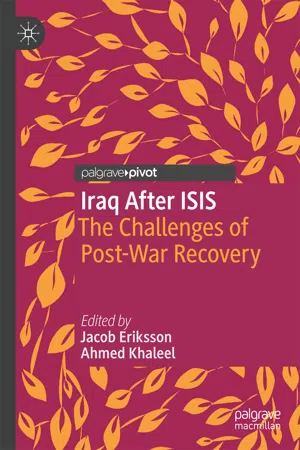
This book explores the challenges of creating a secure and stable Iraq in the wake of the military campaign against the Islamic State of Iraq and al-Sham (ISIS). Analyzing the impact of the fight against ISIS, the collection provides answers to questions relating to both political and humanitarian considerations in Iraqi post-war recovery. In their analysis, the editors and authors develop policy recommendations for the international and Iraqi political communities. It is essential reading for those interested in politics, international relations, post-war recovery, counter-terrorism, Middle Eastern studies and Iraqi studies scholars.
eBook - ePub
Iraq After ISIS
The Challenges of Post-War Recovery
- English
- ePUB (mobile friendly)
- Available on iOS & Android
eBook - ePub
Iraq After ISIS
The Challenges of Post-War Recovery
About this book
Information
© The Author(s) 2019
Jacob Eriksson and Ahmed Khaleel (eds.)Iraq After ISIS https://doi.org/10.1007/978-3-030-00955-7_11. Introduction
Jacob Eriksson1 and Ahmed Khaleel2
(1)
Department of Politics, University of York, York, UK
(2)
Department of Language and Linguistic Science, University of York, York, UK
Abstract
The political, social, economic, and physical recovery following armed conflict is an enormous challenge for any state, but particularly for Iraq, given its extensive history of authoritarianism, failed state-building, and conflict. While the territorial defeat of ISIS presents an opportunity to alter this violent course and address the root causes of violence, it will be a difficult process. This introductory chapter presents the main themes of the book, such as governance, inter- and intra-communal conflict, security, transitional justice, and elaborates on the contributions within it.
Keywords
Armed conflictPost-war recoveryIraqISISThere can be little doubt that armed conflict is a destructive phenomenon. As evidenced by the World Bank, the economic costs incurred take a serious toll on development. 1 In modern urbanised conflict environments, vital infrastructure is often badly damaged and reconstruction is a slow and expensive process. Although less easily quantifiable, the effect on social relations is just as damaging, creating grievances between individuals and whole communities. These add a fresh layer to pre-existing narratives which are central to precipitating conflict. This is also likely to occur in multi-ethnic societies where grievances such as deprivation, inequality, and neglect are waiting to be triggered for violent political purposes.
Rather than acting as an institutional form of conflict resolution, post-war politics often accentuate and perpetuate divisions. Incentives for magnanimous behaviour and moderation are not always clear. Armed conflict alters power dynamics and enables certain stakeholders to rise to prominence and consolidate gains at the expense of others. When longstanding structures engraved in the collective mind for decades are dismantled, such sudden change can bring unexpected and disastrous consequences by ushering in new conflicts. How to engage effectively with different communities affected by the impact of sudden change to long-cultivated structures is perhaps the greatest challenge post-war strategies face.
However, post-war contexts also present opportunities for positive change. Rather than simply recreating the conditions that created conflict, if stakeholders are willing to think critically about the causes of conflict and address grievances on all sides, then there is the possibility to create a more durable, peaceful political and social order. Violence perpetrated without limits can be replaced by the rule of law and institutions that protect the rights of all citizens. This is a challenging task which involves addressing multiple different, often conflicting and seemingly incompatible, interests.
In the wake of the military campaign against the Islamic State of Iraq and al-Sham (ISIS), Iraq is at a critical juncture. This book aims to analyse the political, economic, and social challenges that the Iraqi state now faces, and how these need to be addressed in order to avoid the resurgence of extremism, renewed radicalization, and repeated armed conflict. Together, the different contributions seek to learn from the past and look to the future by considering the complex interests of local, regional, and international actors, and where they overlap, intersect, and diverge. Perspectives are provided on each of the three main communities in Iraq: the Shia, the Sunni, and the Kurds. How, if at all, does each community see its future as part of a unified Iraqi state? What are the key issues that affect them? What are the intra-group dynamics, debates, and conflicts that are most salient for understanding these communities? As history has shown, Iraq is also a focal point for regional and international security. While the global challenge of jihadist extremism will, as Burke argues, remain, the comprehensive defeat of ISIS in Iraq and the construction of something positive on its ruins can contribute substantially to the tarnishing of the wider brand and its appeal. 2
The book begins by considering the legacy of post-2003 Iraq, as the emergence of ISIS was rooted in the failure of state-building following the fall of Saddam Hussein. A legacy of authoritarianism, wars with Iran (1980–1988) and an international coalition (1991), followed by thirteen years of crippling sanctions and economic mismanagement left a profoundly difficult base to build from. Nonetheless, the implementation of key decisions by the Coalition Provisional Authority (CPA) and the Shia-dominated Iraqi state which emerged complicated the task even further. Collective punishment of the Sunni community through processes like de-Ba’athification created disenfranchisement and dislocation from the Iraqi state, which opened the door for the more extremist voices of first al-Qaeda in Iraq and then ISIS to be heard.
In their chapter, Simon Mabon and Ana Maria Kumarasamy analyse this period through Agamben’s theoretical framework of “bare life”, examining how this marginalisation occurred and its disastrous effects. As someone involved in the transitional justice system which played a key role in this, Mohammed Ihsan offers his critical assessment of these processes and how they contributed to these negative dynamics. Ahmed Khaleel also reflects on the difficult position of Iraqi Sunnis during this period. Many have been trapped between Sunni extremists and the state (and associated militias), forced to make difficult decisions to ensure survival. While the militias of the Hashd al-Sha’bi or Popular Mobilisation Units (PMU) are celebrated by the Iraqi government as a force fighting ISIS (many call them “The Holy PMU”), the Sunni Sahwa (Awakening) tribal militia known as the “Sons of Iraq” that fought al-Qaeda and expelled them from Anbar province in 2007 were not afforded the same acceptance or status. They were eventually left to face the retaliation of ISIS , where hundreds of them were killed. 3 Now, division is rife at the political level, with widespread disillusionment about senior Sunni politicians and their ability to serve the interests of the people.
As Iraqis now attempt to rebuild yet again, the challenges are formidable. The United Nations Office for the Coordination of Humanitarian Affairs (UNOCHA) estimates that roughly 6 million Iraqis have been displaced since 2014, and at the time of writing, around 2.6 million Iraqis remain displaced and 8.7 million continue to be in need of humanitarian assistance. 4 In her chapter based on her work on the ground in Iraq with Amnesty International, Razaw Salihy analyses the devastating impact the war against ISIS has had on Iraqi civilians. For many, conditions remain dire amidst an ongoing humanitarian crisis, worsened by continuing security concerns and revenge attacks. Even after the initial defeat of ISIS forces in liberated areas, the destruction and killing did not necessarily cease. When it took control of Tikrit in June 2014, ISIS systematically executed hundreds of Shia army recruits stationed at Camp Speicher. In return, in Amerli and Tikrit, the PMUs destroyed hundreds of Sunni residential buildings and abducted many Sunni civilians in acts of revenge against perceived sympathisers. 5 While some local Sunni militias also participated in such acts, the predominantly sectarian agenda of the Shia militias has profoundly damaging implications for inter-communal relations.
Hayder al-Khoei analyses the situation of the ascendant Iraqi Shia, considering in particular the Shia-dominated PMU, intra-Shia politics, and the influence of Iran. Mobilised by the fatwa of Grand Ayatollah al-Sistani to defend the Iraqi people from ISIS , the Iranian-backed PMUs have risen to prominence and played a key military role at the expense of the weak Iraqi army. To many Iraqis, they are the saviours of the nation who stood up to fight when needed; to others, they are overtly sectarian militias who exact violent revenge against innocent Iraqis with impunity. While the PMUs have been recognised by law as an extra-ministerial body responsible directly to the Prime Minister, their role within the future Iraqi security sector is an open question.
While the Kurdish peshmerga defended their people from ISIS advances and halted their progress, they have also contributed to the suffering of civilians. Peshmerga have destroyed the homes of Sunni Arabs in areas that they wish to incorporate into a future Kurdish state and have denied displaced Sunnis the opportunity to return. 6 In his chapter, Amjed Rasheed considers the position of the Kurds, analysing the history of the relationship between the Kurdistan Regional Government (KRG) and the central government in Baghdad, and its ambiguous future. Iraqi Kurds have enjoyed autonomy from Baghdad since 1991, but their prominent role in the post-2003 Iraqi government and the role of the peshmerga in the fight against ISIS has raised hopes of fulfilling long held dreams of an independent Kurdish state.
In a referendum on 25 September 2017, Kurds voted overwhelmingly for independence from Iraq, but this has been vehemently rejected by Baghdad. In an ongoing conflict between the KRG and the central government, a tense standoff in the oil-rich city of Kirkuk (the spiritual home of Iraqi Kurds) was temporarily resolved by a Kurdish decision to withdraw from practically all of the disputed territories it had captured in the face of advancing PMU and Iraqi security forces. 7 Initially poised to make considerable political and territori...
Table of contents
- Cover
- Front Matter
- 1. Introduction
- 2. Da’ish, Stasis and Bare Life in Iraq
- 3. Transitional Justice in Iraq After 2003
- 4. The Future of the Iraqi Sunni Arabs
- 5. The Kurdish Cause in Iraq: From the Second Republic to the Fall of Kirkuk (2003–2018)
- 6. Terror and Torment: The Civilian Journey to Escape Iraq’s War Against the “Islamic State”
- 7. Al-Hashd al-Sha‘bi: Iraq’s Double-Edged Sword
- 8. International and Regional Dimensions of Iraq’s Post-ISIS Recovery
- 9. Conclusion
- Back Matter
Trusted by 375,005 students
Access to over 1.5 million titles for a fair monthly price.
Study more efficiently using our study tools.
Frequently asked questions
Yes, you can cancel anytime from the Subscription tab in your account settings on the Perlego website. Your subscription will stay active until the end of your current billing period. Learn how to cancel your subscription
No, books cannot be downloaded as external files, such as PDFs, for use outside of Perlego. However, you can download books within the Perlego app for offline reading on mobile or tablet. Learn how to download books offline
Perlego offers two plans: Essential and Complete
- Essential is ideal for learners and professionals who enjoy exploring a wide range of subjects. Access the Essential Library with 800,000+ trusted titles and best-sellers across business, personal growth, and the humanities. Includes unlimited reading time and Standard Read Aloud voice.
- Complete: Perfect for advanced learners and researchers needing full, unrestricted access. Unlock 1.5M+ books across hundreds of subjects, including academic and specialized titles. The Complete Plan also includes advanced features like Premium Read Aloud and Research Assistant.
We are an online textbook subscription service, where you can get access to an entire online library for less than the price of a single book per month. With over 1.5 million books across 990+ topics, we’ve got you covered! Learn about our mission
Look out for the read-aloud symbol on your next book to see if you can listen to it. The read-aloud tool reads text aloud for you, highlighting the text as it is being read. You can pause it, speed it up and slow it down. Learn more about Read Aloud
Yes! You can use the Perlego app on both iOS and Android devices to read anytime, anywhere — even offline. Perfect for commutes or when you’re on the go.
Please note we cannot support devices running on iOS 13 and Android 7 or earlier. Learn more about using the app
Please note we cannot support devices running on iOS 13 and Android 7 or earlier. Learn more about using the app
Yes, you can access Iraq After ISIS by Jacob Eriksson, Ahmed Khaleel, Jacob Eriksson,Ahmed Khaleel in PDF and/or ePUB format, as well as other popular books in Politics & International Relations & Middle Eastern Politics. We have over 1.5 million books available in our catalogue for you to explore.