eBook - ePub
The New Mountaineer in Late Victorian Britain
Materiality, Modernity, and the Haptic Sublime
- English
- ePUB (mobile friendly)
- Available on iOS & Android
eBook - ePub
The New Mountaineer in Late Victorian Britain
Materiality, Modernity, and the Haptic Sublime
About this book
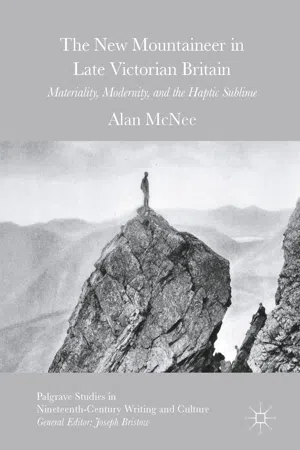
This book is about the rise of a new ethos in British mountaineering during the late nineteenth century. It traces how British attitudes to mountains were transformed by developments both within the new sport of mountaineering and in the wider fin-de-siècle culture. The emergence of the new genre of mountaineering literature, which helped to create a self-conscious community of climbers with broadly shared values, coincided with a range of cultural and scientific trends that also influenced the direction of mountaineering. The author discusses the growing preoccupation with the physical basis of aesthetic sensations, and with physicality and materiality in general; the new interest in the physiology of effort and fatigue; and the characteristically Victorian drive to enumerate, codify, and classify. Examining a wide range of texts, from memoirs and climbing club journals to hotel visitors' books, he argues that the figure known as the 'New Mountaineer' was seen to embody a distinctly modern approach to mountain climbing and mountain aesthetics.
Information
© The Author(s) 2016
Alan McNeeThe New Mountaineer in Late Victorian BritainPalgrave Studies in Nineteenth-Century Writing and Culture10.1007/978-3-319-33440-0_11. Introduction
Alan McNee1
(1)
London, UK
In 1898 the Scottish mountaineer John Norman Collie coined the term from which this book takes its title. ‘The progressive, democratical finger of the “New Mountaineer” is laid with equal irreverence and mockery on Sgurr nan Gillean and Cir Mhor’, Collie wrote.1
The details of Collie’s protest (in essence, that contemporary climbers were dismissive of the challenges and charms of the Cuillin mountains on the Isle of Skye) are obscure now, but his use of the term ‘New Mountaineer’ remains significant. The New Mountaineer may never have joined the New Woman or the New Journalism in the lexicon of fin-de-siècle Britain, but Collie’s belief that a paradigm shift had taken place in the culture of British mountaineering, and that climbers were approaching their activity in a new spirit, was shared by a number of influential writers. This book is about that shift. It examines the profound changes that took place in British mountaineering in the latter part of the nineteenth century, exemplified by the figure of the New Mountaineer, and discusses how attitudes to mountains in this period were transformed by developments both within the recreation of mountaineering and in the wider culture.
Perhaps the most important of the former was the emergence of the new genre of mountaineering literature, which helped to create a self-conscious community of climbers with broadly shared values and attitudes. Meanwhile various cultural and scientific trends influenced the direction of mountaineering. These included a growing preoccupation with the physical basis of aesthetic sensation, and with physicality and materiality in general; a new interest in the physiology of effort and fatigue; and a characteristically Victorian drive to enumerate, codify, and classify.
This book attempts to trace these developments, and to show how they affected the direction of mountaineering. In the pages that follow, I examine a wide range of literature, including a number of sources that have been ignored in most previous studies of the topic. These include the journals of British mountaineering clubs established several decades after the better-known Alpine Club, and visitors’ books from hotels and inns where climbers stayed in Scotland, the English Lake District, and Wales. Through these and many other texts, including memoirs, diaries, and guidebooks, I show how a new approach to mountain climbing emerged in the period from around 1870, and how this was represented in contemporary accounts. I also question to what degree the New Mountaineer represented a real change in the practice of climbing and to what extent he was a product of mountaineering literature itself. I examine critiques and defences of the New Mountaineer, discuss the terms in which mountain experiences were represented, and suggest that an emphasis on physical contact with the quiddity of mountain landscapes became the dominant mode of discussing climbing in late-Victorian Britain. I also argue that, as Romantic discourses about mountains became marginalized, so the physicality and athleticism that replaced them gave rise to a new version of the sublime.
Mountaineering in late-Victorian Britain was one of the characteristic hobbies of the intellectual and commercial elite. This new recreation had a cultural significance that was disproportionate to the relatively small number of people who pursued it actively, and as we shall see writing about mountaineering has a history almost as old as the activity itself. However it is only since the middle of the twentieth century that writers on the sport’s history have begun to analyze the causes or wider significance of the growth of mountaineering. Historians have generally interpreted climbing in one of several ways: as a manifestation of a new approach to risk; as an expression of imperialism; as an instance of the importance of manliness; or in the light of changing class and gender relations.
These are all legitimate and productive lines of enquiry. My own starting point, however, has been to question the very notion of a typical, representative Victorian mountaineer. Many previous accounts of nineteenth-century climbing have tended to elide the differences between the generations of climber who began the sport in the 1850s and those who were climbing towards the end of the century. Instead of assuming that mountaineers were a single group with a coherent, consistent set of values and attitudes, it is more helpful to talk of a multiplicity of narratives and a variety of different Victorian climbers with different attitudes and stated reasons for climbing.
A discernible shift in approach began around 1870, and continued to the end of the century. The climbers of this period had a distinct identity quite different from that of their predecessors in the fifties and sixties. One of my aims in this study has been to look closely at how accounts by mountaineers change over the course of the period from around 1870 to the end of the century, and how they differ from earlier climbing narratives, and to rethink the language of mountaineering. I have been careful to distinguish between the experiences of mountaineers and more general tourist accounts of mountain travel, and I have identified some of the contradictions and paradoxes in mountaineering literature and the different approaches taken by a range of writers. I have also investigated to what degree mountaineering was affected by the wider culture in which climbers operated, and to what extent it constituted a hermetically sealed subculture of its own.
I explore the New Mountaineer and his world over five chapters. Chapters 2 and 3 discusses the sporting, recreational approach that characterized the New Mountaineer, involving disciplines such as mapping and navigation, physical training, photography, and the specialized use of ropes and ice axes. I show how contemporaries regarded this as qualitatively different from the values of the early days of mountaineering, when recreational climbers had supposedly been heavily influenced by the legacy of Romantic writing. I then show another side of this picture by suggesting that these differences were often exaggerated or simplified by late nineteenth-century mountaineering writers. Many mountaineers from the 1850s and even earlier were in fact climbing with a similar attitude to that of the New Mountaineers. For the first generation of British mountaineers, adventure had often been just as powerful a motive as romantic transcendence. Conversely, many climbers in the late nineteenth century were still deeply influenced by Romantic attitudes. I suggest the New Mountaineer was as much a product of the narrative of mountaineering literature as of the praxis of mountain climbing. At the same time, I show that climbers in the late nineteenth century were increasingly confident in claiming that their direct physical engagement with mountains gave them a privileged experience of wild nature not available to the more casual mountain tourist or other observer.
Chapter 4, ‘The Climbing Body’, is concerned with physicality, and connects the New Mountaineer to the wider scientific, medical, and cultural preoccupations of late-Victorian society. I discuss the arguably unprecedented pleasure that climbers were able to take in sensations traditionally considered undesirable, including fatigue, cold, exposure to danger, and discomfort, and I suggest that these are linked to an idea of embodied perception that is central to the ethos of mountaineering at this time. Chapter 5, ‘The Haptic Sublime’, shows how this new approach leads, paradoxically, to a resurgence of the aesthetic of the sublime. However, this new, reinvigorated sublime is qualitatively different from eighteenth-century and Romantic discourses about wild nature. The haptic sublime involves an emphasis on direct physical experience and embodied understanding of mountain landscapes. The mountaineers of this period insisted on the greater intensity and precision of their experience of mountains, which was closely related to the physical nature of their encounters with rock face, glacier, and snow slope.
In Chapter 6, I examine how these new values and beliefs were potentially threatened by the phenomenon of mass tourism to mountain regions, and the strategies – both in the practice of mountaineering and its literature – that were adopted to deal with the threat. Mountaineers looked down on and resented the figure of the cockney tourist or tripper, but they also saw him as subversive of some of their most cherished values. Tourism altered both the physical and psychological landscape in which climbers pursued their hobby.
Before examining these topics, it will be helpful to set out the prehistory of the New Mountaineer. By the time Collie coined the term, mountaineering was already well established as a leisure activity. Eminent Victorians including Leslie Stephen, John Tyndall, Herbert Spencer, John Ruskin, and Martin Conway all contributed to the debate about the purpose and direction of mountaineering. However their prominence and the high level of public interest in mountaineering in this period make it easy to forget just how new this activity was, and how different the Victorian approach to mountains was to that of previous ages. In order to understand how radically different the activity of climbing became from the 1870s, we need to be familiar first with mountaineering’s relatively short history, and secondly with its literature. These will be summarized in the next two sections.
Victorian Mountaineering Historicized
Mountaineering as a recognized leisure activity, undertaken from sporting rather than from scientific motives, really only began in earnest in the middle of the nineteenth century. The formation of the Alpine Club in London in 1857, and the journals it started to publish from the end of that decade, gave shape to this new activity and propelled it into the wider public consciousness. Prior to this period, mountaineering had scarcely existed other than as the preserve of specialist scientists and a few adventurous travellers. Most recreational ascents of mountains in the early nineteenth century were limited to Mont Blanc (climbed because it was the highest summit in the Alps), Snowdon, Ben Nevis, and a few Lakeland peaks. To put the increase in climbing activity in the nineteenth century into perspective: by 1800, only about twenty-two major Alpine peaks had been scaled, a figure whi...
Table of contents
- Cover
- Frontmatter
- 1. Introduction
- 2. The Rise of the New Mountaineer
- 3. Resisting the New Mountaineer
- 4. The Climbing Body
- 5. The Haptic Sublime
- 6. ‘Trippers’ and the New Mountain Landscape
- 7. Conclusion
- Backmatter
Trusted by 375,005 students
Access to over 1.5 million titles for a fair monthly price.
Study more efficiently using our study tools.
Frequently asked questions
Yes, you can cancel anytime from the Subscription tab in your account settings on the Perlego website. Your subscription will stay active until the end of your current billing period. Learn how to cancel your subscription
No, books cannot be downloaded as external files, such as PDFs, for use outside of Perlego. However, you can download books within the Perlego app for offline reading on mobile or tablet. Learn how to download books offline
Perlego offers two plans: Essential and Complete
- Essential is ideal for learners and professionals who enjoy exploring a wide range of subjects. Access the Essential Library with 800,000+ trusted titles and best-sellers across business, personal growth, and the humanities. Includes unlimited reading time and Standard Read Aloud voice.
- Complete: Perfect for advanced learners and researchers needing full, unrestricted access. Unlock 1.5M+ books across hundreds of subjects, including academic and specialized titles. The Complete Plan also includes advanced features like Premium Read Aloud and Research Assistant.
We are an online textbook subscription service, where you can get access to an entire online library for less than the price of a single book per month. With over 1.5 million books across 990+ topics, we’ve got you covered! Learn about our mission
Look out for the read-aloud symbol on your next book to see if you can listen to it. The read-aloud tool reads text aloud for you, highlighting the text as it is being read. You can pause it, speed it up and slow it down. Learn more about Read Aloud
Yes! You can use the Perlego app on both iOS and Android devices to read anytime, anywhere — even offline. Perfect for commutes or when you’re on the go.
Please note we cannot support devices running on iOS 13 and Android 7 or earlier. Learn more about using the app
Please note we cannot support devices running on iOS 13 and Android 7 or earlier. Learn more about using the app
Yes, you can access The New Mountaineer in Late Victorian Britain by Alan McNee in PDF and/or ePUB format, as well as other popular books in Literature & British History. We have over 1.5 million books available in our catalogue for you to explore.