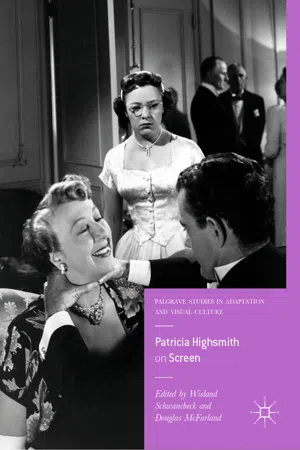
This book is the first full-length study to focus on the various film adaptations of Patricia Highsmith's novels, which have been a popular source for adaptation since Alfred Hitchcock's Strangers on a Train (1952). The collection of essays examines films such as The Talented Mr. Ripley, The Two Faces of January, and Carol, includes interviews with Highsmith adaptors and provides a comprehensive filmography of all existing Highsmith adaptations. Particular attention is paid to queer subtexts, mythological underpinnings, philosophical questioning, contrasting media environments and formal conventions in diverse generic contexts. Produced over the space of seventy years, these adaptations reflect broad cultural and material shifts in film production and critical approaches to film studies. The book is thus not only of interest to Highsmith admirers but to anyone interested in adaptation and transatlantic film history.
eBook - ePub
Patricia Highsmith on Screen
- English
- ePUB (mobile friendly)
- Available on iOS & Android
eBook - ePub
Patricia Highsmith on Screen
About this book
Information
Subtopic
Film & Video© The Author(s) 2018
Wieland Schwanebeck and Douglas McFarland (eds.)Patricia Highsmith on ScreenPalgrave Studies in Adaptation and Visual Culturehttps://doi.org/10.1007/978-3-319-96050-0_11. Introduction: Patricia Highsmith on Screen
Douglas McFarland1 and Wieland Schwanebeck2
(1)
Flagler College, St. Augustine, FL, USA
(2)
TU Dresden, Dresden, Germany
It’s Murder at the Movies!
Patricia Highsmith’s third novel, The Blunderer (1954), opens with a fateful flight from the movies. Bookstore owner Melchior Kimmel buys a ticket for a film called Marked Woman, 1 even though he is oblivious to its sexed-up poster and, for that matter, to the film itself (TB 1). 2 Kimmel is merely looking for an alibi, timing his arrival at the theater so that he will be seen by people before sneaking out again to go through with his plan for killing his wife. The two existing adaptations of the novel flesh out the scene in different ways: Claude Autant-Lara’s Le meurtrier ( Enough Rope , 1963) presents Kimmel’s trip to the cinema as a flashback that may or may not be imagined by Walter, his antagonist, during his own excursion to a movie-theater, and due to the medium’s lack of introspection, it remains for the viewer to decide whether Kimmel (whose thick-lensed glasses suggest that he is unlikely to get much pleasure out of anything visual) is executing a carefully hatched plan, or whether it is the film that triggers his murderous rage. Andy Goddard’s A Kind of Murder (2016), by contrast, runs with Highsmith’s original concept, with Eddie Marsan playing a far more cold-blooded version of Kimmel, who makes sure the other patrons notice him entering a screening of BUtterfield 8 (1960). Still, the nexus between going to the movies and committing murder is equally present here, an impression that is supported by the credits which are laid over Kimmel’s entrance into the theater: they inform the viewers that they are watching “a KILLER FILMS production”.
The scene is an apt emblem of Patricia Highsmith’s own rather ambivalent attitude towards cinema, an institution of which she remained notoriously suspicious. Not only was she reported to generally dislike the movies (including those based on her novels), she remained a firm opponent of television (Schenkar 2009, 275), though both media provided a regular source of income for her throughout almost half a century. But there was not much love lost between Highsmith and the adaptation industry; it arguably remained a passionless marriage of convenience. If Kimmel (a bookworm reluctantly drawn from his natural habitat) seeks out the movie theatre to prepare for the kill, Highsmith occasionally did the same in order to make a killing, and the two endeavors sometimes conflate in her work. Howard Ingham, the protagonist in The Tremor of Forgery (1969), is a novelist who travels to Tunisia to try his hand at a movie script (in spite of knowing that “film scripts, even television plays, were not his forte”, 4), but he ends up killing someone with his typewriter—an event that appears to inconvenience him mainly because the typewriter will need a repair job (TOF 102). Highsmith may have found the dark humor in writing for the screen, yet her tempestuous reactions to the films based on her works strongly suggest that the process of being adapted was rather painful to her.
Highsmith’s books have always served as a popular source for film adaptations. There has been no decade without at least one new Highsmith adaptation in the United States as well as in Europe since Alfred Hitchcock turned her debut novel, Strangers on a Train (1950), into his classic suspense film of the same name (1951). The list of directors who have adapted Highsmith includes renowned filmmakers like Liliana Cavani , Claude Chabrol , Todd Haynes , Anthony Minghella , and Wim Wenders , which means that studying a cinema based on Highsmith affords plenty of opportunities to assess the work of particular auteurs and their methods and approaches. These adaptations provide a cross-section of adaptation strategies that reflect shifts in moral ethos, industry practices, cinematic movements, gender politics, and different media representations. The longevity of Highsmith’s popularity as a source for adaptation opens up the possibility for dialogue between adapters—for instance, when Claude Chabrol makes a film of The Cry of the Owl ( Le cri du hibou , 1987), he may be more interested in the Hitchcockian motif of voyeurism than in adapting Highsmith. 3 At the most extreme, this approach produces ‘indirect’ adaptations of her work which go so far as to obliterate her signature altogether, no doubt encouraged by Hitchcock’s characteristic appropriation of source material.
In addition to opening up a dialogue between individual filmmakers (rather than just between Highsmith and her adapters), this book addresses the different adaptive strategies, the evolution of film noir (including its themes and aesthetics across different time periods and filmmaking-traditions), queer identity politics, and the fragility of genre conventions which are simultaneously enacted and subverted in Highsmith adaptations. While these films owe a considerable intertextual debt to influential 1950s auteurs like Hitchcock or Douglas Sirk , they do not simply follow in their footsteps, and thus cannot simply be categorized as new iterations of well-known genres. What we call a Highsmith adaptation entails a degree of adaptation in a different sense of the word, as characters like the highly adaptable Tom Ripley (see Schwanebeck 2013), not to mention Highsmith’s various other murderous con men, adapt to traditional scripts (of identity, class, gender, and genre) but expose them to be hollow and out of date. Highsmith films reflect this state of affairs through various adaptive and aesthetic strategies, and their glossy, period-drama surface is often deceptive. The way they repeatedly revolve around the notions of (identity) forgery and criminality (themes which are addressed in various chapters of this book) suggests that there is, ultimately, something criminal about the very idea of adaptation to begin with, as Thomas Leitch emphasizes in his opening chapter.
Highsmith’s thematic focus on adaptation itself (especially in the generic context of film noir) extends to the notions of crime and illicit desires, which makes the films resonate significantly with paradigms as diverse as noir, queer cinema, and melodrama. At their core, Highsmith adaptations are psychological thrillers in which the façade of respectability is always threatened with the eruption of violence and the discovery of skeletons in the closet, and in their own way, they reiterate the rise of postwar noir with their stories of everymen who allow themselves to be corrupted when opportunity knocks. In the process of adaptation, the postwar political subtexts of Highsmith’s heroes may not exactly have been obliterated—even Wenders’ dreamlike Highsmith homage The Million Dollar Hotel (2000) is a portrait gallery of America’s forgotten, subaltern subjects of the postwar era—yet they are often buried, palimpsest-like, underneath layers of postmodern playfulness. By a curious coincidence, Steven Spielberg’s Saving Private Ryan (1998), the quintessential story of All-American heroism, casts three actors in the squadron of upright young soldiers who would subsequently play Tom Ripley. 4 There is a certain logical consistency to this curious constellation, not least because the spectrum of the actors’ roles suggests historical continuity. The men returning from the war would advance to become the high achievers of the postwar era, yet watching Matt Damon take off James Ryan’s uniform and put on Tom Ripley’s (borrowed) Princeton jacket a year later provokes a nightmarish thought that always resonates as subtext in contemporary melodrama about phonies: “the possibility that the idea of the unique American individual was not just hiding beneath a phony mask, but rather no longer existed at all” (Cheever 2010, 7); an idea that permeates Mad Men (2007–2015) as much as it does Sloan Wilson’s Man in the Gray Flannel Suit (1955), published the same year as the first Ripley novel and an intriguing companion piece to the latter. 5
This kind of cultural environment produces a characteristic branch of film noir in the postwar years, on which Highsmith leaves her own characteristic stamp. In typical noir fashion, her novels firmly reject the idea ...
Table of contents
- Cover
- Front Matter
- 1. Introduction: Patricia Highsmith on Screen
- 2. The Dark Side of Adaptation
- Part I. Doubles, Copies, and Strangers
- Part II. Queer Encounters
- Part III. Aesthetic, Mythic, and Cultural Transactions
- Part IV. In Conversation with the Adapters
- Correction to: Patricia Highsmith on Screen
- Back Matter
Trusted by 375,005 students
Access to over 1.5 million titles for a fair monthly price.
Study more efficiently using our study tools.
Frequently asked questions
Yes, you can cancel anytime from the Subscription tab in your account settings on the Perlego website. Your subscription will stay active until the end of your current billing period. Learn how to cancel your subscription
No, books cannot be downloaded as external files, such as PDFs, for use outside of Perlego. However, you can download books within the Perlego app for offline reading on mobile or tablet. Learn how to download books offline
Perlego offers two plans: Essential and Complete
- Essential is ideal for learners and professionals who enjoy exploring a wide range of subjects. Access the Essential Library with 800,000+ trusted titles and best-sellers across business, personal growth, and the humanities. Includes unlimited reading time and Standard Read Aloud voice.
- Complete: Perfect for advanced learners and researchers needing full, unrestricted access. Unlock 1.5M+ books across hundreds of subjects, including academic and specialized titles. The Complete Plan also includes advanced features like Premium Read Aloud and Research Assistant.
We are an online textbook subscription service, where you can get access to an entire online library for less than the price of a single book per month. With over 1.5 million books across 990+ topics, we’ve got you covered! Learn about our mission
Look out for the read-aloud symbol on your next book to see if you can listen to it. The read-aloud tool reads text aloud for you, highlighting the text as it is being read. You can pause it, speed it up and slow it down. Learn more about Read Aloud
Yes! You can use the Perlego app on both iOS and Android devices to read anytime, anywhere — even offline. Perfect for commutes or when you’re on the go.
Please note we cannot support devices running on iOS 13 and Android 7 or earlier. Learn more about using the app
Please note we cannot support devices running on iOS 13 and Android 7 or earlier. Learn more about using the app
Yes, you can access Patricia Highsmith on Screen by Wieland Schwanebeck, Douglas McFarland, Wieland Schwanebeck,Douglas McFarland in PDF and/or ePUB format, as well as other popular books in Media & Performing Arts & Film & Video. We have over 1.5 million books available in our catalogue for you to explore.