eBook - ePub
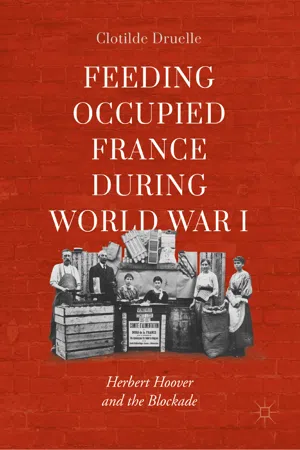
Feeding Occupied France during World War I
Herbert Hoover and the Blockade
- English
- ePUB (mobile friendly)
- Available on iOS & Android
eBook - ePub
About this book
This book examines the history of Herbert Hoover's Commission for Relief in Belgium, which supplied humanitarian aid to the millions of civilians trapped behind German lines in Belgium and Northern France during World War I. Here, Clotilde Druelle focuses on the little-known work of the CRB in Northern France, crossing continents and excavating neglected archives to tell the story of daily life under Allied blockade in the region. She shows how the survival of 2.3 million French civilians came to depend upon the transnational mobilization of a new sort of diplomatic actor—the non-governmental organization. Lacking formal authority, the leaders of the CRB claimed moral authority, introducing the concepts of a "humanitarian food emergency" and "humanitarian corridors" and ushering in a new age of international relations and American hegemony.
Information
© The Author(s) 2019
Clotilde DruelleFeeding Occupied France during World War Ihttps://doi.org/10.1007/978-3-030-05563-9_11. Herbert C. Hoover: The American Epic
Clotilde Druelle1
(1)
Department of History, University of Limoges, Limoges, France
In 1959, four decades after the end of the Great War, the 31st President of the USA, Herbert Clark Hoover (1874–1964), published the first part of An American Epic, a set of documents and comments on the work of American, private or governmental organizations, with which he was associated during his long public life. The four volumes cover nearly half a century; they span the two world wars and the postwars periods. In its totality, the work bears witness to the remarkable perseverance of a man to rescue threatened civilian populations from annihilation by war and hunger, first in Europe, then in Asia. The first Volume, Relief of Belgium and Northern France 1914–1930, inaugurates the series.
That first volume concerns Belgian and French territories that were occupied from the summer of 1914 to the fall of 1918.1 Why was it written by a Republican President of the USA, who was disliked in both the USA and France? Why did Hoover link Belgium with France? What is known about the living conditions, or, rather, the survival of more than two million civilians, who remained in the ten French Departments totally or partially occupied during the Great War and isolated from the rest of the country, and where the occupier refused to relieve the civilians with foodstuff and essential supplies? What was the material daily life like in industrial areas under the Allied blockade , a region highly dependent before the war on imported sources of supply? Whole sections of the history of the First World War in France remain unrecognized, the history of material supplies in particular. This is even truer of the occupied territories running for the most part from Lille to Saint-Mihiel. It is this history of the supply of France invaded during the Great War, with its international, national, and regional implications, that this book examines.
Supplying in time of war means bringing weapons, ammunition, and the commodities needed for consumption. It is to provide food and fodder, raw materials, gasoline, coal and energy, clothing, footwear, medicines, etc. to the military, their mounts, and the civilian population. In practical terms, this means solving problems of procurement, transport, equitable distribution, and immediate or deferred settlement of purchases. These missions, carried out by civilians and the military, by private and public entities, in emergency and under a disorganization of the peacetime economic and financial systems, involved fluctuating territories, and multiple continents, seas, and oceans.
The subject of these complex logistics is for the historian numerous and not easy to determine and verify. Not all materials and documents survived. Ad hoc bodies were established during the first conflict to satisfy the broader supply needs of civilians and the military. Unfortunately, the shifting fortunes of offices and sub-secretariats to different ministries, with tasks terminated often brutally at the end of the war, resulted in the disappearance of a significant and non-quantifiable part of the archive. To date, reference studies on the economic aspects of the Great War in Europe remain those drafted in the 1920s at the request of James T. Shotwell, Director of the Carnegie Endowment for International Peace. Alain Chatriot is not wrong to speak of “a true economic and social encyclopedia of war,”2 referencing about 150 volumes of the European series, of which 36 concern France alone.
Fields of History Intersect at Supply
In seeking to understand an unreported aspect of the period 1914–1918, this research encompasses several countries and multiple fields of history. It has been necessary to bring them into resonance, which, at times, is complex given the number of relations to be established and organized in the chaos of interdependence at work in a global war: the fields of humanitarian history, of international relations and transnational mobilizations, of the USA and the assertion of its hegemony at the beginning of the twentieth century, of civilians in war and war against civilians, of the mobilization of national and international public opinion, and, of course, the economic and financial history and that of the management of organizations. This work therefore also aims to contribute to illuminating these domains of history.
While war primarily involves states, their relations, and policies, this study focuses on an object that is difficult to identify and categorize around the new actors in 1914. The transnational qualifier could apply to the Commission for Relief in Belgium (CRB) and its networks brought together by Herbert Hoover in its mission to supply the occupied regions.3 The Great War is the moment of emergence of non-state diplomatic actors, not without links to the political authorities in their place of origin, but heavily invested in humanitarian action.4 The acts of the personalities involved and of the organizations constituted are part of the beginnings of International Humanitarian Law and its history.5 Herbert Hoover and the CRB are the opening chapter. The International Committee of the Red Cross (ICRC), founded in 1863, foreshadowed this movement. It addressed the wounded of the battlefield before extending to military and civilian prisoners. The CRB, very different in its form, introduced the humanitarian food relief and its internationalization. Voluntarily and without status, it flew its own flag and invented what are today called “humanitarian corridors.” The signatures of its directors were recognized by governments, both belligerent and neutral. The CRB, whose leaders were improvised diplomats, and who had no formal authority, signed conventions with the civil and military authorities, who thus considered themselves engaged. The role of CRB officials cannot be considered to be simply that of intermediaries. They seized the vital interests of civilian populations in the name of higher moral interests. They were only partially mandated, in a second phase, by governments with respect to which they retained a freedom by virtue of appreciation. Louis Chevrillon , the French delegate of the CRB, summarized the aim pursued by Hoover in creating the CRB: “To keep body and mind together.” That organization belongs to this early age of contemporary humanitarianism and participated in the construction of a complex national and transnational humanitarian rhetoric.6 The CRB was instrumental in the diplomacy and international relations of the First World War and its aftermath as a non-governmental actor. It built its legitimacy on the basis of moral and even religious precepts and its service continuing after the Armistice indicated its concrete achievements through economic, financial, and managerial expertise. The CRB was thus a diplomatic agent of a new type and a pioneering humanitarian organization. After 1918, its influence projected into a development of aid and relief programs first in Europe and then into the foundations of the great American philanthropy7 or associations such as the Joint Distribution Committee,8 the American Friends Service Committee of the American Quakers 9 to which Hoover was bound. All of them opened the way to the multiplication of non-governmental organizations (NGO) and international organizations after the Second World War.
Our study also draws attention to the status of the neutrality of countries, organizations, and individuals involved in the field of International Relations and Humanitarian Aid. Neutrality deserves to be reconsidered in its meaning and its role in the conflicts of the twentieth century. It is not synonymous with non-intervention. The Netherlands , at the center of the supply system for all the belligerents of the Western European front of the Great War, is an exemplary case of the meaning and transformations of the conditions for the exercise of neutrality in the first decades of the twentieth century.10
The intersection of International Relations, the domestic and foreign policy histories of the USA, Herbert Hoover’s war years, and the work of the CRB framed the ideology and mechanisms of the political American hegemonic project. Aid to people and countries is part of it. It is hypothesized that it was during and at the end of the Great War that relief was perceived as an instrument of internal and external policy and as a means of promoting international reform. Hoover’s career proves this. As an expatriate businessman in 1914, by 1920 he had become a personality coveted at the same time by the Democrat and Republican machines. Until March 1933, when Roosevelt became president, he had never left the front-page of American news. He remained active behind the scenes until the reconstruction of the post-Second World War era. From 1917, his personal trajectory was joined by the US engagement with the Allies and the international affirmation of the country, which was, after 1919, all too often underestimated on the European side of the Atlantic as isolationist. The war experiences as the Director of the CRB allowed him to dictate his demands to the Republican Administrations of the 1920s, conditioned his own Administration and influenced his vision of what aid should be to Europe both after 1918 and after 1945. Without drawing a line too long and too straight, it is recalled that from the position of Secretary of Commerce, Hoover intervened in all the diplomatic portfolios of the postwar period. It is found in each of the chapters of Joan Hoff Wilson’s study of the relationship between business and foreign policy.11 Yet making Hoover a defender of particular economic interests would be a mistake. Hoover had a political, moral, and social mission. This is not unlike that of Woodrow Wilson . He had become one of his close associates and devoted a study to him.12
The history of supplying occupied territories is also the history of civilians. We know the violence suffered by the French and Belgian populations in 1914, when the German Armies thought they were dealing with an armed resistance of “francs-tireurs” (snipers). The experience of civilians during the wars of the nineteenth and twentieth centuries has been abundantly and grimly documented. It has become a specific field of research, echoing wars with each other. When the cannons thundered in August 1914, the first international conferences in The Hague of 1899 and 1907 on the laws of war and war crimes had just ended, but leaving many questions unresolved. What about the application of the blockade to food? The supply of civilians generally and of those who were occupied in particular? The case of Belgium and Northern France reveals inadequate plans to protect civilians, which are in direct conflict with the strategic, diplomatic, and political stakes of the war. To what extent should a belligerent sacrifice its own population, and that of its Allies, in order to hasten the weakening, even the annihilation of the enemy and the end of the conflict? The question—so familiar to our ears—arose in London, Paris, Berlin, and Washington. The responses fluctuated according the course of the war and the balance of power. The vastly different national and civilian experiences of the Great War will remain perennially in the memories and will be taken into account by those who do not share the feeling that it was “the war to end all wars.” The work Adam Tooze devoted to analyze the construction of Nazi-Germany’s economy provides ample evidence.13
This study also contributes to the history of public opinion and its consideration by governments. Encompassing hunger and its torment, civilian populations taken hostage, violence, de...
Table of contents
- Cover
- Front Matter
- 1. Herbert C. Hoover: The American Epic
- 2. The Occupation of Belgium and Northern France
- 3. The Significance of the Royal Navy’s Blockade of Europe
- 4. The Progressive Coordination of the Supply
- 5. Occupied France: Administration, Protection, and Validation
- 6. Time of Contradictions: Supply in the Heart of the Total War Spring 1917–Fall 1918
- 7. The “End of Innocence,” 1918–1919
- Back Matter
Trusted by 375,005 students
Access to over 1.5 million titles for a fair monthly price.
Study more efficiently using our study tools.
Frequently asked questions
Yes, you can cancel anytime from the Subscription tab in your account settings on the Perlego website. Your subscription will stay active until the end of your current billing period. Learn how to cancel your subscription
No, books cannot be downloaded as external files, such as PDFs, for use outside of Perlego. However, you can download books within the Perlego app for offline reading on mobile or tablet. Learn how to download books offline
Perlego offers two plans: Essential and Complete
- Essential is ideal for learners and professionals who enjoy exploring a wide range of subjects. Access the Essential Library with 800,000+ trusted titles and best-sellers across business, personal growth, and the humanities. Includes unlimited reading time and Standard Read Aloud voice.
- Complete: Perfect for advanced learners and researchers needing full, unrestricted access. Unlock 1.5M+ books across hundreds of subjects, including academic and specialized titles. The Complete Plan also includes advanced features like Premium Read Aloud and Research Assistant.
We are an online textbook subscription service, where you can get access to an entire online library for less than the price of a single book per month. With over 1.5 million books across 990+ topics, we’ve got you covered! Learn about our mission
Look out for the read-aloud symbol on your next book to see if you can listen to it. The read-aloud tool reads text aloud for you, highlighting the text as it is being read. You can pause it, speed it up and slow it down. Learn more about Read Aloud
Yes! You can use the Perlego app on both iOS and Android devices to read anytime, anywhere — even offline. Perfect for commutes or when you’re on the go.
Please note we cannot support devices running on iOS 13 and Android 7 or earlier. Learn more about using the app
Please note we cannot support devices running on iOS 13 and Android 7 or earlier. Learn more about using the app
Yes, you can access Feeding Occupied France during World War I by Clotilde Druelle in PDF and/or ePUB format, as well as other popular books in History & French History. We have over 1.5 million books available in our catalogue for you to explore.