This volume presents insights from five years of intensive Holocaust, genocide, and mass atrocity education at Queensborough Community College (QCC) of the City University of New York (CUNY), USA, to offer four approaches—Arts-Based, Textual, Outcomes-Based, and Social Justice—to designing innovative, integrative, and differentiated pedagogies for today's college students. The authors cover the theoretical foundations of each approach, and include faculty reflections on the programs, instructional strategies, and student reactions that brought the approaches to life across the disciplines.
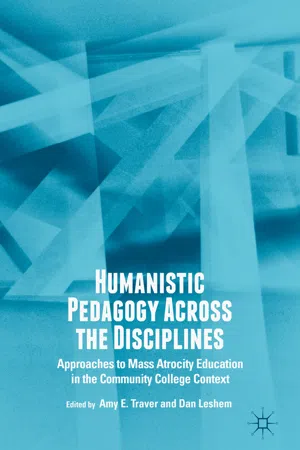
eBook - ePub
Humanistic Pedagogy Across the Disciplines
Approaches to Mass Atrocity Education in the Community College Context
- English
- ePUB (mobile friendly)
- Available on iOS & Android
eBook - ePub
Humanistic Pedagogy Across the Disciplines
Approaches to Mass Atrocity Education in the Community College Context
About this book
Information
Topic
EducationSubtopic
Education Theory & Practice© The Author(s) 2018
Amy E. Traver and Dan Leshem (eds.)Humanistic Pedagogy Across the Disciplineshttps://doi.org/10.1007/978-3-319-95025-9_11. Introduction: Humanistic Pedagogy Across the Disciplines—Approaches to Mass Atrocity Education in the Community College Context
Dan Leshem1
(1)
Harriet and Kenneth Kupferberg Holocaust Center (KHC), Queensborough Community College, CUNY, Bayside, NY, USA
Dan Leshem
As the drive for universal Holocaust education became a widespread phenomenon in the late 1970s, there were many provocative discussions in public forums about how, what, when, and why such content should be taught. Early debates sought to establish a core curriculum or canon of texts, what qualifications instructors should have, and whether Holocaust memory should remain solely within the realm of disciplines such as history and Jewish studies, or if they have a broader and more universal context. This very important, early discussion largely settled around a fixed solution: The Diary of Anne Frank would be taught in middle schools, Elie Wiesel’s Night would be taught in high school, and post-secondary Holocaust education would largely be the domain of history and literature departments. In addition, instruction at all levels would be heavily supplemented by survivor testimony, ideally through in-person rather than video testimony.1 For the past 40 years, in other words, Holocaust victims and survivors , through the moral, ethical, and humane immediacy of their first-person accounts, have been our most effective Holocaust educators.
Considering the age of remaining survivors, it is with pragmatic—yet unresolved—anxiety that Holocaust educators and center directors search for a solution to the following question: How will we teach the Holocaust in the absence of any direct witnesses? Although largely silent and ignored for years after the war, Holocaust survivors have become its most effective and transformative educators over the past several decades. The impact of their presentations to students of all ages is palpable in their audiences’ intellectual and emotional reactions, not only in the immediate moments after the sharing of Holocaust testimony but weeks and even months later in course evaluations and assignments. While the fallibility of survivor memory has been oft noted—especially in terms of details such as dates and precise locations—the truths that they tell are different from those available in contemporaneous documents, photographs, and even diaries. They speak to the human experience of global, national, and local suffering at the hands of other human beings and, at times, the destruction of human beings. Crucially, they speak about their own experiences, in the first person , transforming all their listeners into what has been called “secondary witnesses” (Assmann 2006, 269). Through their narratives we become witnesses to both “inhuman” atrocity and human resilience.
Survivors have also provided a moral compass for Holocaust education by being among the first to advocate that scholars turn away from debates of the uniqueness of the Holocaust and toward the holistic inclusion of a full spectrum of instances of genocide and mass atrocity, especially in the twentieth and twenty-first centuries. This shift in emphasis—which does nothing to diminish the importance of the Holocaust nor obscure those elements of its development, execution, and aftermath that were sui generis and are therefore genuinely unique—is crucial for ensuring the future of Holocaust education, developing the potential to recognize and interrupt societies that are moving toward genocide, and deriving lessons for ourselves and our students about how to become agents of societal change. All of these concerns are at the heart of the humanities curriculum.
Without a doubt, survivor voices—in society in general and in the classroom in particular—have propelled the scholarship and teaching of genocide, mass atrocity, and human rights into a central focus of humanities education. In a sense, Holocaust survivors have taught us how to hear survivors of other genocidal experiences and sensitized us to the traumatic impact of mass atrocity that ripples geographically and generationally from a local context to a global audience. One must bear in mind, however, that Holocaust survivor testimony resonates so profoundly in the United States due to a variety of social, cultural, historical, and religious factors, and might resonate very differently or not at all with students from different educational backgrounds such as recent immigrants from Africa, Asia, and Central and South America. This is not to say that these regions have no specific and local history of genocide and mass atrocity, but rather that a lack of prior exposure to the history of the Holocaust might leave students from these regions at a loss to understand the importance American culture ascribes to the Nazi genocide. For these reasons as well, the expansion of the focus of traditional Holocaust education to a more global understanding of the causes and consequences of genocide and mass atrocity allows students to enter the discussion from the atrocities most proximal to their background and experiences. In other words, if the Holocaust is to be discussed and taught globally, it must be understood in a global context utilizing a Humanistic Pedagogy—teaching practices that emphasize students’ sustained engagement with the most profound challenges of human being, such as humanity’s tendency to create massively violent societies as well as remarkably resilient individuals and cultures.
The NEH/KHC Colloquium Series at Queensborough Community College
Humanistic Pedagogy in the Community College Context
Community colleges have long been at the forefront of transformational pedagogical innovations. In fact, community colleges were fertile ground for the development of Holocaust and genocide pedagogy, giving rise to the first Holocaust courses and centers in the late 1970s and early 1980s.2 Queensborough Community College (QCC) of the City University of New York (CUNY) is home to the Harriet and Kenneth Kupferberg Holocaust Center (KHC), one of the first college-based Holocaust resource centers in the country. The KHC launched in 1983 following years of collecting teaching and learning resources and developing classroom-based practices appropriate to post-secondary education. Over the intervening decades, it has grown into an archive of Holocaust artifacts, a library of over 6000 volumes, an exhibition space that has featured over 30 originally researched exhibits, a center for student learning through internships and fellowships, and a programmatic hub that each year hosts more than 30 events for the campus community and general public.
Significantly, community colleges are an ideal place to establish and test Humanistic Pedagogical practices, in particular. Community colleges are primarily teaching institutions that serve the neediest students—those who have been underserved by underperforming secondary schools, the newest immigrants, and those closest to the poverty level. In order to reach these student bodies in ways that will sustain a lifelong commitment to the ideals of a humanistic education, community college instructors typically leverage their research training and teaching interests to innovate post-secondary pedagogy, often engaging in experimentation designed to meet the needs of ever-evolving student populations. This is especially true at QCC, where, as of the latest statistics, over 400 full-time faculty members—80% of whom have terminal degrees—along with additional part-time and contingent instructors serve 16,000 students who hail from over 129 countries and speak nearly 70 non-English languages at home (QCC Office of Institutional Research and Assessment 2016). Many QCC students themselves came to this country as refugees if not asylum seekers . As is typical with community college students, many QCC students are also “non-traditional” in that “when compared to their baccalaureate-seeking counterparts, who are frequently considered the norm in higher education, (they) are more likely to be older, working, parenting, low-income, female , of color, and of first-generation college and/or American status” (Traver and Katz 2014). Since community colleges are open-enrollment institutions, many QCC students also have developmental education needs in math, reading, and/or writing, in addition to their English language learning challenges. In other words, QCC, like most community colleges, is a teaching and learning laboratory where research-trained faculty work innovatively to provide transformative educational opportunities to students from diverse ethnic, educational, class, linguistic , and cultural backgrounds. These Humanistic Pedagogies, and the transformative learning they support, will become increasingly relevant and even essential at four-year colleges and universities as student expectations evolve along with student populations.
The Initial Hypothesis
For these reasons—to explore possible futures of Holocaust and genocide education in a world without Holocaust survivors and to meet the evolving demands of diverse student populations in higher education—the KHC sought funding from a National Endowment for the Humanities (NEH) Community College Challenge grant in 2010. NEH intended the grant opportunity to identify and fund six national demonstration programs that would develop best practices in incorporating campus-based cultural centers into the humanities curriculum across the disciplines. College-based Holocaust centers around the country consistently struggle to engage faculty around their pedagogical content and approach. This proposal innovated that model by recruiting and supporting faculty to be the thought partners who would themselves create the pedagogical content based on the mission and holdings of the KHC. It envisioned broad, interdisciplinary engagement by faculty throughout the college who would align their ongoing courses with one or more of the colloquium events to deepen their students’ learning in classes across campus. Peer-to-peer collaboration—between the faculty coordinators of each annual colloquium and their colleagues within and outside of their departments—would allow instructors to test the value of their pedagogical innovations through integration...
Table of contents
- Cover
- Front Matter
- 1. Introduction: Humanistic Pedagogy Across the Disciplines—Approaches to Mass Atrocity Education in the Community College Context
- Part I. Approaches to Mass Atrocity Education in the Community College Context: Theoretical Foundations and Programmatic Examples
- Part II. Approaches to Mass Atrocity Education in the Community College Context: Course-Based Examples
- Back Matter
Trusted by 375,005 students
Access to over 1.5 million titles for a fair monthly price.
Study more efficiently using our study tools.
Frequently asked questions
Yes, you can cancel anytime from the Subscription tab in your account settings on the Perlego website. Your subscription will stay active until the end of your current billing period. Learn how to cancel your subscription
No, books cannot be downloaded as external files, such as PDFs, for use outside of Perlego. However, you can download books within the Perlego app for offline reading on mobile or tablet. Learn how to download books offline
Perlego offers two plans: Essential and Complete
- Essential is ideal for learners and professionals who enjoy exploring a wide range of subjects. Access the Essential Library with 800,000+ trusted titles and best-sellers across business, personal growth, and the humanities. Includes unlimited reading time and Standard Read Aloud voice.
- Complete: Perfect for advanced learners and researchers needing full, unrestricted access. Unlock 1.5M+ books across hundreds of subjects, including academic and specialized titles. The Complete Plan also includes advanced features like Premium Read Aloud and Research Assistant.
We are an online textbook subscription service, where you can get access to an entire online library for less than the price of a single book per month. With over 1.5 million books across 990+ topics, we’ve got you covered! Learn about our mission
Look out for the read-aloud symbol on your next book to see if you can listen to it. The read-aloud tool reads text aloud for you, highlighting the text as it is being read. You can pause it, speed it up and slow it down. Learn more about Read Aloud
Yes! You can use the Perlego app on both iOS and Android devices to read anytime, anywhere — even offline. Perfect for commutes or when you’re on the go.
Please note we cannot support devices running on iOS 13 and Android 7 or earlier. Learn more about using the app
Please note we cannot support devices running on iOS 13 and Android 7 or earlier. Learn more about using the app
Yes, you can access Humanistic Pedagogy Across the Disciplines by Amy E. Traver, Dan Leshem, Amy E. Traver,Dan Leshem in PDF and/or ePUB format, as well as other popular books in Education & Education Theory & Practice. We have over 1.5 million books available in our catalogue for you to explore.