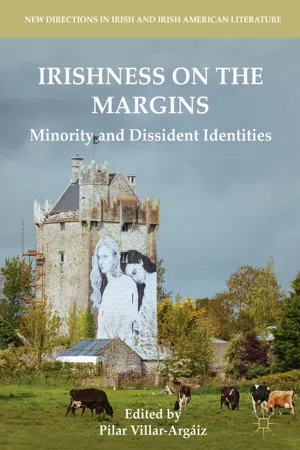
This collection examines the presence of minority communities and dissident voices in Ireland both historically and in a contemporary framework. Accordingly, the contributions explore different facets of what we term "Irish minority and dissident identities," ranging from political agitators drowned out by mainstream narratives of nationhood, to identities differentiated from the majority in terms of ethnicity, religion, class and health; and sexual minorities that challenge heteronormative perspectives on marriage, contraception, abortion, and divorce. At a moment when transnational democracy and the rights of minorities seem to be at risk, a book of this nature seems more pressing than ever. In different ways, the essays gathered here remind us of the importance of 'rethinking' nationhood, by a process of denaturalisation of the supremacy of white heterosexual structures.
- English
- ePUB (mobile friendly)
- Available on iOS & Android
eBook - ePub
About this book
Information
© The Author(s) 2018
Pilar Villar-Argáiz (ed.)Irishness on the MarginsNew Directions in Irish and Irish American Literaturehttps://doi.org/10.1007/978-3-319-74567-1_11. Introduction: Irishness on the Margins—Minority and Dissident Identities
Pilar Villar-Argáiz1
(1)
Departmento de Filologías Inglesa y Alemana, University of Granada, Granada, Spain
Pilar Villar-Argáiz
In the first decade of the new millennium, Ireland entered what Bryan Fanning (2009, p. 179) called an ‘uncertain phase of cultural-economic nation building’. As many social scientists and cultural commentators have argued, key aspects of Irish national identity—the National Question (national reunification), Catholicism and anti-Britishness—have been considerably eroded since the beginning of the 1970s. Assumptions about politics based on the Civil War have been undermined by the rise of new parties with no roots in this period. Assumptions about a homogeneous nation have been eroded by the rapid growth of immigration . And assumptions about the unassailable position of the Catholic Church have been undermined by declining levels of piety, public scandals, the 2015 Referendum result on same-sex marriage and the moral claims made by minorities or survivor groups previously silenced (e.g. Justice for Magdalenes, Adoption Alliance Group). The visits in May 2011 of Queen Elizabeth II and President Barack Obama have also had a significant impact on the Irish national psyche. President Michael D. Higgins’s follow-up state visit to Buckingham Palace in 2014 (for which he was accompanied by Sinn Féin’s Martin McGuinness) has also been relevant in normalising Anglo-Irish relations. At the same time that some old certainties have been displaced, others have been resurrected. The scourge of mass emigration , which many thought had been consigned to the history books, has returned. With Brexit , as Fintan O’Toole (2017a) puts it, ‘[a]n island that has been bedevilled by great uncertainties of belonging is being forced to think again where it belongs in an even more uncertain geopolitical context’. The new global scenario seems to be torn between the defence of liberal, transnational democracy, and new ‘Trumpian’ narrow nationalisms. In this period of geopolitical instability, Yeats’s declaration in The Second Coming that ‘[t]hings fall apart, the centre cannot hold’ seems, once more, prescient.
As Devine (2011, p. ix) claims, it is at times, such as this, of political, social and economic turbulence, that ‘the perspectives and voices of those who are most “othered” or at risk of marginalisation need to be heard’. This edited collection aims to meet the challenges faced by Ireland now, by examining the presence of minority and dissident voices both historically and in a contemporary framework. In the process, the ways in which we define notions such as ‘Irishness’, ‘centre’/‘periphery’, ‘marginal’/‘mainstream’, ‘normative’/‘non-standard’, and ‘majority’/‘minority’ are thoroughly re-examined so as to better accommodate the current polymorphous setting of the island.
The present collection appears at a time of heightened interest in the sociocultural context of minority voices in Ireland, as evidenced by recent publications on contemporary cultural diversity, the integration of immigrant communities and the development of Irish multicultural identities.1 Building on previous studies such as Literary Visions of Multicultural Ireland (Villar-Argáiz 2014a; an edited collection which dealt, for the first time, with literary representations of immigrants in contemporary Irish literature), the book presented here does not focus only on immigrants; it also expands the scope of analysis to other forms of minorities in Ireland, such as Travellers , poor people, mentally ill people or gay and lesbian communities. Furthermore, the book seeks to provide a fuller picture of minority existence than that which is generally offered by scattered articles and studies, by combining literary studies to include aspects of cultural studies in the broadest sense, and by adding a new layer of analysis: dissidence .
This collection is also timely as it focuses on the dynamics of change occurring ‘outside’ and ‘inside’ Ireland’s minority groups at a crucial moment in Ireland when recent events have destabilised the way in which otherness is treated both socially and institutionally. In February 2013, the Irish state issued a historic and emotionally charged apology to survivors of the Magdalene Laundries (setting up a €54 million compensation scheme). In May 2015, Ireland passed a referendum allowing same-sex marriages, marking a turning point in the public acceptance of some minority communities in Ireland.2 On 1 March 2017, Travellers were formally recognised—in a statement to the Dáil—as a distinct ethnic minority group (O’Halloran and O’Regan 2017). The election of Leo Varadkar —the homosexual son of an immigrant doctor from Bombay—as Ireland’s Taoiseach (after he was voted Leader of the Fine Gael Party on 2 June 2017), has been understood—mostly at an international level—as a symbol of the country’s emancipation from a constraining clerical past, in a progressive movement towards the more inclusive accommodation of ethnic and sexual minorities in all areas of public and political life.3 Furthermore, the country is now enmeshed (as are other European countries) in the ongoing negotiations and debates about opening its doors to political refugees. This collection sheds some light upon the tensions entailed in endeavours such as these to accommodate diversity and minority demands.
The title of this collection of essays, Minority and Dissident Identities, needs some clarification at this point. To start with, we define minorities as those identities differentiated from the majority in terms of ethnicity , race , religion , gender, class , health or sexual orientation.4 The other term used in the title, ‘dissidence’ , is intended to connote opposition to hegemonic political, social and sexual structures. By linking both concepts in the title, we intend to stress the interconnections normally established between minority voices and dissident voices. Dissidence is usually connected with those people who do not fit neatly into the grand scheme of things.5 Although not necessarily, circles of resistance tend to appear at the heart of minority groups which are discontented with their treatment by official standards. Indeed, the dissident voices traced in this collection display sensitivity to minority grievances and demands. Some of these voices are minorities within minorities themselves; on the one hand, they are distanced from the majority by their inclusion in the minority group; on the others, they are differentiated from their peers in that minority group by their dissidence and rebellion. One case in point is Panti Bliss, the well-known Irish Drag Queen, whose recent struggle for recognition and against discrimination singled her out among the LGBT community.
Accordingly, the contributions presented here explore different facets of what we term ‘Irish minority and dissident identities’, a phrase we employ in order to refer to the following:
- 1.Political agitators and dissident voices which have been drowned out by the mainstream narratives of Irish nationhood: such as the writer Eimar O’Duffy , a captain in the Irish Volunteers who was highly critical of the Easter Rising (the subject of Keating’s article); or Jimmy Gralton , a leading figure in the Revolutionary Workers’ Group of the 1930s which later led to the Irish Communist Party (the subject of Ojrzyńska’s article).
- 2.Identities differentiated from the majority in terms of religion , class and health: for example, the Muslim community (the object of study in Louvet’s, and Azeez and Aguilera-Carnerero’s contributions); Protestants; Travellers (Ireland’s oldest minority group,6 a category which also includes ethnic differentiation); and poor and mentally ill people (the subjects of O’Malley’s contribution).
- 3.Sexual minorities and dissident identities that challenge heteronormative perspectives on marriage, contraception , abortion and divorce : for example, women facing a crisis pregnancy and undergoing an abortion (Nault’s contribution); activists who fight for lesbian and gay equality and against LGBT oppression and homophobia in Ireland (Woods’s contribution); and unwed mothers and pregnant girls in the Magdalene Laundries (O’Donnell’s, and Benítez-Castro and Hidalgo-Tenorio’s contributions);
- 4.Ethnic minorities and different types of non-Irish migrants, ranging from asylum seekers and political refugees to the so-called economic migrants (the contributions by Alfaro-Hamayon, Gonzalez-Casademont and Martín-Ruiz).
It is also important to stress that these contributions explore the themes of dissidence and minorities in Ireland from various theoretical frameworks, including post-structuralist and postmodernist theories (e.g. Michel Foucault ); post-colonial theories, queer studies and feminist ethical philosophy (particularly as the latter pertains to epistemology that is the generation of knowledge); as well as critical theories of transnationalism and community in the visual arts, critical discourse analysis , corpus linguistics and contemporary Irish critical thought. Such a multidisciplinary approach allows us to complete the kaleidoscopic picture of what can easily be considered univocally as the ‘minority’ voice. Furthermore, the varied range of disciplines represented in this collection (feminism, literary studies, cultural studies, sociological studies) reflects, in Crosson’s words, ‘the evolution of Irish Studies itself as a focus of academic enq...
Table of contents
- Cover
- Front Matter
- 1. Introduction: Irishness on the Margins—Minority and Dissident Identities
- Part I. Unearthing Dissidence in the Irish Past
- Part II. Sexual Minorities and Dissident Gendered Subjects
- Part III. Minority Voices in Irish Public Discourse
- Part IV. The Dissent of Minority Voices in Art
- Back Matter
Trusted by 375,005 students
Access to over 1.5 million titles for a fair monthly price.
Study more efficiently using our study tools.
Frequently asked questions
Yes, you can cancel anytime from the Subscription tab in your account settings on the Perlego website. Your subscription will stay active until the end of your current billing period. Learn how to cancel your subscription
No, books cannot be downloaded as external files, such as PDFs, for use outside of Perlego. However, you can download books within the Perlego app for offline reading on mobile or tablet. Learn how to download books offline
Perlego offers two plans: Essential and Complete
- Essential is ideal for learners and professionals who enjoy exploring a wide range of subjects. Access the Essential Library with 800,000+ trusted titles and best-sellers across business, personal growth, and the humanities. Includes unlimited reading time and Standard Read Aloud voice.
- Complete: Perfect for advanced learners and researchers needing full, unrestricted access. Unlock 1.5M+ books across hundreds of subjects, including academic and specialized titles. The Complete Plan also includes advanced features like Premium Read Aloud and Research Assistant.
We are an online textbook subscription service, where you can get access to an entire online library for less than the price of a single book per month. With over 1.5 million books across 990+ topics, we’ve got you covered! Learn about our mission
Look out for the read-aloud symbol on your next book to see if you can listen to it. The read-aloud tool reads text aloud for you, highlighting the text as it is being read. You can pause it, speed it up and slow it down. Learn more about Read Aloud
Yes! You can use the Perlego app on both iOS and Android devices to read anytime, anywhere — even offline. Perfect for commutes or when you’re on the go.
Please note we cannot support devices running on iOS 13 and Android 7 or earlier. Learn more about using the app
Please note we cannot support devices running on iOS 13 and Android 7 or earlier. Learn more about using the app
Yes, you can access Irishness on the Margins by Pilar Villar-Argáiz in PDF and/or ePUB format, as well as other popular books in Literature & European Literary Criticism. We have over 1.5 million books available in our catalogue for you to explore.