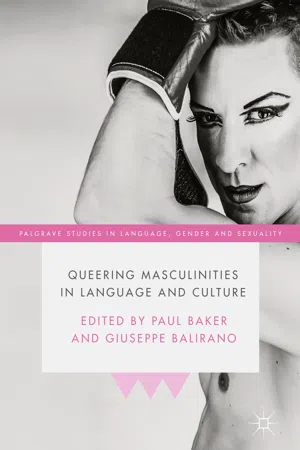
How do we learn what it means to be a man? And how do we learn to question what it means to be a man? This collection comprises a set of original interdisciplinary chapters on the linguistic and cultural representations of queer masculinities in a range of new and older media: television, film, online forums, news reporting, advertising and fiction. This innovative work examines new and emerging forms of gender hybridisation in relation to complex socialisation and immigration contexts including the role of EU institutions in ascertaining asylum seekers' sexual orientation, and the European laws on gender policy. The book employs numerous analytical approaches including critical discourse analysis, corpus linguistics, multimodal analysis, literary criticism and anthropological and social research. The authors show how such texts can disrupt, question or complicate traditional notions of what it means to be a man, queering the idea that men possess fixed identities or desires, instead arguing that masculinity is constantly changing and negotiated through the cultural and political overlapping contexts in which it is regularly produced. These nuanced analyses will bring fresh insights for students and scholars of gender, masculinity and queer studies, linguistics, anthropology and semiotics.
eBook - ePub
Queering Masculinities in Language and Culture
- English
- ePUB (mobile friendly)
- Available on iOS & Android
eBook - ePub
Queering Masculinities in Language and Culture
About this book
Information
© The Author(s) 2018
Paul Baker and Giuseppe Balirano (eds.)Queering Masculinities in Language and CulturePalgrave Studies in Language, Gender and Sexualityhttps://doi.org/10.1057/978-1-349-95327-1_11. Introduction
Giuseppe Balirano1 and Paul Baker2
(1)
Literary, Linguistic and Comparative Studies, University of Naples “L’Orientale”, Naples, Italy
(2)
Linguistics and English Language, Lancaster University, Lancashire, UK
Paul Baker
1 Queer masculinities: By Way of Introduction
This collection brings together diverse experiences, views, and studies stemming from original interdisciplinary research on different linguistic and cultural representations of queer masculinities in new and old media . It is a timely contribution towards ongoing research on changing representations of men and masculinities in contemporary academic studies. Each of the self-contained chapters in the volume is bound into a specific frame of reference enhancing a series of examinations on the ways that masculinities intersect with queer identities and practice s . The diverse authors who contributed to the book have analysed the representation of “queer” social actors from the perspective of gender studies, with the benefit of approaches and insights from masculinity and queer studies, linguistics , anthropology, and semiotics. Queering masculinities aims to promote a range of integrated approaches, particularly those relating to emerging ways of signifying contemporary masculinities and relating constraints, stereotypes , and prejudices within English-speaking contexts by addressing issues concerning gender in linguistic, literary, social, and cultural contexts. Hence, the book entails several analytical approaches spanning from critical discourse analysis and multimodal analysis to literary criticism and anthropological and social research.
The editors’ original idea was to spark academic discourse relating to the existence of and/or resistance to non-hegemonic masculinities in order to acknowledge and foster further analyses of diverse, complementary, and/or contrasted gender identities (Connell 1995). Since masculinity is traditionally seen as one half of a mutual and binary identity construal (along with femininity), it is only through its relationship with other linguistically, semiotically, and socially construed instances of identity that contemporary dominant tropes on masculinity can be produced. The representation of hegemonic masculinity as a form of power by consent and/or power through dominance can, indeed, only gain real authority via its dichotomous interaction with the very concept of femininity , mainly in the ways that femininity serves to outline what masculinity is not (Balirano 2014). Therefore, when “kindliness”, “mildness”, and “passivity” are stereotypically labelled as feminine attributes, the typical masculine traits will necessarily be marked by corresponding antonyms such as “harshness”, “aggressiveness”, and “domination”. Those forms of gender stereotypes and roles are damaging to men as maintained by one of the earliest studies dealing with the negative consequences of gender stereotypes and roles:
According to Fasteau , men are socially expected to be strong , aggressive, confident, and in control of all situations at all times. Since many men find it difficult to live up to this masculine ideal, they may feel a loss of self-esteem, overcompensate with “machismo ” or super-masculinity , or constantly pretend to be something they are not. Men are allowed less flexibility in gender role modelling than women: pre-pubescent females can be “tomboys ”, but it is still not acceptable for males of the same age range to act like “sissies ”. Consequently, boys must learn not to cry when they are hurt and are often pushed into “male” activities regardless of their talents or preferences. Men are forced to prove—to themselves and to others—over and again—that they are masculine.The male machine is a special kind of being, different from women, children, and men who don’t measure up. He is functional, designed mainly for work. He is programmed to tackle jobs, override obstacles, attack problems, overcome difficulties, and always seize the offensive. He will take on any task that can be presented to him in a competitive framework. His most positive reinforcement is victory.He has armor plating that is virtually impregnable. His circuits are never scrambled or overrun by irrelevant personal signals. He dominates and outperforms his fellows, although without excessive flashing of lights or clashing of gears. His relationship with other male machines is one of respect but not intimacy; it is difficult for him to connect his internal circuits to those of others. In fact, his internal circuitry is something of a mystery to him and is maintained primarily by humans of the opposite sex. (Fasteau 1975: 2)
According to Messerschmidt (2012), masculinity is not always the consequence of physical power or male brutality ; it can also be seen as a discursive form of persuasion, a status each man should try and adopt in order to be empowered with those typical male features. Yet, this theorisation does not necessarily apply to those men who do not wish to align themselves with such a restrictive definition. Consequently, non-aligned forms of masculinity result in a constant re-interpretation of models at odds with prearranged schemes. Such dissident voices contribute to the construction of different stances which tend to undermine the very concept of masculinity. Novel and divergent processes of representation and re-configuration of the nature of manliness , seen as a social semiotic and widely shared construct, predictably mark a crisis point for hegemonic men.
When analysing masculinity as a relational construct, the hierarchies of power encompassing the different types of relationships among men must also be clearly identified. Kaufman (1994: 145) maintains that,
Conceptually, in any given society , men maintain hierarchical social roles over other men, as well as over other gender identities . Therefore, an investigation of masculinity cannot hinge on the study of a unique or homogeneous male identity unless we wish to incur the same charges made against some strands of feminist research. As Butler (1990: 3) has observed,[p]atriarchy exists as a system not simply of men’s power over women but also of hierarchies of power among different groups of men and between different masculinities.
Early masculinity theory has been frequently accused of essentialism since only the “essential” qualities of men were studied as those unique properties that make a man what he is. By privileging the concerns of white heterosexual middle-class men, terms like “men’s experience” and “masculinity” reify an over-generalised, homogeneous male population.there is a political problem that feminism encounters in the assumption that the term woman denotes a common identity. Rather than a stable signifier that commands the assent of those whom it purports to describe and represent, women, even in the plural, has become a troublesome term, a site of contest, a cause for anxiety .
Hegemony, then, concerns all possible kinds of masculinity, both those who make up its constituent members and those who either support or challenge it from the flanks. For that reason, Mort (1988: 195) aptly observed that “we are not dealing with masculinity, but with a series of masculinities” (his emphasis), since important factors such as class, race , sexual orientation , and many others are all essential in the construction of a man’s identity. Consequently, the very term “masculinities” must contemplate the fact that any two performances of so-called masculine traits will never perfectly overlap . As the sociologist Connell (2005: 37–38) asserts:
Perceiving diverse forms of masculinity is only a first step towards the recognition of manifold male representations. It is also necessary to observe the relations occurring among men. Men, and their diverse forms of masculinities, cannot only be defined in relation to other men and other masculinities, but also through the study of women or femininities. Consequently, masculinities are perhaps more accurately understood in terms of complex associations of traits belonging to multiple social actors .[t]o recognize diversity in masculinities is not enough. We must also recognize the relations between the different kinds of masculinity: relations of alliance, dominance, and subordination . These relationships are constructed through practices that exclude and include, that intimidate, exploit, and so on. There is a gender politics within masculinity.
The acknowledgement that there are several forms of masculinities must be combined with the recognition that, as, in his seminal study on masculinities, The Men and the Boys , Connell (2000: 10) puts it,
In much the same way as the identities, experiences, and practices of different groups of men and boys may vary widely, depending on factors such as age, race , culture, class, and sexual orientation , so too will their interests and forms of representation.different masculinities do not sit side-by-side like dishes on a smorgasbord. There are definite social relations between them. Especially there are relations of hierarchy, for some masculinities are dominant, while others are subordinated, marginalized.
Male power and dominance is not typically attained by means of brute force or by issuing threats, it is embedded, to use Connell ’s expression, in society and its apparatuses and institutions such as the mass media, church, and school. Any form of dominance entails persuasion—and here the media plays a significant role—the bulk of the population that certain social institutions are acceptable because they are seen as “normal” or even natural. Connell (2005: 77) argues that, at any particular point in time, “one form of masculinity rather than others is culturally exalted”, consequently the concept of “hegemonic masculinity” to refer to a particular variety of masculinity to which all others are subordinated.
Studies of hegemonic masculinity normally set out to identify a specific typology of men who thrive on power and wealth. Such research also attempts to explicate how the legitimacy of social relationships based on dominance often goes unquestioned. Culturally idealised forms of masculinity may not align with more standard forms generally practiced within a given society’s history, at a particular time. Furthermore, the actual personalities of the majority of men may have little in common with the cultural ideals of masculinity. Hegemony may, in fact, resort to fantasy characters to embody its parti...
Table of contents
- Cover
- Front Matter
- 1. Introduction
- 2. Is the Rectum a Gold Mine? Queer Theory, Consumer Masculinities, and Capital Pleasures
- 3. Masculinity and Gay-Friendly Advertising: A Comparative Analysis Between the Italian and US Market
- 4. Come and Get Your Love: Starsky & Hutch, Disidentification, and US Masculinities in the 1970s
- 5. The Televisual Representation of Ageing Gay Males: The Case of Vicious
- 6. The Queer Peer: Masculinity and Brotherhood in Cain and Abel Literature and Imagination
- 7. An Effortless Voice: Queer Vocality and Transgender Identity in Kim Fu’s For Today I Am a Boy
- 8. Painting Social Change on a Body Canvas: Trans Bodies and Their Social Impact
- 9. Neapolitan Social-Transgenderism: The Discourse of Valentina OK
- 10. Undoing Black Masculinity: Isaac Julien’s Alternative Grammar of Visual Representation
- 11. ‘You Cry Gay, You’re In’: The Case of Asylum Seekers in the UK
- 12. The Object of Subordination Is Immaterial: Discursive Constructions of Masculinity in a Far-Right Online Forum
- Back Matter
Trusted by 375,005 students
Access to over 1.5 million titles for a fair monthly price.
Study more efficiently using our study tools.
Frequently asked questions
Yes, you can cancel anytime from the Subscription tab in your account settings on the Perlego website. Your subscription will stay active until the end of your current billing period. Learn how to cancel your subscription
No, books cannot be downloaded as external files, such as PDFs, for use outside of Perlego. However, you can download books within the Perlego app for offline reading on mobile or tablet. Learn how to download books offline
We are an online textbook subscription service, where you can get access to an entire online library for less than the price of a single book per month. With over 1.5 million books across 990+ topics, we’ve got you covered! Learn about our mission
Look out for the read-aloud symbol on your next book to see if you can listen to it. The read-aloud tool reads text aloud for you, highlighting the text as it is being read. You can pause it, speed it up and slow it down. Learn more about Read Aloud
Yes! You can use the Perlego app on both iOS and Android devices to read anytime, anywhere — even offline. Perfect for commutes or when you’re on the go.
Please note we cannot support devices running on iOS 13 and Android 7 or earlier. Learn more about using the app
Please note we cannot support devices running on iOS 13 and Android 7 or earlier. Learn more about using the app
Yes, you can access Queering Masculinities in Language and Culture by Paul Baker, Giuseppe Balirano, Paul Baker,Giuseppe Balirano in PDF and/or ePUB format, as well as other popular books in Languages & Linguistics & Linguistics. We have over 1.5 million books available in our catalogue for you to explore.