This book examines the power held by the French medieval queens during the fourteenth and fifteenth centuries and their larger roles within the kingdom at a time when women were excluded from succession to the throne. Well before Catherine and Marie de' Medici, the last medieval French queens played an essential role in the monarchy, not only because they bore the weight of their dynasty's destiny but also because they embodied royal majesty alongside their husbands. Since women were excluded from the French crown in 1316, they were only deemed as "queen consorts." Far from being confined solely to the private sphere, however, these queens participated in the communication of power and contributed to the proper functioning of "court society." From Isabeau of Bavaria and her political influence during her husband's intermittent absences to Anne of Brittany's reign, this book sheds light on the meaning and complexity of the office of queen and ultimately the female history of power.
Murielle Gaude-FerraguQueenship in Medieval France, 1300-1500The New Middle Ages10.1057/978-1-349-93028-9_2
Begin Abstract
Chapter 1: Marrying the King
Murielle Gaude-Ferragu1
(1)
Université Paris-13, Sorbonne-Paris-Cité, Villetaneuse, France
End Abstract
During the sixth century in the Byzantine Empire, the marriage of the future Emperor Justinian (527-565 CE) was governed by a strange custom, whereby the bride Theodora—the daughter of a bear trainer—was chosen at a beauty contest he had organized.1
Far from this particular practice, the queens of fourteenth- and fifteenth-century France were all of noble blood and descended from the most important families in either Europe or the kingdom, thus presenting a concentration of theoretically irreproachable moral and religious qualities by dint of their birth and education. Their beauty was of little importance, at least for those who presided over the marriages. An official portrait—an established practice in France since at least the second half of the fourteenth century—was usually only sent after the engagement, serving as confirmation that negotiations had taken place and not as a preliminary to the union. It could be said that talk of a king falling in love with an image has only very rarely been verified. Some fine anecdotes have nonetheless been recounted. In 1385, Charles VI’s advisors deemed it time for the king to have a wife. Unable to choose between three potential brides, they sent a painter to do their portraits. Charles VI was said to have chosen Isabeau of Bavaria because he was charmed by her beauty.2
Whatever the reality, chroniclers were always careful to highlight how attractive the princess was, since physical beauty reflected that of the soul. Such beauty corresponded to precise aesthetic archetypes. A beautiful woman had long blond hair (like the Virgin Mary), an oval face, a dainty mouth, blue eyes and a slim waist.3
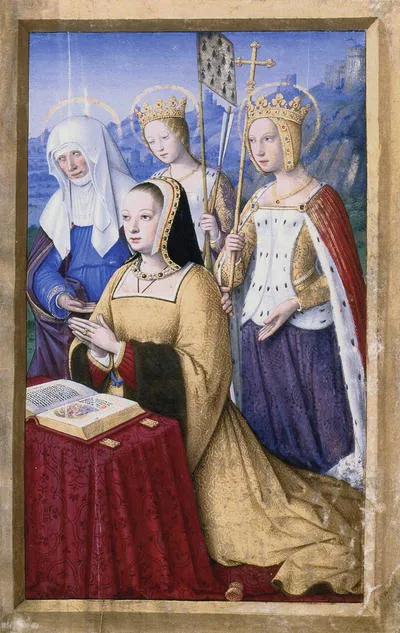
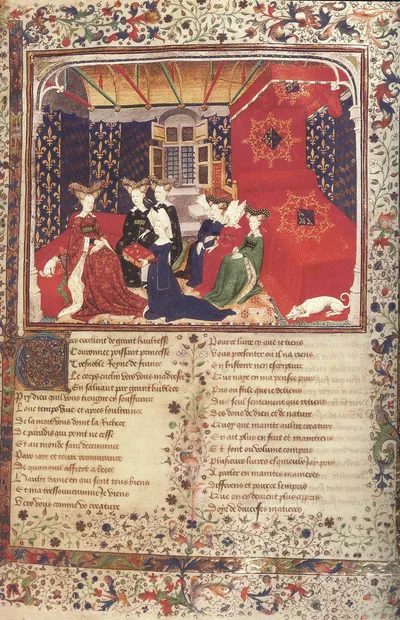
This traditional and stereotypical portrait often evaded the young woman’s actual physical characteristics. The courtly idealization of women remained a constant throughout the fifteenth century, whereas verism prevailed for men, whose flaws were not concealed but instead accentuated in order to render each of their faces even more unique. At the end of the fifteenth century, Jean Perréal and Jean Bourdichon, who ‘portraitured’ Anne of Brittany, offered an idealized vision of her physique (Fig. 1.1).4 Individualization did exist nonetheless, as the famous illumination depicting Isabeau of Bavaria (Fig. 1.2) attests. In this image, which decorated the title page of Christine de Pizan’s Collected Works (1414), the queen is depicted with a high forehead, a large mouth and a double chin, physical traits that are also found on her effigy at Saint-Denis. Marie of Anjou’s official portrait also reveals a few rather individual features, even if she has still been somewhat idealized.5
Fig. 1.1
Portrait of Anne of Brittany, Jean Bourdichon, Grandes Heures d’Anne de Bretagne (Tours, 1505-1508), Paris, BnF, Ms. Latin 9474, fol. 3.
Fig. 1.2
Isabeau of Bavaria, London, British Library, Ms. Harley 4431, fol. 3.
Marriages, which were fiercely negotiated, were thus primarily affairs of the state, responding to numerous diplomatic, territorial and dynastic imperatives.
Matrimonial Strategies
Reinforcing Alliances: Diplomacy in Action
Matrimonial unions belonged to the realm of courtly diplomacy, both foreign and French. They made it possible to establish alliances between the great houses of Europe and reinforced France’s position on the European chessboard.6 During the fourteenth century, sovereigns favored the princesses of the Holy Roman Empire, with John II marrying Bonne of Luxembourg and Charles VI marrying Isabeau of Bavaria. Indeed, the first Valois king Philip VI (whose legitimacy had long been questioned) had sought out a prestigious union for his eldest son John. His close friendship with the King of Bohemia, John of Luxembourg (also known as John the Blind, who died at Crécy in 1346), whom he had known since childhood, became a legal alliance thanks to the marriage of their respective children John (future John II the Good) and Guta (Bonne, as her Christian name was translated).7 In their marriage contract, which was signed in Fontainebleau in 1332, the military clauses were stipulated in detail (in the event of war, especially with England, the King of Bohemia would join the French royal army) along with the future bride’s dowry (120,000 florins). However, Bonne never became queen, falling ill with the black plague in 1349 and dying a year before John acceded to the French throne. Her son Charles V remained forever faithful to both her memory (wanting his entrails to be interred next to his mother’s body at Maubuisson Abbey) and the alliance with the prestigious House of Luxembourg, which became imperial when Bonne’s brother Charles IV acceded to the Empire in 1355.
‘Rapprochement’ with Germany was again promoted at the end of the fourteenth century. Elizabeth (who signed documents using her Gallicized name ‘Isabelle’, but who will be referred to here as Isabeau for the sake of historiographical convenience and despite the depreciative nature of the name) belonged to the powerful Wittelsbach family, who ruled over Bavaria and the Rhenish and Upper Palatinate. The daughter of Duke Stephen III of Bavaria-Ingolstadt, she spent her childhood in Munich. Her marriage to Charles VI, which was celebrated in 1385, was the result of a match desired by Philip the Bold, Duke of Burgundy, who wanted to forge a powerful alliance between the Houses of France and Bavaria.8
Peace and Reconciliation: Placatory Unions and Territorial Expansion
The aims of peace and reconciliation presided over alliances when a union was meant to establish harmony and seal diplomatic peace. Among the various forms of reconciliation between states, marriage occupied a central role by creating new ties between groups that had recently become related. The woman played a crucial role by conveying peace between the involved families and, if she was a princess, to the entire kingdom.9 In this respect, the duchy of Brittany, where a marriage meant to establish peace led to numerous territorial benefits for France, offers a particularly eloquent example.
War between the duchy and the kingdom had gone on for far too long. In February 1486, Duke Francis II of Brittany had his daughters Anne and Isabeau recognized as his sole legitimate heiresses. Since Louis XI had bought the rival Penthièvre family’s rights to the ducal crown, Charles VIII could legitimately lay claim to his Breton heritage. He further enforced his legal right with a military campaign that lasted nearly two years and ended with the Battle of Saint-Aubin-du-Cormier (July 1488). Defeated, Francis II died two months later. At the time, the principality was partly occupied by the royal army. The peace treaty (Treaty of Verger) stipulated that Anne could not marry without the king’s consent.
From 1488 to 1491, Anne of Brittany, surrounded by her council and notably her chancellor, Philip of Montauban, attempted to defend her rights by pursuing her father’s diplomatic strategy. Only 11 years old in 1488, she was still quite young, and her decisions were influenced—and even determined—by those close to her in the Breton party. She was crowned duchess in February 1489 at Saint-Pierre Cathedral in Rennes and married Maximilian of Austria, King of the Romans (December 1490), by proxy and without Charles VIII’s consent, hoping that her husband would provide her with military assistance—which ultimately never came. Anne was subsequently obliged to approach the king, who once more wanted to conquer the principality. In spring 1491, he was the undisputed master. His army had occupied the primary cities, and Breton resistance was collapsing. Marriage made it possible to establish a reconciliation between both parties and negotiate the duchy’s transfer to France, using the law instead of weapons.10
According to custom, a contract was first signed by both the spouses (Treaty of Langeais). It stated that Charles VIII was marrying Anne to maintain perpetual and indissoluble peace between the French crown and the duchy of Brittany. Anne, whom the king had declared her father’s sole heiress, named Charles—the new Duke of Brittany—her perpetual procurator. Should she die childless before her husband, she gave him her rights over the duchy. Charles declared the same: if he died before Anne without a living child, she would once more become the sole Duchess of Brittany on the condition that she remarry his successor, which she did by marrying Louis XII in 1499.
Reinforcing the Dynasty: Prestigious Blood Ties
With the change of branch in 1328, (the Valois line was a new “branch” of the Capetian lineage), marriages were equally used to reinforce the legitimacy of a contested dynasty—that of the Valois—by injecting it with the blood of the prestigious Capetians, thereby unifying two branches of the same lineage (the Capetians were already careful to marry princesses of Carolingian blood).
Indeed, the political situation at the time was an unusual one. When the last direct Capetian died in 1328, his cousin Philip VI took the throne. Despite being Philip III’s grandson and Philip IV’s nephew, the change of royal bloodline was called into question as much outside the kingdom as within it (as early as 1337, the King of England, Edward III, claimed the French crown, as did Charles II, known as Charles the Bad, King of Navarre and Count of Évreux). Thus, the first Valois sought to marry Capetians, who were primarily direct descendan...
Table of contents
Cover
Frontmatter
Introduction
1. Acceding to Royal Dignity
2. A Woman in Politics: The Power of the Queen
3. The Symbolic Government
Backmatter
Trusted by 375,005 students
Access to over 1.5 million titles for a fair monthly price.
Study more efficiently using our study tools.
Frequently asked questions
Yes, you can cancel anytime from the Subscription tab in your account settings on the Perlego website. Your subscription will stay active until the end of your current billing period. Learn how to cancel your subscription
No, books cannot be downloaded as external files, such as PDFs, for use outside of Perlego. However, you can download books within the Perlego app for offline reading on mobile or tablet. Learn how to download books offline
Perlego offers two plans: Essential and Complete
Essential is ideal for learners and professionals who enjoy exploring a wide range of subjects. Access the Essential Library with 800,000+ trusted titles and best-sellers across business, personal growth, and the humanities. Includes unlimited reading time and Standard Read Aloud voice.
Complete: Perfect for advanced learners and researchers needing full, unrestricted access. Unlock 1.5M+ books across hundreds of subjects, including academic and specialized titles. The Complete Plan also includes advanced features like Premium Read Aloud and Research Assistant.
Both plans are available with monthly, semester, or annual billing cycles.
We are an online textbook subscription service, where you can get access to an entire online library for less than the price of a single book per month. With over 1.5 million books across 990+ topics, we’ve got you covered! Learn about our mission
Look out for the read-aloud symbol on your next book to see if you can listen to it. The read-aloud tool reads text aloud for you, highlighting the text as it is being read. You can pause it, speed it up and slow it down. Learn more about Read Aloud
Yes! You can use the Perlego app on both iOS and Android devices to read anytime, anywhere — even offline. Perfect for commutes or when you’re on the go. Please note we cannot support devices running on iOS 13 and Android 7 or earlier. Learn more about using the app
Yes, you can access Queenship in Medieval France, 1300-1500 by Murielle Gaude-Ferragu, Angela Krieger in PDF and/or ePUB format, as well as other popular books in Literature & European History. We have over 1.5 million books available in our catalogue for you to explore.