- English
- ePUB (mobile friendly)
- Available on iOS & Android
eBook - ePub
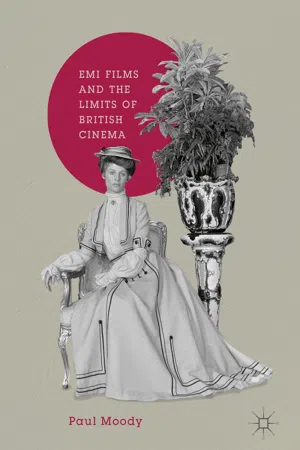
EMI Films and the Limits of British Cinema
About this book
This book is the first of its kind to trace the development of one of the largest and most important companies in British cinema history, EMI Films. From 1969 to its eventual demise in 1986, EMI would produce many of the key works of seventies and eighties British cinema, ranging from popular family dramas like The Railway Children (Lionel Jeffries, 1970) through to critically acclaimed arthouse successes like Britannia Hospital (Lindsay Anderson, 1982). However, EMI's role in these productions has been recorded only marginally, as footnotes in general histories of British cinema. The reasons for this critical neglect raise important questions about the processes involved in the creation of cultural canons and the definition of national culture. This book argues that EMI's amorphous nature as a transnational film company has led to its omission from this history and makes it an ideal subject to explore the 'limits' of British cinema.
Information
Subtopic
Film & Video© The Author(s) 2018
Paul MoodyEMI Films and the Limits of British Cinemahttps://doi.org/10.1007/978-3-319-94803-4_11. Introduction
Paul Moody1
(1)
Brunel University London, London, UK
Paul Moody
And how will we be judged by history—God knows. I suppose they will think it was a sort of renaissance and—it’s the fate of revolutionaries to be absorbed of course—and I expect to be absorbed. If it’s a success I will be absorbed. If it’s a failure you are more likely to stand out. People remember failure more than they remember success in the long run.1—Bryan Forbes, October 1969
Speaking at the start of what would become the most challenging chapter of his career, Bryan Forbes was sanguine about how his efforts would be viewed by history. If it worked, he expected to be mostly forgotten, but if he failed, he knew that this would probably mark the end of his involvement in British filmmaking. This is a book about the company Forbes worked for as Head of Production, EMI Films, and its impact on the British film industry of the 1970s and 1980s. From 1970 to its eventual demise in 1986, EMI would release many of the key works of 1970s and 1980s British cinema, ranging from popular family dramas like The Railway Children (Lionel Jeffries, 1970) through to arthouse oddities like Britannia Hospital (Lindsay Anderson, 1981), and was the largest film production and distribution company in Britain during these decades. However, EMI’s role in these productions has been recorded only marginally, as footnotes in autobiographies or general histories of British cinema. Like the company’s films, this book traverses many themes; it is a cultural history of EMI Films but also raises broader questions about the processes involved in the creation and the definition of a ‘national culture’. In so doing, it will also provide the first comprehensive analysis of the company’s output, assessing its contribution to British culture and asserting its position as a key part of British film history.
That the need for this overview arises at all is the result of a critical neglect of the company and its films from most histories of British cinema. Therefore, taken at face value, it would appear from Forbes’ comments at the start of this chapter that he was a success—EMI Films has been, to use his phrase, mostly ‘absorbed’ into broader debates about filmmaking, with most of the attention paid to its films neglecting to mention the company or its involvement at all. EMI was not an Ealing, a Gainsborough, or a Hammer studios, British companies that are synonymous with the films they produced and have an established niche in the history of British filmmaking. EMI is an entirely different prospect, a film company that has not been included with these names because, firstly, it lacked an easily definable identity due to not being associated with a single genre and, secondly, over time, it was perceived to be making films that had more in common with Hollywood than they did with British culture and society. In many ways, it was a company that always struggled to define itself, and this book is an attempt to understand how and why this happened, and to aim to relocate it within the British filmmaking canon.
There is a long history in British cinema studies of the neglect of certain genres, filmmakers, and aesthetics, the identification of which can be traced back to Alan Lovell’s 1972 article, ‘The Unknown Cinema of Britain’,2 and Julian Petley’s ‘The Lost Continent’3 in 1986, both of which, coincidently, neatly span the majority of the period that EMI was operating as a film company. Both articles in their own ways sought to expand the critical gamut of British film studies, moving away from what had, until then, been a conception of British cinema that associated it primarily with a tradition of realism and opened up critical approaches to British genre and fantasy films for the first time. But as John Hill warns in ‘Revisiting British Film Studies’, in reference to these two works:
The identification of the rhetoric of the ‘lost’ and ‘unknown’ with only certain kinds of British films … is now in danger of becoming an exhausted critical manoeuvre with very little actual purchase on what might legitimately be held to be ‘unknown’ or ‘undervalued’.4
Despite this note of caution, there is strong evidence that EMI has been elided from British cinema history, genuinely ‘lost’ from this debate and ‘unknown’ to most cinema scholars, despite producing work that would comfortably sit within both realist and fantasy traditions. Part of this neglect is due to the time in which these films were produced, with the 1970s being, until very recently, an ‘unknown’ decade in British cinema history. There has been a resurgence of interest in 1970s British cinema over the past decade, although this has been focused primarily on general overviews of notable productions or themes, such as Seventies British Cinema (Shail, 2008); British Culture and Society in the 1970s: The Lost Decade (Forster and Harper, 2010); Don’t Look Now: British Cinema in the 1970s (Newland, 2010); British Film Culture of the 1970s: The Boundaries of Pleasure (Harper and Smith, 2011); Censoring the 1970s: The BBFC and the Decade that Taste Forgot (Barber, 2011); British Films of the 1970s (Newland, 2013); and The British Film Industry in the 1970s: Capital, Culture and Creativity (Barber, 2013). Robert Shail, in his pioneering 2008 work, Seventies British Cinema, argued that the reasons for the critical neglect of the decade up until that point included the fact that the ‘popular perception of the 1970s as “the decade that taste forgot” … includes a broad critical consensus that British cinema of the period was “generally of little interest apart from a few isolated films”’.5 Shail locates this neglect within the wider context of 1970s Britain, arguing that ‘a good deal of the turbulence that beset British film-making in these years can be related directly to the political and economic climate of the decade’,6 a view shared by many of the authors listed earlier.
However, many of the specific problems that affected British filmmaking during this decade can be traced back to the 1960s. In 1968, 43 out of 49 British first features were wholly or partly US financed, but by 1970 the figure was only 29 out of 44.7 Significant American investment had a long history in British filmmaking, since at least the 1930s, but the main driver for US interest in the industry was the establishment of the British Film Production Fund, more commonly known as the Eady Levy, in the 1950s. This tax on the price of cinema admission by what was initially a quarter of a penny per seat was directed back into a production fund for British films, and by 1967, it was generating $12.37 million per year.8 Films registered as British were eligible to apply to the fund for a rebate in proportion to how successful the film was at the box office, with the qualifying criteria resting mainly on the nationality of the majority of the cast and crew. Thus, many films funded by Hollywood qualified and were able to claim support from the fund.9 Structurally, it favoured commercially successful entertainment, and thus was appealing to Hollywood investors who could use this to support their British subsidiary companies. In addition, this incentivised Hollywood companies to make their films more appealing to British audiences, as films that were more successful in Britain would generate higher returns on investment.10 This, coupled with the explosion of interest in all things ‘London’ and the start of the ‘swinging sixties’, meant that Britain became a haven of American money, with Hollywood producers keen to capitalise on the zeitgeist of ‘cool Britannia’, exemplified by work such as the Beatles vehicle A Hard Day’s Night (Richard Lester, 1964), made with money from United Artists. As Margaret Dickinson and Sarah Street argue, ‘after 1961 it became increasingly difficult to define any part of the industry as British rather than Anglo-American’.11
But while this US investment provided a lot of work for British film crews in this period, it was fraught with danger. This was confirmed when, in 1969, after the major US studios suffered huge losses—MGM recording a loss of $35 million, Fox $36.8 million, and Warners $52 million12—it became clear that investment in British production was an easy option to jettison for companies that were seeking extensive reduction in expenditure. MGM’s closure of its studios in Borehamwood and Universal’s closure of its British production programme were just two examples of the malaise that the British industry was now under, with the film technicians’ union, the Association of Cinematograph, Television, and Allied Technicians (ACTT), announcing in August 1969 tha...
Table of contents
- Cover
- Front Matter
- 1. Introduction
- 2. And Soon the Darkness
- 3. Elstree Falling
- 4. Mr Forbes and the Pen-Pushers
- 5. All the Way Up
- 6. The Likely Lad
- 7. Trick or Treat?
- 8. American Adventure
- 9. Honky Tonk Filmmaking
- 10. Memoirs of a Survivor
- 11. Conclusion
- Back Matter
Trusted by 375,005 students
Access to over 1.5 million titles for a fair monthly price.
Study more efficiently using our study tools.
Frequently asked questions
Yes, you can cancel anytime from the Subscription tab in your account settings on the Perlego website. Your subscription will stay active until the end of your current billing period. Learn how to cancel your subscription
No, books cannot be downloaded as external files, such as PDFs, for use outside of Perlego. However, you can download books within the Perlego app for offline reading on mobile or tablet. Learn how to download books offline
Perlego offers two plans: Essential and Complete
- Essential is ideal for learners and professionals who enjoy exploring a wide range of subjects. Access the Essential Library with 800,000+ trusted titles and best-sellers across business, personal growth, and the humanities. Includes unlimited reading time and Standard Read Aloud voice.
- Complete: Perfect for advanced learners and researchers needing full, unrestricted access. Unlock 1.5M+ books across hundreds of subjects, including academic and specialized titles. The Complete Plan also includes advanced features like Premium Read Aloud and Research Assistant.
We are an online textbook subscription service, where you can get access to an entire online library for less than the price of a single book per month. With over 1.5 million books across 990+ topics, we’ve got you covered! Learn about our mission
Look out for the read-aloud symbol on your next book to see if you can listen to it. The read-aloud tool reads text aloud for you, highlighting the text as it is being read. You can pause it, speed it up and slow it down. Learn more about Read Aloud
Yes! You can use the Perlego app on both iOS and Android devices to read anytime, anywhere — even offline. Perfect for commutes or when you’re on the go.
Please note we cannot support devices running on iOS 13 and Android 7 or earlier. Learn more about using the app
Please note we cannot support devices running on iOS 13 and Android 7 or earlier. Learn more about using the app
Yes, you can access EMI Films and the Limits of British Cinema by Paul Moody in PDF and/or ePUB format, as well as other popular books in Media & Performing Arts & Film & Video. We have over 1.5 million books available in our catalogue for you to explore.