- English
- ePUB (mobile friendly)
- Available on iOS & Android
eBook - ePub
About this book
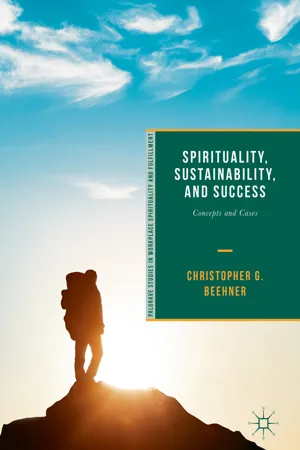
This book offers a pragmatic approach to the benefits of spirituality and sustainability for both individual and organizational success. It introduces sustainability and workplace spirituality as contemporary solutions to the challenging organizational environment. The first few chapters introduce the fundamentals of spirituality, workplace spirituality, and sustainability. The author then demonstrates how the three qualities are beneficial in achieving personal and business success. Through the combination of synthesized research summaries and case studies of individuals and organizations, this book offers readers a fresh perspective on the importance of spirituality and sustainability to organizational performance.
Information
© The Author(s) 2019
Christopher G. BeehnerSpirituality, Sustainability, and SuccessPalgrave Studies in Workplace Spirituality and Fulfillmenthttps://doi.org/10.1007/978-3-319-77806-8_11. Introduction: The Nexus of Spirituality and Sustainability
Christopher G. Beehner1
(1)
Center for Business, Legal and Entrepreneurship, Seminole State College of Florida, Heathrow, FL, USA
Christopher G. Beehner
1.1 Introduction
During the past few decades, the topics of spirituality and sustainability have received considerable interest from both industry and academia. Several scholars suggest spirituality and sustainability are mutually interdependent, with spirituality enhancing efforts to act in a sustainably responsible manner, and sustainability reinforcing the connectedness of all life (Marques, Dhiman, & King, 2010). However, both topics are frequently misunderstood, or even shunned by some members of both communities. While spirituality and religion share common ingredients, the two terms are not synonymous. However, conversations about spirituality are often assumed to be religious, and discussions of spirituality at the workplace are frequently stifled. Likewise, conversations about sustainability are frequently alleged to be the domain of the government, non-profits, and environmentalists, not capitalist business enterprises. I join Holthaus (2012) in lamenting that business acquaintances perceive sustainability as a radical environmentalist threat to commerce, fully convinced that the free market system should guide human endeavors, and that continual economic growth is the only feasible path to successful society.
The premise of this book is that spirituality (individual and workplace) and sustainability are beneficial for individual (and organizational) success. The focus of this text will be the examination of spirituality from a secular perspective and the examination of sustainability from a pragmatic business perspective. The framework for each will be broad, interdisciplinary, non-religious, and non-political in order to be inclusive of a broad readership. The limited religious content is intended to provide a historical perspective of spirituality and sustainability, and not to endorse religiosity or any specific religion as necessary for spirituality or sustainability practice. Armed with an understanding that spirituality is not the same as religion, business leaders and academics may be more likely to engage in conversation about the role of spirituality in business. Moreover, when sustainability is understood to be more than mere liberal “tree hugging” but rather a viable business concept and model, business leaders and academics may be more likely to engage in conversation about sustainable business.
The reader may query why and how two seemingly unrelated terms are being discussed within the same text. This author hopes to demonstrate spirituality and sustainability to be more related than they seem, and that both engender success at individual and organizational levels. Throughout the chapters of this text, similarities and overlap between spirituality and sustainability will be identified. Each chapter will conclude with a chapter case, a personal interview summary, or reflection questions to stimulate critical thinking, and provide instructional tools for academic use and practical application.
This book is premised upon several assumptions. First, while considerable research and evidence exist supporting the occurrence of climate change, this author does not assume that the reader has embraced the ideas of climate change or environmental sustainability. Rather than writing from a perspective that every reader should accept that climate change is occurring, and that humankind is responsible for its occurrence, and required corrective action, this author accepts that skeptics abound. The promotion of an environmental agenda is not the purpose of this text and might therefore taint the desired message of sustainability: it is imperative the current generation take actions to ensure that future generations have a comparable quality of life and access to natural resources—fossil fuels included. Second, while most people globally believe in a God, and adhere to some form of religious or spiritual doctrine, this author does not assume the reader accommodates a particular religious or spiritual condition. Therefore, spirituality will be addressed from a secular perspective—the desire for meaning and purpose in life, and for connection and community with other like-minded individuals.
This text combines two contemporary topics in a practical manner as legitimate tools for individual and organizational or business success. While existing texts examine the individual or organizational benefits of either spirituality or sustainability, few texts incorporate the two constructs in an examination of the relationship between both and individual and organizational success. The overall benefits provided by this text may be an understanding of the benefits of incorporating spirituality and sustainability in both personal/career success and in business/organizational success, and there are examples and resources to assist the reader in the practical application of these principles and in educating others about benefits and practical application.
The expanding interest in both spirituality and sustainability partially stems from the increase in corporate scandals and industry-related environmental disasters in recent decades. Beginning in 2001, a parade of Fortune 500 company executives came forward, confessing ethical misconduct (or were accused of such behavior), from financial misstatement to intentional fraud. The crisis was not unique to the United States, with German automobile manufacturer Volkswagen admitting to intentionally tampering with emission systems to falsify performance data. Sustainability-minded drivers were stunned to learn their environmentally friendly vehicles were emitting pollution at unsafe and illegal levels. The 1989 Exxon Valdes oil spill and the 2010 BP Deepwater Horizon oil rig explosion reinforce the magnitude of industrial accidents on the environment.
Spirituality and sustainability are interrelated, both invoking a higher sense of purpose and meaning among individuals and organizations embracing either or both concepts. Næss (1989) suggests humanity is inseparable from nature: if humanity harms nature, we are harming ourselves. Chavez (2010) suggests the dissection of sustainability and spirituality into two separate parts to be arbitrary, reflective of the materialistic reductionist framework of contemporary society. However, prior to exploring the nexus of spirituality and sustainability, a summary description of spirituality and sustainability is appropriate.
1.2 Brief Summary of Spirituality
This section begins with an examination of the definition and description of spirituality from a secular perspective. Some of the religious influence on spirituality will be examined in the section about the nexus of spirituality and sustainability. The Merriam-Webster dictionary contains multiple definitions for the term spirituality , the more secular being “the quality or state of being spiritual”. In turn, of the five definitions of spiritual, the more secular ones include relating to, consisting of, or affecting the spirit, and related or joined in the spirit . When we get to the core term spirit, we find a total of 14 definitions of spiritual. Again, choosing the secular ones, we find several options: “an animating or vital principle held to give life to physical organisms”; “the immaterial intelligent or sentient part of a person”; “a special attitude or frame of mind”; and “the feeling, quality, or disposition characterizing something”. Clearly, spirituality has multiple meanings outside of religion, adding puzzlement to the topic.
Some scholars suggest any definition of spirituality must contain as criteria the feelings, thoughts, experiences, and behavior emanating from the quest for the Sacred , characterized as a divine entity, object, truth, or reality (Hill et al., 2000). Chavez (2010) noted that the Sacred, unknown, or unknowable entity is part of the foundation of most spiritual doctrines. Mitroff defined spirituality as “the desire to find ultimate purpose in life, and to live accordingly” (Cavanagh, 1999, p. 186). Vaill (1996) described spirituality as “the feeling individuals have about the fundamental meaning of who they are, what they are doing, [and] the contributions they are making” (p. 218). The meaning of life has four characteristics: when individuals consider their lives to be meaningful, they are committed to a meaningful life; the commitment to meaningful life provides the framework for the interpretation of life events and for the foun...
Table of contents
- Cover
- Front Matter
- 1. Introduction: The Nexus of Spirituality and Sustainability
- 2. Individual Spirituality
- 3. Workplace Spirituality
- 4. Sustainability and Sustainable Business
- 5. Spirituality for Individual Success
- 6. Sustainability for Individual Success
- 7. Workplace Spirituality for Organizational Success
- 8. Sustainability for Organizational Success
- 9. Integrating Spirituality and Sustainability for Individual Success
- 10. Integrating Workplace Spirituality and Sustainability for Organizational Success
- 11. The Synthesis of Spirituality and Sustainability for Success
- Back Matter
Trusted by 375,005 students
Access to over 1.5 million titles for a fair monthly price.
Study more efficiently using our study tools.
Frequently asked questions
Yes, you can cancel anytime from the Subscription tab in your account settings on the Perlego website. Your subscription will stay active until the end of your current billing period. Learn how to cancel your subscription
No, books cannot be downloaded as external files, such as PDFs, for use outside of Perlego. However, you can download books within the Perlego app for offline reading on mobile or tablet. Learn how to download books offline
Perlego offers two plans: Essential and Complete
- Essential is ideal for learners and professionals who enjoy exploring a wide range of subjects. Access the Essential Library with 800,000+ trusted titles and best-sellers across business, personal growth, and the humanities. Includes unlimited reading time and Standard Read Aloud voice.
- Complete: Perfect for advanced learners and researchers needing full, unrestricted access. Unlock 1.5M+ books across hundreds of subjects, including academic and specialized titles. The Complete Plan also includes advanced features like Premium Read Aloud and Research Assistant.
We are an online textbook subscription service, where you can get access to an entire online library for less than the price of a single book per month. With over 1.5 million books across 990+ topics, we’ve got you covered! Learn about our mission
Look out for the read-aloud symbol on your next book to see if you can listen to it. The read-aloud tool reads text aloud for you, highlighting the text as it is being read. You can pause it, speed it up and slow it down. Learn more about Read Aloud
Yes! You can use the Perlego app on both iOS and Android devices to read anytime, anywhere — even offline. Perfect for commutes or when you’re on the go.
Please note we cannot support devices running on iOS 13 and Android 7 or earlier. Learn more about using the app
Please note we cannot support devices running on iOS 13 and Android 7 or earlier. Learn more about using the app
Yes, you can access Spirituality, Sustainability, and Success by Christopher G. Beehner in PDF and/or ePUB format, as well as other popular books in Business & Business Ethics. We have over 1.5 million books available in our catalogue for you to explore.