This Palgrave Pivot identifies the key legal, economic, and policy issues surrounding the allowance to use and interpret electronic data consistently and in a scientifically valid manner in U.S. courts. Evidence based on the analysis of large amounts of electronic data ("Big Data") plays an increasing role in civil court disputes, providing information that could not have been obtained from a witness stand. While Big Data evidence presents opportunities, it also presents legal and public policy challenges and concerns. How can one be sure that deviations found in Big Data fall outside the norm? If statistical analyses can be conducted and presented different ways, how can judges and juries make sense of conflicting interpretations? When does Big Data extraction stop being investigative and instead become an invasion of privacy? This book traces the history of Big Data use in U.S. courts, couples current case studies with legal challenges to explore key controversies, and suggests how courts can change the way they handle Big Data to ensure that findings are statistically significant and scientifically sound.
eBook - ePub
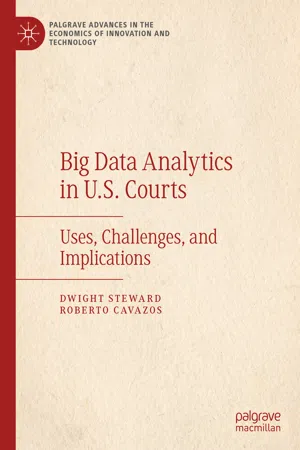
Big Data Analytics in U.S. Courts
Uses, Challenges, and Implications
- English
- ePUB (mobile friendly)
- Available on iOS & Android
eBook - ePub
About this book
Information
© The Author(s) 2019
D. Steward, R. CavazosBig Data Analytics in U.S. CourtsPalgrave Advances in the Economics of Innovation and Technologyhttps://doi.org/10.1007/978-3-030-31780-5_11. Data Analytics and Litigation
Dwight Steward1 and Roberto Cavazos2
(1)
EmployStats , Austin, TX, USA
(2)
Merrick School of Business, University of Baltimore, Baltimore, MD, USA
Abstract
This book examines the use of Big Data and statistical analyses in litigation. This is timely as the use and reliance upon Big Data by business and government has exploded. From a public policy and legal perspective, the implications of this are indeed monumental. Using examples, court decisions, and discussions, we draw connections across many different types of litigation. In business disputes, employment cases, consumer class actions, and even personal injury lawsuits, the analysis of enormous amounts of data often provides evidence that would be otherwise unattainable from witnesses testifying to the facts of the case.
Keywords
Big DataLitigationData analyticsComplex litigationThis book examines the use of Big Data and statistical analyses in litigation. This is timely as the use and reliance upon Big Data by business and government has exploded. Organizations of all types are increasingly reliant on analytics and Big Data systems for supporting and informing most, if not all, of their functions. Crucially, in a corollary to More’s Law which states that the density of transistors on a circuit board will double every two years leading to doubling of computing power, it is likewise true that the volume of data created and used by business and government doubles every 18 months.
From a public policy and legal perspective, the implications of this are indeed monumental. In addition, technological innovation in Big Data as well as areas such as Artificial Intelligence, Internet of Things, and Smart Contracts all have significant implications on how organizations function, privacy, security, how transactions are carried out, and myriad other factors with enormous legal implications. Using examples, court decisions, and discussions from a range of lawsuits and courts, we draw connections across many different types of litigation.
What Is Big Data?
What’s ‘big’ in big data isn’t necessarily the size of the databases, it’s the big number of data sources we have, as digital sensors and behavior trackers migrate across the world.1
Before proceeding with the discussion on Big Data some clarity is required on the terms that are often used interchangeably. Statistics is properly understood as the use of samples to make inferences about populations. A staple of statistical analysis are surveys, sampling, and testing hypothesis. Statistical analysis is widely used in litigation. Data analysis entails analyzing data of a particular set or population. A financial data analyst examines his firm’s stocks, an insurance claims analyst examines her company’s extensive claims data, a human resources analyst dives into his agencies’ personnel data to assess risk of key staff retiring, and so on. Like inferential statistics, data analysis has been extensively used in litigation (audits, patterns, averages, anomalies, etc.).
Big Data is an elaboration of data analysis but it is also different in ways that have significant implications for litigation. It is not necessarily inferential and relies upon computational techniques which examine patterns, trends, and other features of behavior in the data. Big Data examples are credit card transactions, health insurance claims, and online behavior among others. A key difference between data analysis and Big Data analysis can be gleaned by example. Data analysis generates reports on, say, sales by month. Big Data analysis also examines sales but seeks to find patterns for the effect of time of day consumers shop, the weather, location of store, type of credit card, bundle of goods bought, and so on. Big Data analysis is made possible by the decreasing cost of storage space, the use of cloud computing and the recognition that Big Data analytics can confer a competitive advantage or at minimum efficiency enhancing benefits to an organization.2
The National Institute of Standards and Technology defines Big Data as follows: Big Data consists of extensive datasets primarily in the characteristics of volume, variety, velocity, and/or variability that require a scalable architecture for efficient storage, manipulation, and analysis. Further, the Big Data paradigm consists of the distribution of data systems across horizontally coupled, independent resources to achieve the scalability needed for the efficient processing of extensive datasets.3 While seemingly obtuse, this definition of Big Data has implications for organizational behavior, risk, and ultimately litigation. Unlike merely storing large amounts of data and then analyzing, the use of Big Data requires links among disparate systems, reconfiguring, and/or acquiring complex information system architectures and in increasingly common cases reconfiguring an organization’s very structure. For example, Big Data is defined by some as “Big data is not all about volume, it is more about combining different data sets and to analyze it in real-time to get insights for your organization. Therefore, the right definition of big data should in fact be: mixed data.”4
These processes are complex, expensive, and can be risky. The risk inheres in that organization leadership may not fully understand the implications of using or relying on Big Data. Further, Big Data systems may fail to comply with administrative processes and laws governing the use of personal or confidential data. Combining different datasets is fraught with risk and uncertainty. In addition, true Big Data systems require complex infrastructure at times connected to the internet which expose data and systems to hacking and ultimately legal risks.
Data and Big Data in Litigation
In an increasing number of legal cases, large collections of electronic data information, or in some instances Big Data, determine which party ultimately prevails. In business disputes, employment cases, consumer class actions, and even personal injury lawsuits, the analysis of enormous amounts of electronic data often provides evidence that would be otherwise unattainable strictly from witnesses testifying to the facts of the case. In some instances, electronic data is the only way to analyze the parties dueling allegations in a lawsuit.
Lawsuits involving employment discrimination are an area where statistics and Big Data have been used extensively. In employment cases, especially ones involving many plaintiffs, the compilation, tabulation, and analysis of Big Data has been relied upon heavily with the rise of electronic computing. In class action employment lawsuits, litigants frequently introduce mountains of data and analysis to support or refute the allegations of gender, race, age, or other type of illegal employment discrimination.
Litigation in instances of employee unpaid overtime and off-the-clock work allegations is an area where statistical and large data analyses are used extensively. In these cases, commonly referred to as wage and hour cases, former or current employees allege that the defendant illegally denied them their legal right to overtime premium pay, the defendant’s timekeeping system illegally shaved work time, or the defendant required them to perform work before or after punching in for work or while punched out for a work break. In these types of wage and hour cases it is typical for parties to present evidence based on the collection and analysis of extensive daily time and salary electronic databases. In some instances, where data is not collected by the defendant, the parties may perform sophisticated statistical surveys, based on the electronic information that is available, to provide insights into the allegations in the case.
In response to the complexity of these cases, a number of courts have established special courts to handle complex cases such as the ones involving massive amounts of electronic data. In California, numerous state courts have been set up to handle complex cases where the judge is particularly well versed in the nuances that these types of complex cases involve. A quick review of the court docket of these complex courts shows that a number of these cases are large employment wage in our class actions that involve the analysis and calculations involving these large electronic datasets. Many of the litigants report that the cases flow more efficiently and a number of the issues are adjudicated rapidly. It is often noted that the monetary cost of establishing and maintaining these types of complex courts is relatively expensive.
The Average Wholesale Pricing (AWP) pharmaceutical drug litigation that began in the mid-2000s is also instructive in the use of large electronic databases information as evidence in litigation. Medical billing data typically conforms to the true definition of Big Data with separate systems communicating, exchanging information, and generating new and enormous sets of data. In these cases, individual plaintiff whistleblowers and state’s attorneys alleged that pharmaceutical drug companies conspired to overcharge Medicaid programs for their pharmaceutical products. The plaintiffs in these cases alleged that drug companies fraudulently reported prices to drug pricing reporting agencies that were higher than their actual average wholesale prices. Medicaid programs use the average wholesale price calculated by companies reporting prices to determine the reimbursement to pharmacists for the medicines that they provide to patients. Accordingly, as it is alleged, since the reported average wholesale price was inflated, the reimbursement to pharmacists, and others who receive Medicaid payments, will be inflated.
The analysis of the defendant’s actions, and liability, and ultimately the calculation of any damages incurred as a result of the defendant’s alleged actions requires the analysis of massive amounts of electronic data. Even in small states with relatively small Medicaid programs, the investigation into the plaintiff’s allegations and calculation of economic damages requires the a...
Table of contents
- Cover
- Front Matter
- 1. Data Analytics and Litigation
- 2. History of Data Analysis in US Courts
- 3. Examples of Litigation Involving Big Data Analytics
- 4. The Courts as Gatekeeper of Big Data Evidence
- 5. Indirect Use of Big Data Analytics in US Courts
- 6. Future Challenges and Recommendations
- Back Matter
Trusted by 375,005 students
Access to over 1.5 million titles for a fair monthly price.
Study more efficiently using our study tools.
Frequently asked questions
Yes, you can cancel anytime from the Subscription tab in your account settings on the Perlego website. Your subscription will stay active until the end of your current billing period. Learn how to cancel your subscription
No, books cannot be downloaded as external files, such as PDFs, for use outside of Perlego. However, you can download books within the Perlego app for offline reading on mobile or tablet. Learn how to download books offline
Perlego offers two plans: Essential and Complete
- Essential is ideal for learners and professionals who enjoy exploring a wide range of subjects. Access the Essential Library with 800,000+ trusted titles and best-sellers across business, personal growth, and the humanities. Includes unlimited reading time and Standard Read Aloud voice.
- Complete: Perfect for advanced learners and researchers needing full, unrestricted access. Unlock 1.5M+ books across hundreds of subjects, including academic and specialized titles. The Complete Plan also includes advanced features like Premium Read Aloud and Research Assistant.
We are an online textbook subscription service, where you can get access to an entire online library for less than the price of a single book per month. With over 1.5 million books across 990+ topics, we’ve got you covered! Learn about our mission
Look out for the read-aloud symbol on your next book to see if you can listen to it. The read-aloud tool reads text aloud for you, highlighting the text as it is being read. You can pause it, speed it up and slow it down. Learn more about Read Aloud
Yes! You can use the Perlego app on both iOS and Android devices to read anytime, anywhere — even offline. Perfect for commutes or when you’re on the go.
Please note we cannot support devices running on iOS 13 and Android 7 or earlier. Learn more about using the app
Please note we cannot support devices running on iOS 13 and Android 7 or earlier. Learn more about using the app
Yes, you can access Big Data Analytics in U.S. Courts by Dwight Steward,Roberto Cavazos in PDF and/or ePUB format, as well as other popular books in Business & Business General. We have over 1.5 million books available in our catalogue for you to explore.