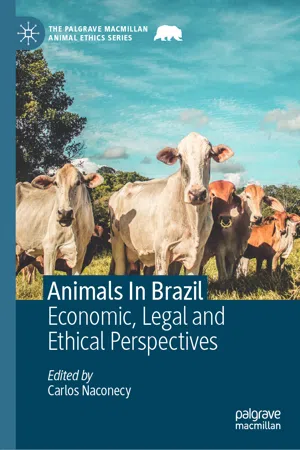
- English
- ePUB (mobile friendly)
- Available on iOS & Android
eBook - ePub
About this book
Information
Topic
FilosofiaSubtopic
Filosofia etica e morale© The Author(s) 2019
C. Naconecy (ed.)Animals In BrazilThe Palgrave Macmillan Animal Ethics Serieshttps://doi.org/10.1007/978-3-030-23377-8_11. Introduction
Carlos Naconecy1
(1)
Oxford Centre for Animal Ethics, Oxford, UK
Abstract
This book presents a collection of essays on some of the main aspects of human–animal interaction in Brazil, aiming to shed light on the legal, economic, socio-environmental, and ethical dimensions of it. The first essay addresses the profound transformations in the consumption and production of animal-sourced foods that took place over the last five decades in the country. The authors examine the consequences of this phenomenon for the lives of animals, the health of the population, and the environment. The next essay offers an analysis of the animal welfare and animal protection legislation in Brazil. The following chapter presents a number of notable cases involving animal advocacy and activism in recent years. The last section deals with certain historical, sociocultural, and economic aspects that influence the Brazilian ethos regarding the morality of the treatment of animals.
Keywords
BrazilEnvironmentLivestockAnimal ethicsBrazilian legislationThe book that you are now reading presents a collection of essays on some of the main aspects of human–animal interaction in Brazil. The project that culminated in this work began in September 2014, when Andrew Linzey, director of the Oxford Centre for Animal Ethics, asked if I would be interested in taking further the idea of an anthology on the situation of animals in Brazil. Later, Clair Linzey, while visiting Brazil on account of her doctoral research, encouraged me to make this project a reality.
In terms of the circumstances of animals, Brazil’s crucial role in the international scenario is not hard to explain. We know that around 99% of all animals with which humans interact are animals destined to be eaten. And Brazil has a strong vocation for livestock production. The country occupies a privileged position in the global meat supply chain. The largest meat processing company in the world, JBS, is Brazilian. Brazil usually ranks among the top three positions as global exporter and producer of beef and chicken; there are almost as many cattle as there are people in the country. Brazil’s ecological responsibility on this planet is also immense: it is home to the world’s largest rainforest, the Amazon—and over 80% of the deforestation of this area, which hosts the greatest biodiversity on earth, is due to cattle breeding.
For these reasons, among others, Brazil’s worldwide importance for animal life seems unquestionable. Anyone who has even the slightest interest in the circumstances of animals at the international level must take into account what this country has—and, most importantly, what it has not—done about this. This book aims to shed light on the legal, economic, socio-environmental, and ethical dimensions of this problem.
As for the ethical dimension of the “animal issue”, the key question is: are we, human beings, justified in using and abusing animals as we have historically been doing? Or is there more to be taken into account, to the extent of demanding a change in this behaviour on the basis of morality? Such reflection is still very recent compared to the other fields of human thought. Although there have been isolated manifestations throughout history, beginning in ancient times, it was only in the 1970s that moral reasoning about the way we treat animals received a new and vigorous impetus. This movement, led by Anglo-Saxon philosophers, has since produced a plethora of literary works in different disciplines.
About thirty years elapsed until this movement reached the Brazilian community and intellectuals. More markedly in the last decade, books in the national language have begun to be published, specialized journals released in the academic field, and graduate programs integrated into university curricula.1
As in other countries, Brazilian society also believes that the life and welfare of animals is morally important, at least to some extent. But, as in other countries, the topic of debate is what we can deduct from this moral importance or status in terms of our own obligations. In other words, what kind of moral duties does animal welfare/animal life impose upon us. Furthermore, since the country has the second largest population of cats and dogs in the world, part of the Brazilian society also wonders about the difference in moral treatment between pets and animals used as food or for experimentation.
It is correct to say that ethical sensitivity toward the treatment of animals in Brazil has taken the form of a growing spiral. The increase in public and academic interest in the ways we treat animals has grown consistently in recent years in this country. There have never been so many academic conferences and university courses dedicated to animal topics as there are now in Brazil. Public debate is also intensifying. It is clear that we are facing a global trend that has already reached our country. It is clear that this national movement is part of a worldwide critical mass of moral reflection that is, therefore, more comprehensive.
The issue, however, is not restricted only to ethics and to respect for animals. There are other dimensions to be considered. When we raise animals for food, for example, we are not only creating problems for the animals themselves. This activity also entails serious social and environmental problems, be they on a micro or macro scale. The impacts of the Brazilian meat industry on climate, deforestation, loss of biodiversity, excessive water use, land degradation, concentration of land ownership, invasion of indigenous lands, contaminant waste management, slave labor, and food security are already well known and documented. As a matter of fact, livestock farming is the largest emitter of greenhouse gases in Brazil. Extensive livestock production, in which the animals are not confined as they are in industrial farming, predominates in the country: less than 2% of the total herd is confined. Although this method may be more beneficial in terms of animal welfare, it is primarily accountable for deforestation in the country, the environmental consequences of which are extremely disturbing—and potentially disastrous.
The bad news is that such highly detrimental impacts have increased rather than diminished. In Brazil, land is being cleared of more trees to produce pasture, meat exports are on the rise, and consumption is increasing. Moreover, the political power of agribusiness in the country is overwhelming. It lobbies permanently to approve bills that ease barriers to deforestation, encourages meat production, and obtains government subsidies for livestock production. It should be taken into account that the meat industry is viewed as strategic for the national economy: the Brazilian trade balance is largely dependent on meat exports (despite the meat supply chain, in its current form, being inefficient in terms of what is consumed and produced in animal husbandry).
Now, about this book: it is divided into three thematic sections (Animals for Food, Animal Law and Advocacy, and Animal Ethics), totalling four essays. These thematic categories are not intended to be exhaustive, since much has been left out of the rich and complex universe of animal life in Brazil. The collaborators of this volume come from three different academic backgrounds (Law, Sciences and Philosophy), and thus present different perspectives on the animal issue as it appears in the country today.
In “Food Animals in Brazil: Five Decades of Transformation”, Cynthia Schuck Paim and Marly Winckler address the profound transformations in livestock production and consumption that have taken place over the last five decades in this country, along with the impacts on the lives of animals, the health of the population, and the rich, but fragile, national environment. Brazil has gone from being a net food importer to one of the world’s largest food producers in the world, particularly of animal-sourced foods: as of 2017, Brazil has become the second largest exporter of meat, the first exporter of beef, and the second largest producer of soybeans, used mostly as animal feed. Schuck and Winckler hold that abundance of land, natural resources, and governmental incentives, combined with a pronounced appetite for meat, dairy, and eggs nationally and abroad created in Brazil the perfect conditions for the rapid expansion of the livestock industry. This phenomenon has put enormous pressure on nearly every ecosystem in Brazil: from the Atlantic rainforest and the world’s largest tropical wetland area (Pantanal), to the vast tropical savanna (Cerrado) and the Amazon—the largest rainforest on the planet, with the greatest biodiversity on the globe. The five-fold increase in the production of animals used as food witnessed over the last five decades also happened along with a radical transformation in the form and structure of the animal production systems. The changes in the pig, poultry, and fish farming sectors were particularly dramatic, with subsistence activities being replaced by highly industrialized production processes involving the intensive production of animals bred for incredibly fast growth rates in landless factory-style farms.
In “The Legal Protection of Animals in Brazil: An overview”, Daniel Braga Lourenço and Carlos Frederico Ramos de Jesus offer a historical analysis of the animal welfare and animal protection legislation in Brazil. The Brazilian Constitution dedicates a whole chapter to environmental protection and brings an important rule (in article 225, paragraph 1º, VII) which determines the duty of public power to protect animals against the acts which endanger “its ecological function, cause the extinction of species or subject animals to cruelty”. Nonetheless, this important legal disposition is usually interpreted in the sense of conferring just an indirect protection to animals, i.e., as a way of promoting the dignity of human existence. This opens a dangerous window to practices that explore animals as things and property. The authors then argue for a different, yet plausible, interpretation of that Constitutional rule: it is possible to claim that, according to Brazilian Constitution, animals are not mere things; they are subjects of right and entitled to freedom from cruelty. Finally, they examine bills in Brazilian Legislative that aim to change the status of animals.
In “Cases and Debates in the Brazilian Animal Rights Arena”, Bruno Garrote presents a number of notable cases involving animal rights in Brazil dating back a few years. These cases include typical competitions involving bulls, horses, and cowboys, the ban on the marketing of foie gras in the city of São Paulo, the rescue of beagles from an animal testing lab, the shared custody of a dog, and the first time in history that a writ of habeas corpus was granted to an animal, a chimp called Cecília.
The last section, entitled “Factors That Influence the Brazilian Ethos Regarding Animals”, deals with certain historical, sociocultural, and economic aspects that supposedly influence the Brazilian ethos regarding the morality of the treatment of animals. The first of these is the legacy of the Brazilian slave-owning past. The second characteristic is the strong presence of emotivity and passion in Brazilian popular psychology, to the detriment of rationality and objectivity, and how this affects public debates in Brazil. The third factor is the absence of the habit of engaging in social protest in favor of ethics and worthy causes. The fourth trait is the influence of Catholic doctrine in the country. The last point is the impact of adverse social circumstances on the moral desensitization of the population to the situation of animals—especially commonplace violence, social exclusion, and poverty in Brazil.
I wish to thank all the collaborators for their contributions to this volume, since unpublished texts were written especially for this project.
I hope this work will help professionals, researchers, and graduate students become more familiar with the current Brazilian panorama involving the treatment of animals in the country. Readers will realize that the animal issue in Brazil, as in other countries, also has its own potentialities, contradictions, and limitations. I trust that readers will develop at least a bare notion of such complexity, and will henceforth be able to deepen their interest (and perhaps involvement) in such an important and urgent topic.
Note
- 1.The concern over animal welfare in the academic field, initially in the departments of Veterinary, first arose in the 1990s in Brazil. According to the researcher Vânia Rall, in a private conversation, the initial milestone of the defense of animals in Brazilian society took place in 1895, when the NGO International Union for the Protection of Animals (UIPA, in Portuguese) was founded in São Paulo. As in other countries, with the advent of the Internet, local NGOs have promoted the disclosure of facts to the Brazilian public about nationwide animal maltreatment, the harmful consequences of livestock farming and of meat consumption.
© The Author(s) 2019
C. Naconecy (ed.)Animals In BrazilThe Palgrave Macmillan Animal Ethics Serieshttps://doi.org/10.1007/978-3-030-23377-8_22. Food Animals in Brazil: Five Decades of Transformation
Cynthia Schuck Paim1 and Marly Winckler2
(1)
Cartagena, Spain
(2)
Florianópolis, Brazil
Abstract
The authors address the profound transformations in the consumption and production of animal-sourced foods that took place over the last five decades in this country. Abundance of land, natural resources, and governmental incentives, combined with a pronounced appetite for meat, dairy, and eggs nationally and abroad created in Brazil the perfect conditions for the rapid expansion of the livestock industry. They examine the consequences of this phenomenon for the lives of animals, the health of the population, and the loc...
Table of contents
- Cover
- Front Matter
- 1. Introduction
- 2. Food Animals in Brazil: Five Decades of Transformation
- 3. The Legal Protection of Animals in Brazil: An Overview
- 4. Cases and Debates in the Brazilian Animal Rights’ Arena
- 5. Factors That Influence the Brazilian Ethos Regarding Animals
- Back Matter
Trusted by 375,005 students
Access to over 1.5 million titles for a fair monthly price.
Study more efficiently using our study tools.
Frequently asked questions
Yes, you can cancel anytime from the Subscription tab in your account settings on the Perlego website. Your subscription will stay active until the end of your current billing period. Learn how to cancel your subscription
No, books cannot be downloaded as external files, such as PDFs, for use outside of Perlego. However, you can download books within the Perlego app for offline reading on mobile or tablet. Learn how to download books offline
Perlego offers two plans: Essential and Complete
- Essential is ideal for learners and professionals who enjoy exploring a wide range of subjects. Access the Essential Library with 800,000+ trusted titles and best-sellers across business, personal growth, and the humanities. Includes unlimited reading time and Standard Read Aloud voice.
- Complete: Perfect for advanced learners and researchers needing full, unrestricted access. Unlock 1.5M+ books across hundreds of subjects, including academic and specialized titles. The Complete Plan also includes advanced features like Premium Read Aloud and Research Assistant.
We are an online textbook subscription service, where you can get access to an entire online library for less than the price of a single book per month. With over 1.5 million books across 990+ topics, we’ve got you covered! Learn about our mission
Look out for the read-aloud symbol on your next book to see if you can listen to it. The read-aloud tool reads text aloud for you, highlighting the text as it is being read. You can pause it, speed it up and slow it down. Learn more about Read Aloud
Yes! You can use the Perlego app on both iOS and Android devices to read anytime, anywhere — even offline. Perfect for commutes or when you’re on the go.
Please note we cannot support devices running on iOS 13 and Android 7 or earlier. Learn more about using the app
Please note we cannot support devices running on iOS 13 and Android 7 or earlier. Learn more about using the app
Yes, you can access Animals In Brazil by Carlos Naconecy in PDF and/or ePUB format, as well as other popular books in Filosofia & Filosofia etica e morale. We have over 1.5 million books available in our catalogue for you to explore.