Uses an established method, Optimal Control Theory, to solve the economic problem of equity vs efficiency in the allocation of funds
?Explores how to design optimal regional policies
Addresses the growing need for effective policy making
eBook - ePub
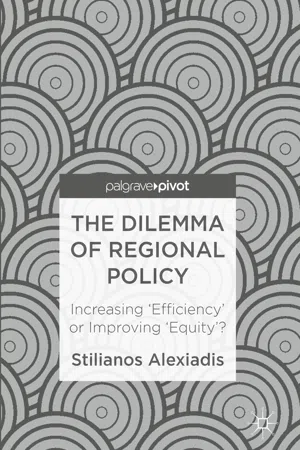
The Dilemma of Regional Policy
Increasing ‘Efficiency’ or Improving ‘Equity’?
- English
- ePUB (mobile friendly)
- Available on iOS & Android
eBook - ePub
About this book
Information
Topic
BetriebswirtschaftSubtopic
Business allgemein© The Author(s) 2018
Stilianos AlexiadisThe Dilemma of Regional Policyhttps://doi.org/10.1007/978-3-319-68900-5_11. Setting the Overall Context
Stilianos Alexiadis1
(1)
Department of Strategic Planning of Rural Development, Evaluation & Documentation, Greek Ministry of Rural Development and Food, Athens, Greece
Abstract
This study attempts to illustrate the theoretical desirability and practical utility to optimising the regional allocation of investment, subject to certain constraints. A major focus of this study is to develop a decision-making method that specifies regional policies that enable maximising output and minimising regional disparities simultaneously. Stated in alternative terms, this study develops an ‘optimum strategy’ applicable to regional policy-making and planning in such a way as to improve monitoring and evaluation of regional policy.
Keywords
Regional disparitiesConflictsRegional policyEconomic developmentPolicy modelsStrategyJEL Classification
R101.1 The Scope for Optimality in Economic Growth
‘Justice’, or more accurately an equitable distribution of the fruits of development, is a key notion in theoretical economics and policy-making. Indeed, ‘no society can surely be flourishing and happy, of which the greater part of the members are poor and miserable. It is but equity, besides, that they who feed, cloth and lodge the whole body of the people, should have such a share of the produce of their own labour as to be themselves tolerably well fed, clothed, and lodged’, an argument put forward by Smith (1776, p. 88) [emphasis added]. The importance of ‘equity’ in theoretical economics and policy can hardly be challenged. It has been suggested, for example, that the elimination of poverty and the achievement of greater equality in income distribution should at least supplement, if not replace, aggregate growth as a target of development policies (Stewart and Streeten 1976). ‘Taking it for granted that a more equal distribution of wealth is to be desired’, as Marshall (1907) argues, ‘how far would this justify changes in the institutions of property or limitations of free enterprise even when they would be likely to diminish the aggregate wealth?’ (p. 4). This particular quotation raises a more general question with clear policy implications: the conflict between the aims of improving the distribution of income (equity) and increasing wealth of the economy as a whole (aggregate efficiency). When a conflict of choice arises, a move towards one objective can be attained only at the expense of moving away from other objectives. All economics, according to Winch (1971), is concerned with is ‘choice’ and choices in economics always involve conflicts.1 Conflicts are not uncommon in macroeconomic analysis.2 As macroeconomic analysis became accepted, Ford (1971) notes,
governments were not slow to realise that it offered them useful guidelines for managing their economies in the short run at least. For they could now devise economic policies to help them achieve some diverse objectives or targets as reduction of excessive unemployment, control of inflation and the avoidance of price increases, the elimination of gold losses by balance of payments adjustment, and the mitigation or elimination of economic instability. However, they have come to realise that certain objectives may conflict and that they may have to compromise by “trading off” the level of unemployment against price increases.3 (p. 153) [emphasis added]
A case of particular interest is the consumption-saving trade-off implied in the model by Ramsey (1928). According to this approach, the consumer’s lifetime utility depends on the time path of consumption, and the aim of dynamic optimisation is to determine the time path of consumption that maximises the consumer’s lifetime utility. At each point in time, the consumer faces an inter-temporal trade-off because immediate consumption reduces future consumption by lowering capital accumulation and output growth. This trade-off is linked with the idea of optimal economic growth.4
Economic growth has been seen as a solution to a variety of economic problems. Thus, for example, it is frequently argued that ‘economic growth, rather than the redistribution of income or wealth, provides the only hope of alleviating or eliminating poverty’ (Jones 1975, p. 2). Dissatisfaction, however, with the ‘market solution’ to the problem of income distribution led economists to look more closely into the character of growth paths based on an ethically explicit criterion function over time. Optimal growth theory, according to Dasgupta and Hagger (1971), recognises the importance of ethical judgments by formulating them explicitly in a ‘social welfare function’, as proposed by Arrow (1951). In the case of the policy issues which arise in connection with the growth objective, ethical judgments can hardly be avoided. More specifically, ‘growth policy is inextricably bound up with the choice of a rate and pattern of investment’ (Dasgupta and Hagger 1971, p. 364) [emphasis added].
The analysis in this study is structured upon the notion of optimality in investment activity, which, undeniably, acts as a catalyst in the process of economic growth. The existing literature employs input-output analysis or Keynesian macroeconomic models. Nevertheless, neither Leontief’s multi-sectoral input-output analysis nor Keynes’ aggregate theory is in- and by itself capable of providing optimal solutions to those investment problems which involve alternatives and constraints (Kurihara 1964). In several theoretical models and empirical applications, optimal investment is examined from a ‘sectoral’ perspective. This resulted to a variety of frameworks in which the aggregate (national) economy is of primary interest (e.g. Koopmans 1965; Bose 1968; Dasgupta 1969; Weitzman 2005). As a result most policy analysis has focused mainly on aggregate efficiency rather than equity.5 Investment choices are themselves bound up with the question of distribution of consumption between generations and the personal distribution of income, an issue of particular significance in mainstream economic analysis (e.g. Dalton 1920; Pigou 1912, 1949). Spatial inequality is an important determinant of interpersonal income inequality. However, little theoretical work in this direction seems to have been done as yet.
Chinitz (1966) argues that certain frameworks designed for the analysis of national growth problems might ‘very logically and necessarily want to have a significant regional component’ (p. 1) [emphasis added]. Furthermore, competition is increasing between regions, rather than countries, particularly in a context of economic and social restricting stemming from the globalisation of the economy. In an environment of rapid technological change combined with market liberalisation and deregulation, investment is more mobile. Regional investment policy, consequently, can be considered as an indistinguishable element of the overall development policy. It is of critical importance, therefore, to examine the issue of optimality in regional investment activity and its implications for regional policy.
1.2 Optimality in Regional Policy
An idea which has been much bandied around by politicians and the news media is that of economic development. An explicit concern over the existing levels of economic development across the world runs through a special field in economics, termed as development economics. Krugman (1995) defines this field as ‘a branch of economics concerned with explaining why some countries are so much poorer that others, and with prescribing ways for poor countries to become rich’ (p. 6). Some economists consider that this is a natural outcome, or at least the global-capitalist order of things: the rich get richer and so do the poor, but without even catching up (Hurst et al. 2000). As argued by Stewart and Streeten (1976), however, policies that emphasise greater equality within low-income countries may widen the gap of incomes between rich and poor countries, while policies that aim at reducing the international gap often widen the domestic one.
Economic development refers mainly to social welfare. Differences in economic development, according to Cox (1972), connote differences in social welfare and therefore conflict both between nations and between regions within a nation (p. 349) [emphasis added].
Regional disparities often cause political and ethnic tensions, which undermine social cohesion and economic stability. The strongest argument in favour of regional policies lies in the long-run persistence and even widening of regional disparities. In the European Union (EU), for example, despite substantial expenditure, at national and community level,6 regional dispa...
Table of contents
- Cover
- Frontmatter
- 1. Setting the Overall Context
- 2. Regional Allocation of Investment
- 3. Conflicts in Regional Policy
- 4. Compatibility Between Equity and Efficiency
- 5. Conclusion
- Backmatter
Trusted by 375,005 students
Access to over 1.5 million titles for a fair monthly price.
Study more efficiently using our study tools.
Frequently asked questions
Yes, you can cancel anytime from the Subscription tab in your account settings on the Perlego website. Your subscription will stay active until the end of your current billing period. Learn how to cancel your subscription
No, books cannot be downloaded as external files, such as PDFs, for use outside of Perlego. However, you can download books within the Perlego app for offline reading on mobile or tablet. Learn how to download books offline
Perlego offers two plans: Essential and Complete
- Essential is ideal for learners and professionals who enjoy exploring a wide range of subjects. Access the Essential Library with 800,000+ trusted titles and best-sellers across business, personal growth, and the humanities. Includes unlimited reading time and Standard Read Aloud voice.
- Complete: Perfect for advanced learners and researchers needing full, unrestricted access. Unlock 1.5M+ books across hundreds of subjects, including academic and specialized titles. The Complete Plan also includes advanced features like Premium Read Aloud and Research Assistant.
We are an online textbook subscription service, where you can get access to an entire online library for less than the price of a single book per month. With over 1.5 million books across 990+ topics, we’ve got you covered! Learn about our mission
Look out for the read-aloud symbol on your next book to see if you can listen to it. The read-aloud tool reads text aloud for you, highlighting the text as it is being read. You can pause it, speed it up and slow it down. Learn more about Read Aloud
Yes! You can use the Perlego app on both iOS and Android devices to read anytime, anywhere — even offline. Perfect for commutes or when you’re on the go.
Please note we cannot support devices running on iOS 13 and Android 7 or earlier. Learn more about using the app
Please note we cannot support devices running on iOS 13 and Android 7 or earlier. Learn more about using the app
Yes, you can access The Dilemma of Regional Policy by Stilianos Alexiadis in PDF and/or ePUB format, as well as other popular books in Betriebswirtschaft & Business allgemein. We have over 1.5 million books available in our catalogue for you to explore.