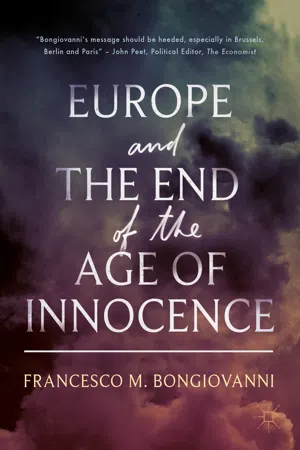
"Bongiovanni's message should be heeded, especially in Brussels, Berlin and Paris" – John Peet, Political Editor, The Economist
- English
- ePUB (mobile friendly)
- Available on iOS & Android
eBook - ePub
Europe and the End of the Age of Innocence
About this book
Information
Topic
Negocios y empresaSubtopic
Negocios en general© The Author(s) 2018
Francesco M. BongiovanniEurope and the End of the Age of Innocencehttps://doi.org/10.1007/978-3-319-74370-7_11. Introduction
Francesco M. Bongiovanni1
(1)
http://www.francescobauthor.com
Any fool can know. The point is to understand.
Albert Einstein
End AbstractApart from deserving my gratitude, anyone who read my first book, The Decline and Fall of Europe , is entitled to ask whether this sequel is really justified. Have things changed so much since the book was published in 2012 that a new one is necessary, or is this just the old dish being warmed up? To this legitimate question the returning reader needs a clear answer—as much as I needed one before deciding to embark on this new writing adventure. The fact is, sadly, that there have been dramatic new developments—most as sudden as they were unexpected—which have caused Europe to find itself today on a significantly more worrisome trajectory than the one I had anticipated in my first book. Interestingly, some of the people who, back then, suggested that The Decline and Fall of Europe was too pessimistic now say it was perhaps not pessimistic enough. This change in mood reflects the simple truth that, since 2012, the situation in Europe has considerably deteriorated across many dimensions and the changes are starting to directly and visibly affect a vast number of people. On top of a general worsening in ways that had largely been predicted at the time, new developments have piled up that may take the continent into uncharted, dangerous territory. I am therefore afraid that the answer to the above question is that it is high time to re-examine the situation in Europe .
The Decline and Fall of Europe was intended to be a 360 degree tour, offering a balanced description of the European ‘system’ and of the intractable challenges facing Europe, which were leading to inexorable decline across any dimension one cared to analyse. Among these, the transformation of the welfare state into the unsustainable ‘Civilization of Entitlements’ that was bound to condemn parts of Europe to gradual impoverishment (which I have at times jocularly taken to illustrate as follows in my speeches: ‘you can have long vacations or you can have the money for long vacations, but you can’t have both’); the crisis of a single currency built on a flawed architecture; the vast inefficiencies of the EU’s Tinguely Machine and so on. The purpose of the book was to try to figure out what was really going on and where it could take Europe, concluding that ‘the quality of life our children will know will be inferior to the quality of life we have enjoyed in the past half century’.1 At the time The Decline and Fall of Europe was published, Europeans were still by and large in denial. Subjects such as failed immigration and integration policies, and the Islamization of Europe ’s open societies were still mostly considered taboo. A major publishing house I had approached about translating the book for distribution in France replied that while what the book said was true and mattered, the French were not ready to hear such truths. Similarly, publishers I approached in Germany, Italy, Spain and Scandinavia showed scant interest in translating the book for distribution in their own countries. It seemed that Europeans didn’t really want to know (or perhaps they already knew everything, or the book wasn’t good enough). The book therefore remained available only in its original English language and generally did much better in North America , the United Kingdom and Asia than in continental Europe . I was invited to give some speeches, lectures and TV interviews outside Europe. The point I am making here is that non-Europeans seemed far more interested in understanding the plight of Europe than Europeans themselves, whose main concern appeared to be to ensure that their privileged way of life would continue.
How much things have changed since then! Europeans have by and large woken up to the first tremors of the Titanic scraping against the iceberg. By early 2017 most of them were finally conscious of the frightening realities they were facing and recognized that there was no room left for blissful denial—a sea change from their attitude five years earlier. Something had clearly evolved in the collective European psyche, and denial had given place to bewilderment, fear and anger. These feelings translated into the recent and spectacular rise of ‘alternative politics’ across most of the continent, a development that could lead to dangerous territory if historical precedent is any indication. Europeans are now affected enough, worried enough, angry enough that they finally show significant interest in trying to understand what is hitting them (this will hopefully cause my books finally to be translated!). Consider, for instance, the controversial issue of the Islamization of European societies . New interest in this issue translated into the phenomenal success of Phillippe Houllebecq ’s 2015 book Submission,2 a political-fiction novel set in 2022 in a France governed by its first president from an Islamic party. One can agree or disagree with the relevance of Houllebecq ’s book, but the fact remains that it sold 120,000 copies in France in five days upon its January 2015 launch, and became a top seller in Italy and Germany as well. This awakening does not, however, necessarily mean Europeans will collectively muster the will and courage to take appropriate measures to steer the ship away from the iceberg, assuming one can figure out what the appropriate measures should be. Unfortunately, I see very little chance of this happening and profess complete trust in the ability of governing political ‘elites’ to ensure that the ship holds its course steady to hit the iceberg, head on and at full speed. The reader will, by the way, notice that throughout this book the word ‘elites’ (in the context of European or Western political elites) is set within quote marks, reflecting the difficulty I encounter in associating the mediocre class of people guiding the Western world today with the very word ‘elite’.
Allow me to confess something personal. Writing a book on Europe is quite demanding, particularly if one carries out one’s own research, as I did for both books. This was all the more so in my case, since writing and researching takes away precious time from my interests in business and composing music. Unfortunately, not much money is to be made by writing such a book. So, my motivation had to come from some other direction. I wrote The Decline and Fall of Europe because of the shock I experienced when I came back from spending 15 years in the dynamic continent that is Asia only to find a Europe busy tying a rope around its own neck. I was then prompted to write Europe and the End of the Age of Innocence because the slow decay I had predicted in the first book appeared to have been replaced by a potentially swifter and more turbulent end game.
It seems that as Europeans are finally becoming interested in knowing more about their destiny and the reality surrounding them, they are realizing that they cannot rely on their political leaders, governments or the mainstream media to always tell the truth. Social media is not necessarily better. All of these players have been compromised, time and again caught lying, hiding facts, fabricating or manipulating information to advance their own interests or ideology-driven agendas. Having woken up from a long state of slumber and denial, the average European hungers for information but has become very suspicious of what he/she is fed, and rightly so. Written by an average European who put himself through the difficulties of trying to find out what was really going on, Europe and the End of the Age of Innocence is a small contribution to the need for a balanced and informative view, which I hope is laid out in a way that everybody can read and understand. To my readers, I should like to reiterate that I am no scholar, journalist, historian, political scientist or politician, nor do I harbour ambitions of becoming any of these. I am an ordinary man who decided to undertake a new journey of discovery to find out a bit more about today’s Europe, put these findings on paper and share them with you. Once again, ‘Trying to make sense of all the material turned out to be like one of these games where you connect the dots and slowly see patterns emerging.’3 No one is entirely impervious to outside influence or can wholly shed his/her own education and background; yet I have attempted to write a book devoid of ideological bias, laying out the facts as well as I could given my limited research capabilities and, apart from a few instances where I can’t resist venturing an opinion, I generally leave it to the reader to reach his/her own conclusions.
Had the trajectory followed by Europe been more or less in line with the findings laid out in The Decline and Fall of Europe , I wouldn’t have bothered to write a sequel, and you wisely wouldn’t have considered reading it had I done so. Yet, to name just a few of the unexpected and sudden developments that made necessary a reassessment of Europe’s state of affairs, who would have predicted, just a year before Brexit , let alone back in 2012, that the UK would leave Europe—the first time since the end of the Second World War that the European integration process has been officially put in reverse? Who would have said, back in 2012, that Marine le Pen would have had a significant chance of winning France’s 2017 presidential election with a programme intending to lead Europe’s second-largest country down the path of far-right nationalism and outside Europe and the eurozone , potentially reducing the European project to a chapter in history books? Who would have said, even in 2016, that the German general election of September 2017 would result, for the first time since the end of the Second World War, in a far-right nationalist party entering parliament and that Germany would find itself without a government? Who would have imagined that German Chancellor Angela Merkel would suddenly and unilaterally open her country’s doors to a human tsunami fleeing what American journalist George Friedman aptly calls the ‘world of chaos’, causing the death of Schengen, and fracturing Europe along East–West lines (just as mismanagement of the euro fractured Europe along North–South lines)? Who would have said that the placid Merkel would take actions that would contribute in no small measure to Brexit , to the rebirth of nationalism and the explosion of alternative politics across the continent? The issue of ‘others’ has now inserted itself prominently into the forefront of European life and politics. The ‘trilogy’ formed by unwanted mass immigration (UMI) , by the creeping yet increasingly visible Islamization of Europe’s open societies and of their Euromuslim minorities (by which I mean Muslims living in Europe), and by the daily Jihadist terrorist acts that have become Europe’s ‘new normal’, has replaced the economy and jobs as the main topic of conversation across the continent and constitutes a key focus of this book. Will Europe’s open societies and cherished way of life survive this onslaught? As I am writing these lines, I just heard on the news that another bombing took place in a London subway with dozen wounded and that yet another soldier was stabbed by a Jihadist in France. By the time you finish reading the first section of this book, it is likely that further Jihadist attacks will have taken place, that several thousand more migrants from Africa or the Middle East will have reached European shores and that a few hundred million euros of taxpayer money will have been spent dealing with UMI . The ‘trilogy’ is dramatically changing the broad socio-political landscape, to the great surprise of the mediocre and clueless traditional political ‘elites’ who, having fallen prey to a new form of seductive, multiculturalist and post-national ideology, have mostly chosen to ignore reality and the grievances of their constituencies (the fact, however, that politicians who tell the truth don’t enjoy long careers means ordinary people carry their share of responsibility). Where can this sea change take Europe?
And let’s not forget the Trump presidency—another unexpected development with profound implications for an increasingly fragmented Europe that may have to fend for itself more and more in an increasingly unstable world. After a long absence, geopolitics is inviting itself to Europe’s table, where it is finding a reluctant, bewildered and unprepared host. As if all this were not enough, Germany has become Europe’s de facto ruler, a position for which its qualifications are dubious at best. Granted, Berlin has probably not coveted this position and more likely finds itself in it as a consequence of France’s not-so-slow collapse and the United Kingdom’s recent estrangement. Germany’s policies in relation to the euro—in particular, its misplaced insistence on fiscal austerity measures and refusal to entertain any idea of economic solidarity —have ravaged southern economies and cast serious doubts on the viability of the single currency. Since Germans see Germany first (and who can blame them?) and Germany does not deliver the ‘international public goods’ (by which I mean things that a nation does but that other nations perceive as being also beneficial to them) that would contribute to its legitimacy as leader of Europe and benefit the rest of its partners, the ship scrapes the iceberg with no qualified captain on deck. The very recent and surprising dose of instability injected into German politics will make things even more difficult for Europe. Some of the challenges just mentioned couldn’t have been anticipated in The Decline and Fall of Europe , yet others could perhaps have been anticipated, constituting shortcomings of my previous analysis which it is now time to set right. To understand the plight of Europe, we are compelled to take a closer look at these and other issues in the course of the book. We shall also take a fresh look at what happened—or rather, what didn’t happen—to the euro after 2012, and what it means for the future of the single currency. We shall take a look at the geopolitical impact of the USA’s very recent inroads into European energy markets and the relationship with the Ukrainian crisis. Covering all issues affecting Europe today is an impossible task, so we shall focus on selected ones, among which what I call the ‘trilogy’ figures prominently. As stated above, this in my opinion is to a large extent responsible for Europe’s very recent and dramatic political transformation.
Zooming out to look at the broader picture one can see that Europe is not alone in its predicament. The entire ‘Western world’ seems to have lost its compass. The West in general doesn’t seem to know what it stands for anymore, or where it wants to go. Perhaps this is due to the ‘fatigue’ of a Western civilization on the declining slope of its life curve—it is, after all, the destiny of civilizations, to come and go, just as anything ‘alive’ does. Perhaps because it is fast losing the absolute and relative pre-eminence among civilizations it was used to enjoying for many centuries. Or perhaps because it is tearin...
Table of contents
- Cover
- Front Matter
- 1. Introduction
- Part I. The Trilogy
- Part II. A Brief History of How to Mess Things Up
- Back Matter
Trusted by 375,005 students
Access to over 1.5 million titles for a fair monthly price.
Study more efficiently using our study tools.
Frequently asked questions
Yes, you can cancel anytime from the Subscription tab in your account settings on the Perlego website. Your subscription will stay active until the end of your current billing period. Learn how to cancel your subscription
No, books cannot be downloaded as external files, such as PDFs, for use outside of Perlego. However, you can download books within the Perlego app for offline reading on mobile or tablet. Learn how to download books offline
Perlego offers two plans: Essential and Complete
- Essential is ideal for learners and professionals who enjoy exploring a wide range of subjects. Access the Essential Library with 800,000+ trusted titles and best-sellers across business, personal growth, and the humanities. Includes unlimited reading time and Standard Read Aloud voice.
- Complete: Perfect for advanced learners and researchers needing full, unrestricted access. Unlock 1.5M+ books across hundreds of subjects, including academic and specialized titles. The Complete Plan also includes advanced features like Premium Read Aloud and Research Assistant.
We are an online textbook subscription service, where you can get access to an entire online library for less than the price of a single book per month. With over 1.5 million books across 990+ topics, we’ve got you covered! Learn about our mission
Look out for the read-aloud symbol on your next book to see if you can listen to it. The read-aloud tool reads text aloud for you, highlighting the text as it is being read. You can pause it, speed it up and slow it down. Learn more about Read Aloud
Yes! You can use the Perlego app on both iOS and Android devices to read anytime, anywhere — even offline. Perfect for commutes or when you’re on the go.
Please note we cannot support devices running on iOS 13 and Android 7 or earlier. Learn more about using the app
Please note we cannot support devices running on iOS 13 and Android 7 or earlier. Learn more about using the app
Yes, you can access Europe and the End of the Age of Innocence by Francesco M. Bongiovanni in PDF and/or ePUB format, as well as other popular books in Negocios y empresa & Negocios en general. We have over 1.5 million books available in our catalogue for you to explore.