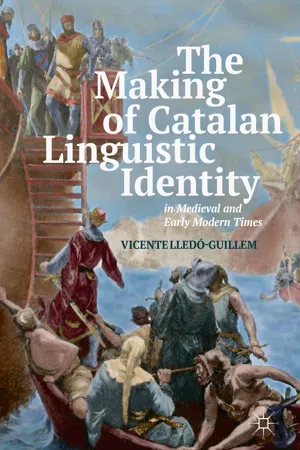
The historical relationship between the Catalan and Occitan languages had a definitive impact on the linguistic identity of the powerful Crown of Aragon and the emergent Spanish Empire. Drawing upon a wealth of historical documents, linguistic treatises and literary texts, this book offers fresh insights into the political and cultural forces that shaped national identities in the Iberian Peninsula and, consequently, neighboring areas of the Mediterranean during the Middle Ages and the Early Modern Period. The innovative textual approach taken in these pages exposes the multifaceted ways in which the boundaries between the region's most prestigious languages were contested, and demonstrates how linguistic identities were linked to ongoing struggles for political power. As the analysis reveals, the ideological construction of Occitan would play a crucial role in the construction of a unified Catalan, and Catalan would, in turn, give rise to a fervent debate around 'Spanish' language that has endured through the present day. This book will appeal to students and scholars of historical linguistics, sociolinguistics, Hispanic linguistics, Catalan language and linguistics, anthropological linguistics, Early Modern literature and culture, and the history of the Mediterranean.
eBook - ePub
The Making of Catalan Linguistic Identity in Medieval and Early Modern Times
- English
- ePUB (mobile friendly)
- Available on iOS & Android
eBook - ePub
The Making of Catalan Linguistic Identity in Medieval and Early Modern Times
About this book
Information
© The Author(s) 2018
Vicente Lledó-GuillemThe Making of Catalan Linguistic Identity in Medieval and Early Modern Timeshttps://doi.org/10.1007/978-3-319-72080-7_11. Introduction
Vicente Lledó-Guillem1
(1)
Romance Languages and Literature, Hofstra University, Hempstead, NY, USA
The rise of the different Romance languages after the fall of the western Roman Empire is a long-debated topic of historical linguistics.1 Since the sixteenth century and until the present day, scholars have wondered how it was possible that a highly standardized imperial language such as Latin evolved into so many Romance languages in different parts of Europe . Certainly, Latin had a uniform vocabulary , spelling and grammar , to such an extent that, for example , the Latin grammars written by Donatus (fourth century C.E.) and Priscian (sixth century C.E.) became the models for the grammars of other languages in the Middle Ages and the Early Modern Period .2 Furthermore, the Latin alphabet is widely used in the writing systems of many languages, and Latin vocabulary has had a considerable influence because of its prestige . This uniform and prestigious language has been called Classical Latin . However, the uniformity of Classical Latin was a mirage, since the vast majority of the population of the Empire spoke different varieties of the Latin language. These different varieties have been grouped together with the name Vulgar Latin or Proto-Romance , which never had a uniform vocabulary , spelling system , or grammar . Once Rome ceased to be an imperial political center at the end of the fifth century C.E., the different varieties of spoken Latin were open to different interpretations . On the one hand, they could have been interpreted as part of a unified language called Latin , as had been the case during the Roman Empire. On the other hand, the interpretation of linguistic difference throughout the western Roman Empire could follow the political remapping of Europe after the Fall of Rome.
Clearly, the latter interpretation prevailed in the course of history, and an ideologically unified Vulgar Latin or Proto-Romance was transformed into politically independent languages with their own distinctive writing systems beginning mainly in the thirteenth century.3 Had the Proto-Romance area been unified politically, these Romance languages may have never been delineated and people would have continued to refer to their respective regional varieties as Latin . Furthermore, had the political history of Medieval Europe been different, we could today be witness to the existence of a different number of Romance languages, with different names, and with a quite different geographical and social distribution . In fact, as Ralph Penny indicates, the creation of a Romance language was intimately connected to a central political entity powerful enough to invest considerable energy and resources into constructing a language that would represent that political power (1999, 51–52).
We must bear in mind that a fundamental aspect of this linguistic construction was the naturalization of the process by which Latin had been transformed into particular Romance languages. It was important to demonstrate and convince the population that Latin had evolved according to the characteristic or unique features of a given territory or society , in such a way that language had essentially followed a natural process that respected the natural divisions of humanity . By naturalizing the transformation of Latin into particular Romance languages, some of the concrete historical circumstances that made possible the construction of different languages must be disregarded or effectively erased. While this process of naturalization occurred principally during the nineteenth century, one can observe instances of “linguistic nationalism ” of social elites already during the thirteenth century, when some of the Romance languages were given a specific written name for the first time.4 Linguistic differentiation was not always easy to establish in the Romance world , especially in those areas where boundaries had been imposed quite abruptly due to political circumstances. One of those areas was the Catalan-Occitan area.
Nowadays, most language historians agree that Catalan is a unique and clearly differentiated Romance language. According to August Rafanell , there may be some disagreements as to the name that Catalan should have received as a language, but its separate identity is rarely questioned. The use of Catalan extends from a few kilometers north of Perpignan in France to a few kilometers south of Alicante in Spain , and from the west of Lleida to the Sardinian city of Alguer . The Corbières plateau in present-day France is considered the geographical feature that separates Catalan to the south from Occitan to the north, with an invisible line of isoglosses found i...
Table of contents
- Cover
- Front Matter
- 1. Introduction
- Part I. The Political Use of the Occitan Language by the Catalan-Aragonese Monarchy
- Part II. The Interpretation of the Catalan-Occitan Relationship in the Construction of the Spanish Empire
- Back Matter
Trusted by 375,005 students
Access to over 1.5 million titles for a fair monthly price.
Study more efficiently using our study tools.
Frequently asked questions
Yes, you can cancel anytime from the Subscription tab in your account settings on the Perlego website. Your subscription will stay active until the end of your current billing period. Learn how to cancel your subscription
No, books cannot be downloaded as external files, such as PDFs, for use outside of Perlego. However, you can download books within the Perlego app for offline reading on mobile or tablet. Learn how to download books offline
Perlego offers two plans: Essential and Complete
- Essential is ideal for learners and professionals who enjoy exploring a wide range of subjects. Access the Essential Library with 800,000+ trusted titles and best-sellers across business, personal growth, and the humanities. Includes unlimited reading time and Standard Read Aloud voice.
- Complete: Perfect for advanced learners and researchers needing full, unrestricted access. Unlock 1.5M+ books across hundreds of subjects, including academic and specialized titles. The Complete Plan also includes advanced features like Premium Read Aloud and Research Assistant.
We are an online textbook subscription service, where you can get access to an entire online library for less than the price of a single book per month. With over 1.5 million books across 990+ topics, we’ve got you covered! Learn about our mission
Look out for the read-aloud symbol on your next book to see if you can listen to it. The read-aloud tool reads text aloud for you, highlighting the text as it is being read. You can pause it, speed it up and slow it down. Learn more about Read Aloud
Yes! You can use the Perlego app on both iOS and Android devices to read anytime, anywhere — even offline. Perfect for commutes or when you’re on the go.
Please note we cannot support devices running on iOS 13 and Android 7 or earlier. Learn more about using the app
Please note we cannot support devices running on iOS 13 and Android 7 or earlier. Learn more about using the app
Yes, you can access The Making of Catalan Linguistic Identity in Medieval and Early Modern Times by Vicente Lledó-Guillem in PDF and/or ePUB format, as well as other popular books in Languages & Linguistics & Languages. We have over 1.5 million books available in our catalogue for you to explore.