eBook - ePub
Quandaries of School Leadership
Voices from Principals in the Field
- English
- ePUB (mobile friendly)
- Available on iOS & Android
eBook - ePub
Quandaries of School Leadership
Voices from Principals in the Field
About this book
This book provides insights into the everyday practices of school leaders as told through the real-life stories of principals. The editors and their contributors blend practice with theory, helping aspiring leaders to discover that school leadership is not simply putting prescribed solutions into action, but a constant encounter with quandaries that demand thinking, responding, and adjusting to the situations at hand. Readers build their capacities to view quandaries from multiple lenses, consider a variety of responses, and draw conclusions based on perspectives that may vary from those initially identified. The chapter authors encourage a sharper self-awareness of what scholars value and envision about education, encouraging them to think about how to navigate decision-making through a variety of theoretical frameworks and practices while balancing their own leadership platform development.
Information
Topic
EducationSubtopic
Education Administration© The Author(s) 2018
Debra J. Touchton, Mariela A. Rodríguez, Gary Ivory and Michele Acker-Hocevar (eds.)Quandaries of School Leadershiphttps://doi.org/10.1007/978-3-319-59120-9_11. The Journey Begins
Debra J. Touchton1
(1)
Stetson University, DeLand, FL, USA
Debra J. Touchton
Leadership development is a life-long journey. It is not an event; it is a process. Vaill (1989) asserts in his book Managing as a Performing Art: New Ideas for a World of Chaotic Change that management/leadership is a performing art. Have you ever thought of leadership that way? I had not until reading his book (1989).
He states:
If management is a performing art, the consciousness of the management is transformed, I think. One becomes much more interested in the quality of the process and much more aware of how a given course of action does or does not resemble other things that one has done or not done (p. 1544).
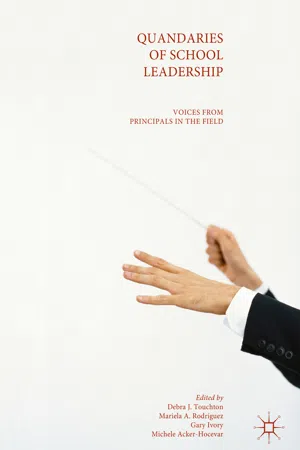
We want you to see this book as a piece of sheet music, the map to your own leadership development; the school leader as the conductor; the school as the orchestra. Using this metaphor , the chapter authors assist you, the conductor, as you create your own music to lead your school. Let’s think about the conductor: What does a conductor do? The orchestra conductor leads the musicians with exactness, inspiration, and passion. Isn’t that how effective, successful school leaders conduct the music of teaching and learning? You will read more about this concept of leadership as a performing art in the contributions by John Mancinelli and Michele Acker-Hocevar (Chap. 2), and by Gary Ivory and Rhonda McClellan (Chap. 13).
This book provides you with four products:
- 1.Descriptions of quandaries faced by real school leaders in the twenty-first century, told to us in their own words. These leaders provide vivid and compelling views of the world in which you work or aspire to work. Your work as an educational leader will be largely about facing quandaries, such as those our principals described.
- 2.A variety of different perspectives: (a) those of principals who participated in focus groups across the nation; (b) theoretical frameworks introduced to you that offer insight into patterns of behavior; (c) those of the chapter authors; and (c) additional resources found within each chapter.
- 3.Reflective questions, providing you with the opportunity to think about how you might resolve quandaries that principals have faced in their lives and work as they described them in focus groups. Your solutions may be as multifaceted as the quandaries.
- 4.The opportunity to develop a leadership platform that reflects your knowledge, values, and beliefs based on quandaries that principals have faced in the field. This platform is your own perspective on education and educational leadership. It is a reminder of what you think is valuable, and important to know and remember—an ethical compass of sorts—suggesting the direction you might take and not regret later.
What’s in This Book for Me?
In each chapter, you will be given a glimpse into principals’ work through excerpts from the Voices 3 focus transcripts. The principals’ contributions portray quandaries that they faced. The chapter authors introduce theoretical frameworks for you to think about while you examine a principal’s quandary. The authors’ job is to make addressing each quandary complicated, while your job is to anticipate the various viewpoints of stakeholders so as to consider a multitude of solutions about how you might address the quandaries, and what responses and reactions might occur. The authors have included reflection questions. Some have chosen to embed these within the chapter while others have added them at the end of their chapter. Either way, the questions are a way for you to ponder the quandaries, as well as further develop and enhance your leadership platform and cognitive sophistication when thinking about solutions.
The Voices 3 Research Project
The voices you encounter in these chapters are real. In a project entitled Voices from the Field: Phase 3 (Voices 3), researchers across the USA conducted focus groups in which the interviewer asked questions and encouraged a conversation among the participants (Acker-Hocevar et al. 2009). Between 2003 and 2006, thirteen principal focus groups were conducted around the country in small and medium-sized school districts. The gender and ethnicity of the eighty-four principals in the study are shown in Table 1.1.
Table 1.1
Principals’ demographics
Gender | African American | European American | Hispanic | Other | Not reported | Total |
|---|---|---|---|---|---|---|
Female | 7 | 18 | 5 | 7 | 6 | 43 (50.6%) |
Male | 3 | 29 | 4 | 3 | 2 | 41 (48.2%) |
Total | 10 (11.8%) | 47 (55.3%) | 9 (10.6%) | 10 (11.8%) | 9 (10.6%) | 84 (100%) |
The focus group questions were based on Murphy’s (2006) “anchors” for school-leadership preparation . Principals were asked to share their perspectives on (1) the No Child Left Behind Act (in force at the time of the study); (2) doing what’s best for children; and (3) how they involve “other people wanting to have a voice in decision making” (Acker-Hocevar et al. 2012, p. 4). The focus groups’ conversation were transcribed and analyzed, and the stories presented within the chapters come directly from these transcripts. Each Voices 3 principal cited in this book has been given a number to ensure confidentiality. Some chapter authors have supplemented the Voices 3 data with interviews they have conducted with other principals. Those principals are not numbered.
Professional Standards for Educational Leaders
When conceiving of and compiling this book, the chapter authors were asked to address one of the ten Professional Standards for Educational Leaders (PSELs) that most related to their chapter. The National Policy Board for Educational Administration adopted the PSELs in 2015 (NPBEA 2015). The PSELs replaced the Interstate School Leaders Licensure Consortium (ISLLC) Standards. Like the ISLLC Standards, the PSELs were designed to guide policy , to frame most licensure examinations, and to outline the competencies needed by today’s school leaders. The ten standards are listed below and are explained further in Chap. 3:
- 1.Mission, Vision, and Core Values
- 2.Ethics and Professional Norms
- 3.Equity and Cultural Responsiveness
- 4.Curriculum, Instruction, and Assessment
- 5.Community of Care and Support for Students
- 6.Professional Capacity of School Personnel
- 7.Professional Community for Teachers and Staff
- 8.Meaningful Engagement of Families and Community
- 9.Operations and Management
- 10.School Improvement
Quandary: What Is It?
You may be asking yourself, “What is a quandary?” The Oxford English Dictionary defines it as a state of uncertainty over what to do in a difficult situation. A few synonyms to further the understanding of a quandary are predicament, trouble, mess, and dilemma. Principals encounter many situations and chall...
Table of contents
- Cover
- Frontmatter
- 1. The Journey Begins
- 2. Understanding Role-Making in Leadership Performance
- 3. Developing a Leadership Platform: Using and Understanding the Professional Standards for Educational Leaders
- 4. The Ambiguity in Clarifying Expectations
- 5. Ethics: Acting Ethically to Promote Each Student’s Academic Success and Well-Being
- 6. Principals Supporting English Learners in US Public Schools
- 7. Quandaries of Assessment and Accountability
- 8. Emotional Intelligence as a Means to Combat Funding Cuts: Meeting Student Academic Success and Promoting Well-Being in Challenging Financial Times
- 9. Elementary School Principals Supporting the Professional Capacity of Teachers
- 10. Shared Voice and Vision: Fostering Professional Communities for Student Success
- 11. Leadership and Resource Allocation in Schools: Applying Micropolitical Perspectives
- 12. Leadership for Change
- 13. Leadership Development and the Study of Expertise
- Backmatter
Trusted by 375,005 students
Access to over 1.5 million titles for a fair monthly price.
Study more efficiently using our study tools.
Frequently asked questions
Yes, you can cancel anytime from the Subscription tab in your account settings on the Perlego website. Your subscription will stay active until the end of your current billing period. Learn how to cancel your subscription
No, books cannot be downloaded as external files, such as PDFs, for use outside of Perlego. However, you can download books within the Perlego app for offline reading on mobile or tablet. Learn how to download books offline
Perlego offers two plans: Essential and Complete
- Essential is ideal for learners and professionals who enjoy exploring a wide range of subjects. Access the Essential Library with 800,000+ trusted titles and best-sellers across business, personal growth, and the humanities. Includes unlimited reading time and Standard Read Aloud voice.
- Complete: Perfect for advanced learners and researchers needing full, unrestricted access. Unlock 1.5M+ books across hundreds of subjects, including academic and specialized titles. The Complete Plan also includes advanced features like Premium Read Aloud and Research Assistant.
We are an online textbook subscription service, where you can get access to an entire online library for less than the price of a single book per month. With over 1.5 million books across 990+ topics, we’ve got you covered! Learn about our mission
Look out for the read-aloud symbol on your next book to see if you can listen to it. The read-aloud tool reads text aloud for you, highlighting the text as it is being read. You can pause it, speed it up and slow it down. Learn more about Read Aloud
Yes! You can use the Perlego app on both iOS and Android devices to read anytime, anywhere — even offline. Perfect for commutes or when you’re on the go.
Please note we cannot support devices running on iOS 13 and Android 7 or earlier. Learn more about using the app
Please note we cannot support devices running on iOS 13 and Android 7 or earlier. Learn more about using the app
Yes, you can access Quandaries of School Leadership by Debra J. Touchton, Mariela A. Rodríguez, Gary Ivory, Michele Acker-Hocevar, Debra J. Touchton,Mariela A. Rodríguez,Gary Ivory,Michele Acker-Hocevar in PDF and/or ePUB format, as well as other popular books in Education & Education Administration. We have over 1.5 million books available in our catalogue for you to explore.