The book is the first to cover all areas of privatization in Israel and one of the first to do so in general, including state infrastructure, immigration policy, land, health, education, welfare, regulation, and policy design. As such, it offers a comprehensive volume for students, policy makers, and scholars interested in the economic, sociological, political, and legal perspectives of a major policy trend that has changed the face and character of the modern state. In addition, it is a vital contribution to those who have an interest in changes in Israeli society, politics, and economy.
eBook - ePub
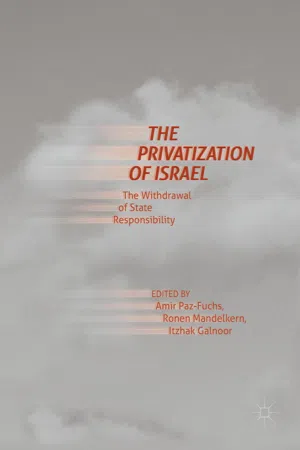
The Privatization of Israel
The Withdrawal of State Responsibility
- English
- ePUB (mobile friendly)
- Available on iOS & Android
eBook - ePub
The Privatization of Israel
The Withdrawal of State Responsibility
About this book
Information
© The Author(s) 2018
Amir Paz-Fuchs, Ronen Mandelkern and Itzhak Galnoor (eds.)The Privatization of Israelhttps://doi.org/10.1057/978-1-137-58261-4_11. Privatizing Israel: An Introduction
Ronen Mandelkern1, 2 and Amir Paz-Fuchs3
(1)
School of Political Science, Government and International Affairs, Tel Aviv University, Tel Aviv-Yafo, Israel
(2)
Chazan Center, The Van Leer Jerusalem Institute, Jerusalem, Israel
(3)
School of Law, Politics and Sociology, University of Sussex, Brighton, UK
Ronen Mandelkern (Corresponding author)
Amir Paz-Fuchs
Introduction
“Revolutionary”, “Transformational”, “Unprecedented” (e.g., Gutwein 2003). These are only some of the expressions used to describe the change that the Israeli political economy underwent in a mere 20 years. The common analysis suggests that Israeli economic and social institutions were established during the pre-state period and consolidated in the early 1950s on a collectivist foundation but, since the mid-1980s (some would say the late-1970s, when the Labor Party lost the general elections for the first time), after those foundations began to crumble, industries and services were privatized, labor unions were downsized to a role that is a faint relic of their omnipotent past and, as a consequence, inequality and poverty grew substantially.
The case of the Israeli political-economic transformation seems to be, at least in terms of its vast scope, unprecedented. Political economies tend to have institutionalized configurations and, despite changes in government, which sometimes lead to changes in policy , they tend to preserve their basic structures (Campbell 2004; Hall and Soskice 2001). Like welfare states, which have been analogized to “elephants on the move”, prevailing political-economic structures are normally subject only to minor and gradual change of direction (Hacker 2004; Pierson 1996; Streeck and Thelen 2005). A transformative upheaval of the kind and depth seen in relation to the Israeli political economy is exceptional, and deserves special attention.
How did this come to pass? Accepted wisdom suggests that the (neo)liberal streak, which was latent and disparaged in Israel’s first 30 years, gained credence, ideologically and professionally, following the economic meltdown that occurred in the early 1980s. Professional economists who were schooled under neoliberal guidance warned against reckless government policy in advance, and successfully saved the economy from the brink. In the aftermath, they were rewarded with significant public legitimacy, which was converted into institutionalized political influence (Mandelkern 2015, 2017). The most prominent manifestation of that dynamic was the legal empowerment of the two state bodies that were led from the 1950s onwards by Israeli economists: the Ministry of Finance and the Bank of Israel (Maman and Rosenhek 2011). These two bodies played a crucial role in “liberating” Israeli financial and labor markets from the stronghold of the government and the labor unions and, most relevant for present purposes, led an unabashed policy of privatization of government industries, corporations, and services (Shalev 1999).
In this respect, Israel exemplifies well, perhaps even paradigmatically, the ubiquitous shift toward privatization of economic enterprises, public utilities, and public and social services. Against this background, this book aims to explore how these far-reaching transformations took place, what they included and what were their effects. In this sense, this book will provide important insights not only for students of Israel but also for those interested in how privatization, and neoliberalism more generally, affects employment and social and political relations across society.
At the same time, the Israeli case also demonstrates how the interaction between the forces of privatization and other forces shaping public policy produces complex results in practice. The national forces upon which the formation of the Israeli state was formed continue to influence Israel’s public policies (Mandelkern and Shalev, forthcoming). In some cases, national and privatization trends counter each other; while in others they interact in more subtle and unexpected ways. In other words, and given the strong political power of national identity in the Israeli context, this case also reveals how the political power of nationalism interacts with that of neoliberalism. In this context, we should note that we see the Israeli experience as comparable in many significant ways to that of other countries (cf. Levi-Faur 1998). Accordingly, this book shows that privatization in Israel, as well as its limits, has been shaped by normative, ideological, economic, and political influences that are present in other countries.
This introductory chapter includes three sections. The first provides a conceptual background for the rest of the book, focusing on defining privatization and its various possible manifestations. The second provides a political-economic background that places Israeli privatization policies in their concrete—and to a certain degree unique—historical context. The third section provides an overview of the book and its organizing logic.
Privatization: A Conceptual Introduction
The remit of this book is vast, covering areas as diverse as public utilities and education , security and welfare services, and much in between. As scholars of these fields often arrive from a wide range of disciplines—including (but not exclusively) law, political science, sociology, education , geography, and public policy —they may well disagree not only on theory and application but also on the foundational understandings of the concepts themselves. Bearing in mind the task ahead, we have made a conscious decision not to offer an independent contribution to the conceptual analysis of privatization and related concepts (outsourcing, liberalization, etc.). However, we find that it is useful to state, at the outset, how we understand the term “privatization” as it used throughout this book.
The debate over the meaning of privatization has been a vibrant one for over 30 years. In a narrow, traditional sense, privatization refers to the transfer of ownership from the state, a local authority or one of their subsidiaries to a business entity or to a third-sector organization (commonly referred to as an NGO (OECD 2002)). For the purposes of this book, however, we adopt a wider understanding of the term. Generally speaking, privatization will refer to a process which shifts the boundaries between the state (also known as “the public”) and the business or third sector (“the private”). Therefore, it will include not only the transfer of ownership, but also the following: (i) employment of user charges (“fiscal privatization”) for public services (on this see Paz-Fuchs 2017); (ii) contracting-out, or outsourcing, in which services are still paid for by the public authority, but are operated by non-state actors; and (iii) privatization by omission, which refers to the authorities’ decision (or nondecision) not to fund new social initiatives or to cut funding for existing social initiatives, thus creating a quantitative and/or qualitative gap between public demand and actual supply of services, which is filled by non-state actors.
It will be apparent that conceptual issues have surfaced within this brief outline of privatization. Thus, outsourcing includes a wide range of practices. For example, one may want to distinguish between the government’s use of a private construction company for a social housing project or to build a bridge, on the one hand, and its use of a company to run a prison or a shelter for victims of domestic violence. The first involves a fixed term contract, offered to a company that has gained expertise in an area where the government is lacking, based on parameters that are easily reducible to exact parameters. The latter is an open-ended contract for the provision of “soft services”, which are not easily quantifiable, in an area that has traditionally been the preserve of the state. A further instance of outsourcing has attracted attention in Israel in recent years: the engagement of individual consultants, or small firms, to plan, negotiate, draft contracts (including procurement contracts), supervise, and regulate on behalf of the government. The fact that the government continues to pay for these services and goods, in all their permutations, has led some to argue th...
Table of contents
- Cover
- Front Matter
- 1. Privatizing Israel: An Introduction
- 2. Privatization Policy: The Burden of Proof
- Part I. Privatization of Public Assets
- Part II. Privatization of the Israeli Welfare State
- Part III. Privatization of the State
- Part IV. Social and Political Aspects
- Back Matter
Trusted by 375,005 students
Access to over 1.5 million titles for a fair monthly price.
Study more efficiently using our study tools.
Frequently asked questions
Yes, you can cancel anytime from the Subscription tab in your account settings on the Perlego website. Your subscription will stay active until the end of your current billing period. Learn how to cancel your subscription
No, books cannot be downloaded as external files, such as PDFs, for use outside of Perlego. However, you can download books within the Perlego app for offline reading on mobile or tablet. Learn how to download books offline
Perlego offers two plans: Essential and Complete
- Essential is ideal for learners and professionals who enjoy exploring a wide range of subjects. Access the Essential Library with 800,000+ trusted titles and best-sellers across business, personal growth, and the humanities. Includes unlimited reading time and Standard Read Aloud voice.
- Complete: Perfect for advanced learners and researchers needing full, unrestricted access. Unlock 1.5M+ books across hundreds of subjects, including academic and specialized titles. The Complete Plan also includes advanced features like Premium Read Aloud and Research Assistant.
We are an online textbook subscription service, where you can get access to an entire online library for less than the price of a single book per month. With over 1.5 million books across 990+ topics, we’ve got you covered! Learn about our mission
Look out for the read-aloud symbol on your next book to see if you can listen to it. The read-aloud tool reads text aloud for you, highlighting the text as it is being read. You can pause it, speed it up and slow it down. Learn more about Read Aloud
Yes! You can use the Perlego app on both iOS and Android devices to read anytime, anywhere — even offline. Perfect for commutes or when you’re on the go.
Please note we cannot support devices running on iOS 13 and Android 7 or earlier. Learn more about using the app
Please note we cannot support devices running on iOS 13 and Android 7 or earlier. Learn more about using the app
Yes, you can access The Privatization of Israel by Amir Paz-Fuchs, Ronen Mandelkern, Itzhak Galnoor, Amir Paz-Fuchs,Ronen Mandelkern,Itzhak Galnoor in PDF and/or ePUB format, as well as other popular books in Politics & International Relations & Middle Eastern Politics. We have over 1.5 million books available in our catalogue for you to explore.