This book offers an alternative analysis of the various theories and dimensions of green and environmental justice which are rooted in political economy. Much green criminological literature sidelines political economic theoretical insights and therefore with this work the authors enrich the field by vigorously exploring such perspectives. It engages with a number of studies relevant to a political economic approach to justice in order to make two key arguments: that capitalism has produced profound ecological injustices and that the concept of ecological justice (human and ecological rights) itself needs critiquing. Green Criminology and Green Theories of Justice is a timely text which urges the field to revisit its radical roots in social justice while broadening its disciplinary horizons to include a meaningful analysis of political economy and its role in producing and responding to environmental harm andinjustice.
eBook - ePub
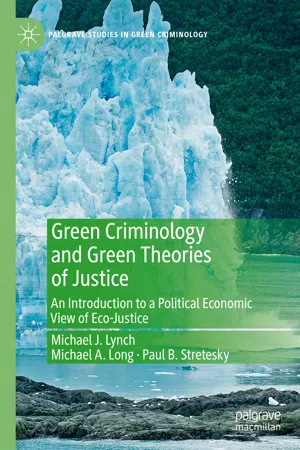
Green Criminology and Green Theories of Justice
An Introduction to a Political Economic View of Eco-Justice
- English
- ePUB (mobile friendly)
- Available on iOS & Android
eBook - ePub
Green Criminology and Green Theories of Justice
An Introduction to a Political Economic View of Eco-Justice
About this book
Information
© The Author(s) 2019
M. J. Lynch et al.Green Criminology and Green Theories of JusticePalgrave Studies in Green Criminologyhttps://doi.org/10.1007/978-3-030-28573-9_11. Introduction: Green Theories of Justice and Political Economy
Michael J. Lynch1 , Michael A. Long2 and Paul B. Stretesky3
(1)
Department of Criminology, University of South Florida, Tampa, FL, USA
(2)
Department of Sociology, Stillwater, OK, USA
(3)
Department of Social Sciences, Northumbria University, Newcastle, UK
The world system, the treadmill of production, Gaia, metabolic rift, planetary boundaries, the human ecological footprint, political economy—these are terms that have not been widely employed within green criminology in the analysis of green crime, environmental law and eco-justice issues. They are, however, theories and phrases employed in the environmental sociology and ecological Marxist literatures and in natural science literature to address problems related to discussions exposing the problem of ecological destruction, the extent of ecological destruction and its measurement, and the state of the world’s ecosystem(s), and also to explanations for why ecological destruction occurs. Here, we make extensive use of these terms to develop a green criminological theory of eco-justice—which we present in segments—that draws on political economic, environmental sociological and scientific explanations of contemporary environmental crises.
The term eco-justice, as we review in a later chapter, has been employed in prior literature in various fields, and even within green criminology (White 2013). In White’s view, eco-justice can be or has been examined from three perspectives: through the use of an environmental justice approach that addresses ecological harms that affect humans; via an ecological justice approach that examines ecological harms against the environment; and as an extension of a species justice approach directed toward exploring ecological harms against nonhuman animals. This broad classification of green justice or eco-justice certainly has its uses and facilitates the organization of the kinds of theories of green/eco-justice to which green criminologists have and might refer. In the present work, our focus is on eco-justice specifically in relation to theories that we suggest can be anchored to political economic theory. This unique view of theories of eco-justice is developed in separate chapters focused on how concepts such as the ecological footprint, planetary boundaries and so forth (noted earlier) can be conceptualized from a political economic perspective. In focusing on a political economic view of eco-justice, it is not our intent to provide a critique of other approaches green criminologists have employed to discuss eco-justice or green justice or any other descriptors green criminologists have used. Our intent is to provide another view of eco-justice which can be used alongside of existing views as a supplement to augment those approaches, or to replace those views. The decision about whether to use our approach or any other view is, of course, up to any particular individual green criminologist to make, and we are not arguing for the superiority of our view, or that it should replace views others have or will continue to employ.
This book examines several structural viewpoints related to the problem of ecological justice in the contemporary world from a political economic vantage point. Those discussions are relevant to conceptualizing what we will call eco-justice—which we define later as a particular view of justice situated ecologically, analyzed within the context of political economic theory and guided by the incorporation of scientific research on ecological concerns. This book proposes a political economic theory of eco-justice in order to provide a unique vantage point for addressing the problem of justice and injustice that stems from the production of ecological harms. Again, in taking up this position, we are particularly interested in developing a political economic discussion of eco-justice that we believe is useful for clarifying a more general understanding of green justice. This structural approach is consistent with conceptualizing a green criminology that is written from a political economic perspective (Lynch 1990; Lynch et al. 2013; Stretesky et al. 2013).
Political economic approaches to green criminology owe a great deal to environmental sociology. In environmental sociology, a political economic explanatory revolution took place with regard to the analysis of environmental issues spearheaded by Catton and Dunlap’s (1978, Dunlap 1997) critiques of the anthropocentric tendencies sociology exhibits in the analysis of environmental/ecological issues, and how those approaches intersect with the development of an environmental sociology that takes as its main concern the society-nature intersection. In their review of the society-nature intersection literature in sociology, Goldman and Schuman (2000: 565) argued that the existing literature on that intersection must be examined in light of political economic structures. A similar claim can be made about green criminology and its treatment of the society-nature intersection. The political economic approach to eco-justice we take here is an effort to better promote that view within green criminology and illustrates the ways in which a political economic approach toward green criminology increasingly intersects with and integrates into environmental sociology.
In previous works we have taken up a political economic orientation to a variety of environmental/green issue, but in those prior works we have not completed an extensive or full-blown analysis of eco-justice issues from the perspective of political economy. For example, in previous works we have explored the political economic approach as it applies to the following issues/topics/kinds of analyses: (1) empirical and theoretical analysis of environmental justice, such as the unequal distribution of pollution across communities with different racial, ethnic and class characteristics (Stretesky and Lynch 1998, 1999, 2002; Lynch and Stretesky 1998, 1999; Lynch et al. 2001; Kosmicki and Long 2016); (2) the analyses of environmental penalties in relation to justice and environmental justice concerns, illustrating how community race, ethnic and class characteristics relate to and impact penalties applied to environmental/green offenders (Lynch and Stretesky 2013b; Lynch et al. 2004a, 2004b; Stretesky and Lynch 2011; Stretesky et al. 2013b; Long et al. 2012); (3) the study of how the political economic structure of global trade relations influences the production of carbon dioxide pollution (Stretesky and Lynch 2009), and how the treadmill of production impacts ecological disorganization including pollution outputs (Long et al. 2018), ecological withdrawals (Long et al. 2017) and wildlife trade (Stretesky et al. 2018); (4) analysis of state crimes of global warming which facilitates eco-injustice by driving the production of climate change pollution (Lynch and Stretesky 2010, 2012; Lynch, Burns and Stretesky 2010); (5) the development of environmental justice movements (Stretesky et al. 2011; Stretesky et al. 2012; Stretesky et al. 2017); (6) the intersection of social and environmental justice issues for Native Americans (Lynch and Stretesky 2012, 2013b; Lynch et al. 2018a); (7) the assessment of media analysis of ecological crimes and the presentation of power relationships and harm in those analyses (Lynch et al. 2000; Lynch et al. 1989); and (8) a variety of other eco-justice issues related to the following: planetary boundaries (Long et al. 2014); nonhuman animal harms (Stretesky et al. 2013a); green victimization of children in schools (Barrett et al. 2016); the intersection of social and ecological justice for workers (Lynch 2016a), and the poor (Lynch et al. 2018b); eco-city models of justice and victimization (Lynch 2013; Lynch and Boggess 2015, 2016); environmental enforcement and biases associated with informal community water monitoring organizations in the United States (Lynch and Stretesky 2013b); inequality/difference in court sentencing (Cochran et al. 2018); deterrence of environmental offenders (Barrett et al. 2018); the relationship between ecological disorganization and crime (Stretesky et al. 2017); and how political economic organization affects community power structures, the unequal production of green crime and the unequal distribution of access to green justice (Lynch 2016b). None of these studies, however, offer a complete or well-developed political economic view of eco-justice. In considering this body of work, one of the other criticisms we have of our own efforts in this area is its failure to make more evident the larger political economic theory and assumptions that stand behind these individual studies that relate to various forms of green (in)justice.
In other words, in the various studies noted above, we have repeatedly made reference to the problem of ecological and environmental justice issues pertinent to green criminology without, however, elaborating a more general political economic theory of green justice that informs our analysis and without specifically laying out the political economic roots of those analyses in any specific form. We have not, until now, felt it necessary to elaborate the larger structural-political economic model of green justice and eco-justice that we have employed as the basis for these works. However, with the expansion of research on green justice issues from different points of view, we believe additional clarification of the relevance of a political economic approach of eco-justice is important and can contribute to further development of the green criminological position on eco-justice.
Much of the discussion of green forms of justice/injustice in the green criminological literature is based on the analysis of justice issues impacting nonhuman species that has been influenced by the significant theoretical and historical work done on this issue particularly by Piers Beirne (1999, 2002, 2007, 2009) and Ted Benton (1998). Given the purpose of the current work—discussing the structural and political economic origins of green criminological perspectives on justice—we will not review the content of Beirne’s arguments here and leave this subject with our acknowledgment of its significant contribution to green criminology, a contribution that is easily identified through any analysis of the green criminological literature. The reason we do not directly take up a more “general” theoretical or philosophical approach to nonhuman eco-justice (NHEJ) is that this form of analysis has been taken up by others in more elaborate (and well-argued) forms (e.g., Beirne 1999; Cazaux 1998, 1999; Nurse 2016; Sollund 2011). But what has been missing from those analyses is a consideration of the political economic dimensions of eco-justice for nonhuman animals, a point we will elaborate upon in the chapters that follow in different ways.
In our own work, we have examined a variety of situations in which data is analyzed to address the presence/absence of environmental (in)justice. The goal of such studies is to typically determine one of two things. First, following the original definition of environmental justice, whether the distribution of environmental hazards and exposure to toxins and pollutants...
Table of contents
- Cover
- Front Matter
- 1. Introduction: Green Theories of Justice and Political Economy
- 2. Connecting Ecological Decline and Eco-justice
- 3. Eco-justice and an Orientation toward the Ecosystem
- 4. Human Social & Ecological Justice in the Global World Capitalist System and the Treadmill of Production
- 5. Unsustainable Economic Development and Nonhuman Ecological Justice
- 6. Gaia and a Green Theory of Justice
- 7. Metabolic Rift and Eco-justice
- 8. Political Economy, Food and Eco-justice
- 9. Conclusion
- Back Matter
Trusted by 375,005 students
Access to over 1.5 million titles for a fair monthly price.
Study more efficiently using our study tools.
Frequently asked questions
Yes, you can cancel anytime from the Subscription tab in your account settings on the Perlego website. Your subscription will stay active until the end of your current billing period. Learn how to cancel your subscription
No, books cannot be downloaded as external files, such as PDFs, for use outside of Perlego. However, you can download books within the Perlego app for offline reading on mobile or tablet. Learn how to download books offline
Perlego offers two plans: Essential and Complete
- Essential is ideal for learners and professionals who enjoy exploring a wide range of subjects. Access the Essential Library with 800,000+ trusted titles and best-sellers across business, personal growth, and the humanities. Includes unlimited reading time and Standard Read Aloud voice.
- Complete: Perfect for advanced learners and researchers needing full, unrestricted access. Unlock 1.5M+ books across hundreds of subjects, including academic and specialized titles. The Complete Plan also includes advanced features like Premium Read Aloud and Research Assistant.
We are an online textbook subscription service, where you can get access to an entire online library for less than the price of a single book per month. With over 1.5 million books across 990+ topics, we’ve got you covered! Learn about our mission
Look out for the read-aloud symbol on your next book to see if you can listen to it. The read-aloud tool reads text aloud for you, highlighting the text as it is being read. You can pause it, speed it up and slow it down. Learn more about Read Aloud
Yes! You can use the Perlego app on both iOS and Android devices to read anytime, anywhere — even offline. Perfect for commutes or when you’re on the go.
Please note we cannot support devices running on iOS 13 and Android 7 or earlier. Learn more about using the app
Please note we cannot support devices running on iOS 13 and Android 7 or earlier. Learn more about using the app
Yes, you can access Green Criminology and Green Theories of Justice by Michael J. Lynch,Michael A. Long,Paul B. Stretesky in PDF and/or ePUB format, as well as other popular books in Social Sciences & Trade & Tariffs. We have over 1.5 million books available in our catalogue for you to explore.