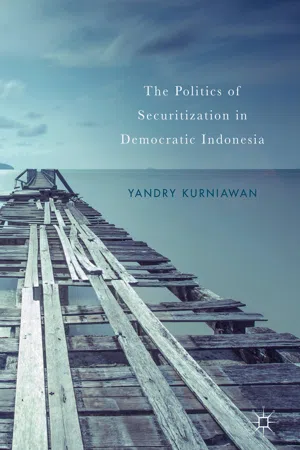
The book presents a novel analytical perspective on Indonesia's security policies during its transition to democracy. Kurniawan's analysis revolves around extraordinary measures and normal politics in response to the existential threat to the Indonesian state. This perspective is at the centre of the analysis which examines the process of securitization and desecuritization taken by the Indonesian government. This volume is essential reading for practitioners, students of Indonesian politics and researchers alike.
- English
- ePUB (mobile friendly)
- Available on iOS & Android
eBook - ePub
The Politics of Securitization in Democratic Indonesia
About this book
Information
© The Author(s) 2018
Yandry KurniawanThe Politics of Securitization in Democratic Indonesia https://doi.org/10.1007/978-3-319-62482-2_11. Introduction
Yandry Kurniawan1
(1)
Department of International Relations, University of Indonesia, Jawa Barat, Indonesia
Global political affairs in the last 200 years have been characterized by a constant pursuit of democracy through the process of democratization. Huntington’s waves of democracy,1 for instance, show us that the first wave of democratization on the global stage was started in the USA back in 1828 and reached its peak in 1922. The second wave began at the end of World War II and reached its peak in 1962 (Kurzman 1998: 43). Finally the third wave began when the Portuguese Flower Revolution took place in 1974, which initially encompassed Southern Europe and Latin America and eventually Eastern Europe, Asia, and Africa (Kurzman 1998: 43; Croissant and Merkel 2004: 1).
Why do we need democracy? A general explanation usually refers to the core definition of liberal democracy. This theory argues that democracy guarantees free elections; the separation of state’s power; independent government institutions; effective civilian control over the military, political, and civic pluralism; equality before the law; individual and group freedoms; and so forth (Bünte and Ufen 2009: 6). Another canonical answer relies on the conventional wisdom of democratic peace. At the global level, the proponents of democratic peace have long argued that “democratically governed states rarely go to war with each other or even fight each other at low levels of lethal violence” (Russett 1993: 25). At the domestic level, the democratic peace argument holds that democratic regimes are able to defuse potential violence by diverting popular discontent into institutionalized channels. Dissident movements do not need to resort to organized violence against state authorities since they can redress their grievances through many forms of non-violent collective action. Such an argument is also supported by statistical analyses that reveal an “inverted U-curve” relationship between repression and civil violence. The U-curve suggests that established democracies are less susceptible to civil war. In short, the benefits of peaceful negotiations in a democracy exceed the benefits of violent conflict (Mason 2003: 26).
Unfortunately, the transition itself to democracy is anything but an easy process.2 Previous studies have addressed this issue and shown the significant relationship between democratic transition and the outbreak of violent conflicts, both in the domestic arena3 and in the international sphere (manifested in interstate wars).4 These studies posit a relatively similar argument in explaining the outbreak of violent conflicts, especially during the early stages of the democratic transition . Sources of shortcomings during any transition include the threatened old elites, a widening of the political spectrum, the inflexible interests of newly developed groups and lack of time to accommodate those interests, the weakening of the central authority,5 a high level of political participation,6 the uncertainties of the transition process due to new and multiple centers of power and decision-makers,7 and weak political institutions.8 All in all, these shortcomings can be summarized by repeating Huntington’s argument that “the typical problem of political development is the gap between high levels of political participation and the weak integrative institutions to reconcile the multiplicity or contending claims” (Mansfield and Snyder 1995: 22) .
The relation of democratization and conflict, as presented above, is supported by the empirical, historical record on the pattern of violent conflicts in the world, particularly in the second half of the twentieth century. The record shows that between 1945 and 1999 there were twenty-five interstate wars resulting in a total of 3.3 million battle deaths, but 127 domestic violent conflicts took place, which resulted in 16.2 million battle deaths (Mason 2003: 19). Some areas where massive democratic transitions took place in the second half of the last century, such as Latin America, Africa, Asia, as well as Central and Eastern Europe, have become the site of almost all domestic violence conflicts. Take some cases, for instance, in the former Yugoslavia, the Caucasus, and Indonesia, where the democratic transition coincided with a rise in national independence movements, spurring separatist warfare (Mansfield and Snyder 2002a: 297) . In number, “of the nearly 100 countries considered as ‘transitional’ in recent years, only a relatively small number—probably fewer than twenty—are clearly en route to becoming successful, well-functioning democracies or at least have made some democratic progress and still enjoy a positive dynamic of democratization” (Croissant and Merkel 2004: 2) . Perhaps, Indonesia, the country central to this study, may fall into this category.
Indonesia’s security dynamics have been through a dramatic change since the collapse of Suharto’s New Order Regime on 21 May 1998. During the period prior to, and after the collapse of the regime, the country once again experienced one of the most severe internal conflicts in its history. It began with a series of massive student protests, followed by the kidnapping of students and activists, the May riots in Jakarta in 1998, other riots in some parts of the archipelago, communal conflicts, and the re-emergence of long suppressed secessionist movements. Soon after Suharto stepped down and the country started its democratic transition, Indonesia suddenly turned into one of the most conflict-prone areas in the world. This fact can be seen both in the outbreak of horizontal conflicts between different groups of society and in the vertical conflicts. In the latter case, local political contenders verbally and physically challenged the legitimacy of the central government. To summarize the scene of the day, in its earlier phase of transition Indonesia had to deal with at least three separatist movements, three violent communal conflicts, and a number of riots. As for the transnational security challenge, Indonesia suffered at least thirty terrorist bomb attacks from 1999 to 2009. And piracy, for example, scored its highest number attacks worldwide in Indonesian waters during the period 1998–2003.9 Such a situation caused some observers to start speculating about the breakup of Indonesia (Aspinall and Berger 2001; Emmerson 2000) and commenting about how violence must be embedded in the Indonesian culture (Collins 2002).
However, after roughly seven years of the democratization process, Indonesia has shown a certain degree of positive achievements in both mitigating conflicts and democratizing the country. The terminations of the conflicts in Aceh and Maluku serve as good examples. To a certain degree, the peace in Aceh was not achieved by the military defeat of the separatist group; instead peace was agreed upon in a negotiated manner with the signing of the Helsinki Peace Treaty between the conflicting parties in 2005. In the same vein, the termination of the conflict in Maluku was not through territorial occupation by the military, but with the signing of the Malino Peace Treaty between various hostile groups in this area. Even more, both treaties were the result of the initiative of the ministry of people’s welfare. Furthermore, no violent conflict in Indonesia has been recorded in the UCDP/PRIO Armed Conflict Dataset since 2005.10 Also, Freedom House upgraded Indonesia’s democratic status from “partly free” to “free” in 2006, and with that, Indonesia is the only “free” country in the Southeast Asian region.11 Compared to its regional neighbors in Southeast Asia like Malaysia and Thailand, “where democratic constitutions are stagnating, if not backsliding, Indonesia, has cemented its status as Southeast Asia’s political role model” (Beech 2009). These facts, just to name few, show that Indonesia has moderately succeeded in managing its rocky transition and has cemented itself as one of the most vibrant democratizing states in the first decade of the twenty-first century.
The initial factor of the democratic transition in Indonesia was bringing Suharto’s authoritarian regime of the New Order era to an end. This regime was directly and indirectly supported by the Indonesian armed forces (Angkatan Bersenjata Republik Indonesia/ ABRI, later on Tentara Nasional Indonesia/ TNI) . During this period, the Indonesian military institutions performed a wide range of functions beyond the conventional one, namely defense. For a long period of time, the military had been actively engaged in the daily political routines and had enjoyed a deeply rooted existence and influence at the national and local levels of the country’s political and institutiona...
Table of contents
- Cover
- Frontmatter
- 1. Introduction
- 2. Securitization Theory: A Theoretical Framework
- 3. A Historical Overview on the State of Emergency and Martial Law in Indonesia
- 4. The Indonesian Political Changes, (In)Security, and Securitization
- 5. Securitization and Desecuritization Dynamics in the Aceh Separatist Movement
- 6. Securitization and Desecuritization Dynamics in the Maluku Communal Conflict
- 7. Conclusion: Securitization–Desecuritization Dynamics in Indonesia’s Democratization
- Backmatter
Trusted by 375,005 students
Access to over 1.5 million titles for a fair monthly price.
Study more efficiently using our study tools.
Frequently asked questions
Yes, you can cancel anytime from the Subscription tab in your account settings on the Perlego website. Your subscription will stay active until the end of your current billing period. Learn how to cancel your subscription
No, books cannot be downloaded as external files, such as PDFs, for use outside of Perlego. However, you can download books within the Perlego app for offline reading on mobile or tablet. Learn how to download books offline
Perlego offers two plans: Essential and Complete
- Essential is ideal for learners and professionals who enjoy exploring a wide range of subjects. Access the Essential Library with 800,000+ trusted titles and best-sellers across business, personal growth, and the humanities. Includes unlimited reading time and Standard Read Aloud voice.
- Complete: Perfect for advanced learners and researchers needing full, unrestricted access. Unlock 1.5M+ books across hundreds of subjects, including academic and specialized titles. The Complete Plan also includes advanced features like Premium Read Aloud and Research Assistant.
We are an online textbook subscription service, where you can get access to an entire online library for less than the price of a single book per month. With over 1.5 million books across 990+ topics, we’ve got you covered! Learn about our mission
Look out for the read-aloud symbol on your next book to see if you can listen to it. The read-aloud tool reads text aloud for you, highlighting the text as it is being read. You can pause it, speed it up and slow it down. Learn more about Read Aloud
Yes! You can use the Perlego app on both iOS and Android devices to read anytime, anywhere — even offline. Perfect for commutes or when you’re on the go.
Please note we cannot support devices running on iOS 13 and Android 7 or earlier. Learn more about using the app
Please note we cannot support devices running on iOS 13 and Android 7 or earlier. Learn more about using the app
Yes, you can access The Politics of Securitization in Democratic Indonesia by Yandry Kurniawan in PDF and/or ePUB format, as well as other popular books in Politics & International Relations & Asian Politics. We have over 1.5 million books available in our catalogue for you to explore.