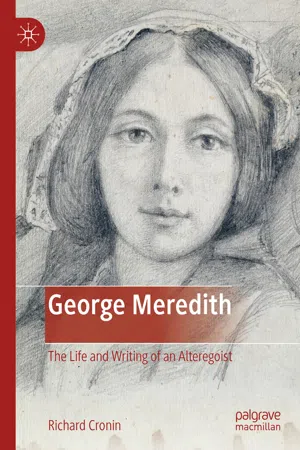
George Meredith: The Life and Writing of an Alteregoist is not only a critical biography of the Victorian novelist and poet George Meredith but also a portrait of the novel in the later nineteenth century. Interweaving analysis of Meredith's novels and poems with discussion of his life, Richard Cronin focuses primarily on the books Meredith read and wrote—arguing that novels by the end of the nineteenth century were shaped as much by the reading as by the experience of their writers. Cronin places Meredith's novels in relation to the work of his contemporaries including Henry James, Thomas Hardy, and George Gissing. Organized thematically, the book explores Meredith's personal side—including his hostility to biography, his origins as the son of a tailor, his marriages—as well as his reading habits, and the prose style that is the most complete expression of his strange but compelling personality.
- English
- ePUB (mobile friendly)
- Available on iOS & Android
eBook - ePub
About this book
Information
© The Author(s) 2019
R. CroninGeorge Meredithhttps://doi.org/10.1007/978-3-030-32448-3_11. Meredith and the Personal
Richard Cronin1
(1)
University of Glasgow, Glasgow, UK
Richard Cronin
Concealing
Meredith hated the thought that he might become the subject of a biography. ‘Horribly will I haunt the man who writes memoir of me,’1 he wrote to Edward Clodd, the agnostic and evolutionist. It was a pointed threat. At the time Clodd was engaged in a biography of a fellow agnostic and evolutionist, the novelist Grant Allen. Meredith was 71 by then and already knew that the biography he dreaded was inevitable. A year later, in 1900, he explained to a young correspondent that he was careful to write only ‘blunt letters’, letters that gave away little of himself, as a shield against ‘the memoir or biography few can now escape’.2 I doubt if he was acting simply out of policy. Even when he was writing to close friends, even when he was being bawdy or loving, Meredith’s letters remain oddly impersonal. The Egoist, Sir Willoughby Patterne, acknowledges, ‘I am not completely myself in my letters.’3 Meredith might have said the same. His letters suggest a man who was never at his ease when what he was supposed to be doing was being himself. But Meredith was certainly sincere in his wish to deter biographers, and Clodd at least was deterred. He did not attempt a biography of Meredith. He confined himself to a brief article in the Fortnightly Review, ‘George Meredith: Some Recollections’,4 published a few weeks after Meredith died.
Meredith’s anxiety was longstanding. In 1891 the journalist Clement Shorter had suggested that he might include a chronology of Meredith’s life and writings as a preface to a new edition of his novel, The Tragic Comedians. Meredith was appalled. ‘This “Chronology” must be quashed,’ he wrote: ‘Here is the citation of pieces of work which I wish to forget and see forgotten. And personal matter too!’ ‘There is no excuse’, he insisted, ‘for heading the book with such stuff.’5 In 1901 he was astonished by rumours that he was writing his own life: ‘I see in the papers that I am writing an autobiography. I would as soon think of composing a treatise on the origin of Humpty-Dumpty.’6 He was chief reader for the publishing firm of Chapman and Hall, and in 1899, when the manuscript of Janet Ross’s autobiography, Early Days Recalled, was submitted to him, he grudgingly recommended publication. Forty years before, in 1859, while he was writing Evan Harrington, Meredith had been in love with Janet Ross, then Janet Duff Gordon, or imagined that he was. But the letter that he wrote to her was less than encouraging:
It is the kind of book done by volatile German ladies. You will be discreeter, and yet the book must necessarily be of that kind of skeleton-cupboard and desk-drawer prattle; the artless prattler archly appealing to a gracious audience and picking up her bouquets. She becomes a figurante.7
A figurante was a ballet dancer, a woman whose art consisted in an indecorous display of her own body to the public gaze. Meredith sharply refused Janet Ross’s permission to make use of his own letters to her. They were ‘entirely private communications; there is nothing in them for the public’.8 Ten years later, Edward Clodd asked him whether he had kept any letters from Grant Allen that might be of use to him as Allen’s biographer, and Meredith responded just as sharply: ‘In this matter of letters I treat my friends as I wish they should treat me and reserve not one for the public maw.’9
He brusquely rebuffed correspondents who wrote asking for personal information. ‘I cannot refer you to any published account of the personal me,’ he told one of them.10 With a German critic who planned to write a book about him he was still more emphatic, ‘All that is needed to say of me should be found in Men of the Times. I do not minister to gossip.’11 Meredith does not specify which edition of Men of the Time he has in mind, but all editions are uninformative. The 1879 edition, for example, describes him as a ‘novelist, born in Hampshire about 1828, and educated partly in Germany’. He was ‘brought up to the law, which he quitted for literature’. There follows a list of his publications, pretty accurate except that it includes Mary Bertrand, a novel of 1860 the author of which was a Francis Meredith (no relation).12 Entries on other writers are almost as terse, but the entry on Meredith is exceptional in that it makes no reference at all to his parentage or to his marriages.
Meredith was reminding his German admirer somewhat tartly to confine her interest to the books. George Gissing, a novelist that Meredith has a claim to have discovered, responded similarly to requests for information about his life: ‘My work is my autobiography, which those may read who care to do so.’13 Gissing’s was a view that Meredith often took himself:
Our books contain the best of us. I hold that the public has little to do with what is outside the printed matter beyond hearing that the writer is reputedly a good citizen.14
The tone is a little lofty, but it is easy to sympathise with the sentiment. Meredith took it very far, and maintained it to the very end. Richard H. P. Curle wrote to him after agreeing to contribute the entry for Meredith in Alfred Miles’s splendid anthology The Poets and Poetry of the Nineteenth Century. Each poet’s work was represented by a selection of characteristic poems preceded by a brief biographical introduction. It was the introduction that worried Meredith: ‘I should counsel you to keep from anything personal to me—my portrait, the walk up hill to see the dawn and look over the valley, etc. etc. When I read that form of eulogy I am not impressed.’15 Most men would allow their habits of rising early and taking a walk up Box Hill to be put before the public without protest, but not Meredith. He was 77 when he wrote to Curle, and he had kept up that reluctance to allow the public access to his private life for more than 50 years. It was not a foible peculiar to him. Henry James expressed his ‘utter and absolute abhorrence’ of any attempted biography. He issued ‘a curse no less explicit than Shakespeare’s own on any such as try to move my bones’, and stipulated that all his private papers should be burnt: ‘Then, the pale forewarned victim, with every track covered, every paper burnt and every letter unanswered, will, in the tower of art, the invulnerable granite, stand, without a sally, the siege of all the years.’16 Thomas Hardy was more pragmatic. Aware that he could not prohibit biographers he decided to forestall them. The studiously reticent biography published under the name of Florence Hardy, his second wife, had been almost all of it dictated by Hardy himself. But Meredith’s reticence was more extreme than James’s or Hardy’s.
The first biographer to break Meredith’s embargo, S. M. Ellis, published George Meredith: His Life and Friends in Relation to His Work in 1920, 11 years after Meredith’s death. Ellis was a close relation. The youngest of Meredith’s aunts, Catherine, had married Samuel Burdon Ellis of the Royal Marines. S. M. Ellis was their grandson, which makes him Meredith’s second cousin. Ellis begins with a dramatic flourish: ‘During his lifetime an impenetrable veil of reticence, and, in consequence, of mystery also, hid the facts of George Meredith’s origin and family history and his own early days from public knowledge.’17 Meredith had been born in February 1828, the son of a tailor, a naval outfitter, Augustus Urmston Meredith, who lived above the shop at 73, Portsmouth High Street, and he was ashamed of it. His ‘tailoring parentage was’, according to W. S. Blunt, ‘the secret trouble of his life’.18 His mother died when he was only five. Then, when he was 21, he married Mary Ellen Nicolls, the daughter of Thomas Love Peacock and the widow of Captain Edward Nicolls of the Royal Navy. Eight years later, in 1857, four years after the birth of their son Arthur, his wife left him. She was pregnant by the painter, Henry Wallis. Her second son was born in April the following year. By then Meredith had removed Arthur from her care. He seems to have decided that his wife should never be permitted to see her son again. He relented only in the autumn of 1861, when his wife was dying of Bright’s Disease. It was not just chance that brought Humpty Dumpty to Meredith’s mind when he wanted to explain how unlikely it would be for him to write an autobiography. He and Humpty had something in common. Both of them had a great fall that left them shattered, and Meredith found it just as impossible as Humpty to put his pieces together again.
Meredith decided very early that the best way of coping with his past was to turn his back on it. As he went through life he rolled up his past behind him. In 1849, just before Meredith married, his father emi...
Table of contents
- Cover
- Front Matter
- 1. Meredith and the Personal
- 2. Tailordom
- 3. Mary (Courtship)
- 4. Mary (Marriage)
- 5. Novel People
- 6. Sons
- 7. Marie
- 8. Meredith and the Meredithian
- Back Matter
Trusted by 375,005 students
Access to over 1.5 million titles for a fair monthly price.
Study more efficiently using our study tools.
Frequently asked questions
Yes, you can cancel anytime from the Subscription tab in your account settings on the Perlego website. Your subscription will stay active until the end of your current billing period. Learn how to cancel your subscription
No, books cannot be downloaded as external files, such as PDFs, for use outside of Perlego. However, you can download books within the Perlego app for offline reading on mobile or tablet. Learn how to download books offline
Perlego offers two plans: Essential and Complete
- Essential is ideal for learners and professionals who enjoy exploring a wide range of subjects. Access the Essential Library with 800,000+ trusted titles and best-sellers across business, personal growth, and the humanities. Includes unlimited reading time and Standard Read Aloud voice.
- Complete: Perfect for advanced learners and researchers needing full, unrestricted access. Unlock 1.5M+ books across hundreds of subjects, including academic and specialized titles. The Complete Plan also includes advanced features like Premium Read Aloud and Research Assistant.
We are an online textbook subscription service, where you can get access to an entire online library for less than the price of a single book per month. With over 1.5 million books across 990+ topics, we’ve got you covered! Learn about our mission
Look out for the read-aloud symbol on your next book to see if you can listen to it. The read-aloud tool reads text aloud for you, highlighting the text as it is being read. You can pause it, speed it up and slow it down. Learn more about Read Aloud
Yes! You can use the Perlego app on both iOS and Android devices to read anytime, anywhere — even offline. Perfect for commutes or when you’re on the go.
Please note we cannot support devices running on iOS 13 and Android 7 or earlier. Learn more about using the app
Please note we cannot support devices running on iOS 13 and Android 7 or earlier. Learn more about using the app
Yes, you can access George Meredith by Richard Cronin in PDF and/or ePUB format, as well as other popular books in Literature & Literature General. We have over 1.5 million books available in our catalogue for you to explore.