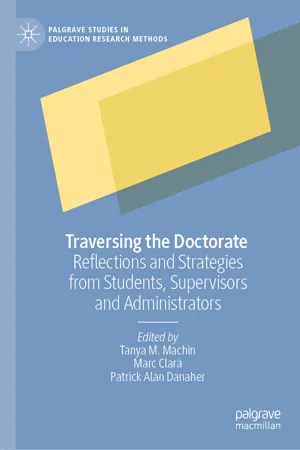
This book explores the multiple ways in which doctoral programs are traversed by students, supervisors and administrators. Rather than proposing a single, homogeneous approach as the most effective form of doctoral education, the editors and contributors focus on the diversity of global approaches to the doctorate, including doctoral experiences from Australia, Finland, Chile, New Zealand and Spain. The doctorate emerges from this analysis as a highly complex, heterogeneous and situated phenomenon that resists easy solutions. Strategies that are successful in traversing the doctorate are found to be grounded in contexts that cannot necessarily be generalised to other situations: in doing so, the authors emphasise the importance of presenting a diverse array of experiences and stories. The separate and shared perspectives of doctoral students, supervisors and administrations are mapped and analysed in ways that bring their voices compellingly to life: this book will be of interest and value to students and scholars of the doctoral journey, as well as of international and comparative education.
eBook - ePub
Traversing the Doctorate
Reflections and Strategies from Students, Supervisors and Administrators
- English
- ePUB (mobile friendly)
- Available on iOS & Android
eBook - ePub
Traversing the Doctorate
Reflections and Strategies from Students, Supervisors and Administrators
About this book
Information
Topic
ÉducationSubtopic
Formation pour adultes© The Author(s) 2019
T. M. Machin et al. (eds.)Traversing the DoctoratePalgrave Studies in Education Research Methodshttps://doi.org/10.1007/978-3-030-23731-8_11. Traversing the Doctorate: Situating Scholarship and Identifying Issues
Tanya M. Machin1 , Marc Clarà2 and Patrick Alan Danaher3, 4, 5
(1)
School of Psychology and Counselling, University of Southern Queensland, Toowoomba, QLD, Australia
(2)
Department of Psychology, University of Lleida, Lleida, Spain
(3)
Faculty of Business, Education, Law & Arts, University of Southern Queensland, Toowoomba, QLD, Australia
(4)
Central Queensland University, Rockhampton, QLD, Australia
(5)
University of Helsinki, Helsinki, Finland
Marc Clarà
Introduction
Research about doctoral students, supervisors and programs is extensive, and continues to grow rapidly. As we elaborate below, the propositions and themes emerging from that research are diverse, and represent assumptions and perspectives from multiple disciplines and paradigms. At the same time, it is possible to discern some common concerns and abiding interests in that research that constitute stable landmarks that in turn facilitate efforts directed at “traversing the doctorate”.
This chapter presents a necessarily distilled overview of selected literature relating to doctoral study and supervision, including highlighting some significant foci of that scholarship. This overview is followed by an account of the book’s structure and organising questions, as well as of the strategies for maximising the rigour of its chapters.
Situating the Scholarship and Identifying Its Issues
The literature related to doctoral study and supervision is both extensive and growing. Moreover, this literature reflects the separate and shared viewpoints of students and supervisors. Some publications highlight the micro-level experiences of individual doctoral research teams, while others draw attention to the wider contexts in which such teams carry out their work.
More specifically, one of the recurring foci in the scholarship pertaining to doctoral study and supervision is the increasing professionalisation of such study and supervision. This professionalisation refers to a move from a largely individualised and private intellectual space to a more clearly defined, visible and accountable set of relationships geared towards the attainment of prespecified outcomes. While some researchers have examined these changes in terms of heightened control and managerialism (e.g., Matos, 2013) and vocationalism (Dahan, 2007), others have viewed such developments as explicit research training, codes of research practice and supervisor training workshops more positively (e.g., Humphrey, Marshall, & Leonardo, 2012; McCulloch & Loeser, 2016). Other indicators of enhanced professionalisation include positing “…that the goal of doctoral supervision is praxis and that this involves a learning alliance between multiple institutional agents grounded in a relational ethics of mutual responsibility” (Halse & Bansel, 2012, p. 377).
Another important focus of the doctoral study and supervision scholarship is the increased concentration on the significance of understanding the experiential knowledge of doctoral students and supervisors. For example, Bastalich (2017) noted “…the need for a greater emphasis on content and context learning within future research and practice around doctoral education” (p. 1145). Engaging with this challenge, Fulton and Hayes (2017) elaborated a “based superstructure model” (p. 1) of a professional doctoral program that included retrospective experiential knowledge. Meloy (2012) presented a lively account of doctoral students’ decision-making processes, reflections on methodology and academic writing strategies. From a different perspective, Gray, Agllias, Schubert and Boddy (2015) applied three feminist research principles to accentuate the centrality of women’s experiences in doctoral study, and Dortch (2016) researched the academic self-efficacy of African American women in doctoral education, while Naidoo (2015) explored the experiences of non-traditional doctoral students through the lens of their habitus. Whitehead (2019) confirmed the wider relevance of self-studies and other publications that explicate the experiential dimension with his assertion that such work contributes “…to creating and democratizing knowledge” (p. 97). We concur that the demystification of doctoral study and supervision through such means as highlighting the experiential dimension can indeed contribute to democratising such study and supervision and to maximising its social impact.
A third significant focus of the doctoral study and supervision scholarship is related to the associations between such doctoral study and supervision on the one hand and broader issues connected with the national and international knowledge economy on the other hand. For instance, Wildy, Peden and Chan (2015) linked the increased popularity of professional doctorates with the respective knowledge economies in Australia, China and Iceland, while Armsby, Costley and Cranfield (2018) stressed the broader significance of doctoral programs: “…a wider understanding of the values and purpose of doctoral education within and beyond the academy that recognises the production of knowledge through practice, and supports ethical social action” (p. 2226). Two different perspectives on conceptualising this broader significance were provided by focusing on knowledge management (Stamou, 2017) and on moral positions (Hancock, Hughes, & Walsh, 2017).
Finally in this section of the chapter, while most of the literature pertaining to doctoral study is understandably written by and for doctoral students and supervisors, it is appropriate to acknowledge the subset of that literature composed from the standpoint of administrators. For example, Pifer and Baker (2016) included program administrators as a distinct group as being able and required to enact distinctive strategies in the authors’ proposed stage-based approach to support in doctoral education. Zhou and Okahana (2019) investigated the relative impact of academic and financial support provided by departmental administrators on doctoral students’ completion times in the United States, while Rockinson-Szapkiw, Spaulding and Spaulding (2016) considered a broader range of administrative and other support services for online doctoral students, also in the United States. Still in the United States, the perceptions of administrators of a doctoral program for nursing students were recorded in relation to the program’s impact on academic staff members (Smeltzer et al., 2017). Likewise, a study by McGovern and Zimmerman (2018) found that administrators play an important role in enhancing the effectiveness of social work doctoral programs in the United States. More widely, Johnson, Nicola and Hobson (2018) evaluated the utility of a whole-of-institution, extended orientation program for doctoral students at an Australian university, concluding that the program “…demonstrates the ways in which ALL practitioners can lead such programs by combining the roles of specialists in academic language and learning and content deliverers with the roles of partnerships and collaboration” (p. A175).
These four foci of the doctoral study and supervision literature—the increasing professionalisation of such study and supervision, understanding doctoral students’ and supervisors’ experiences, links with the national and international knowledge economy, and the influence and interests of program administrators—help to situate the doctoral study and supervision sch...
Table of contents
- Cover
- Front Matter
- 1. Traversing the Doctorate: Situating Scholarship and Identifying Issues
- Part I. Designing the Doctorate
- Part II. Supervising the Doctorate
- Part III. Relationships in the Doctorate
- Part IV. Travelling Through the Doctorate
- Back Matter
Trusted by 375,005 students
Access to over 1.5 million titles for a fair monthly price.
Study more efficiently using our study tools.
Frequently asked questions
Yes, you can cancel anytime from the Subscription tab in your account settings on the Perlego website. Your subscription will stay active until the end of your current billing period. Learn how to cancel your subscription
No, books cannot be downloaded as external files, such as PDFs, for use outside of Perlego. However, you can download books within the Perlego app for offline reading on mobile or tablet. Learn how to download books offline
Perlego offers two plans: Essential and Complete
- Essential is ideal for learners and professionals who enjoy exploring a wide range of subjects. Access the Essential Library with 800,000+ trusted titles and best-sellers across business, personal growth, and the humanities. Includes unlimited reading time and Standard Read Aloud voice.
- Complete: Perfect for advanced learners and researchers needing full, unrestricted access. Unlock 1.5M+ books across hundreds of subjects, including academic and specialized titles. The Complete Plan also includes advanced features like Premium Read Aloud and Research Assistant.
We are an online textbook subscription service, where you can get access to an entire online library for less than the price of a single book per month. With over 1.5 million books across 990+ topics, we’ve got you covered! Learn about our mission
Look out for the read-aloud symbol on your next book to see if you can listen to it. The read-aloud tool reads text aloud for you, highlighting the text as it is being read. You can pause it, speed it up and slow it down. Learn more about Read Aloud
Yes! You can use the Perlego app on both iOS and Android devices to read anytime, anywhere — even offline. Perfect for commutes or when you’re on the go.
Please note we cannot support devices running on iOS 13 and Android 7 or earlier. Learn more about using the app
Please note we cannot support devices running on iOS 13 and Android 7 or earlier. Learn more about using the app
Yes, you can access Traversing the Doctorate by Tanya M. Machin, Marc Clarà, Patrick Alan Danaher, Tanya M. Machin,Marc Clarà,Patrick Alan Danaher in PDF and/or ePUB format, as well as other popular books in Éducation & Formation pour adultes. We have over 1.5 million books available in our catalogue for you to explore.