- English
- ePUB (mobile friendly)
- Available on iOS & Android
eBook - ePub
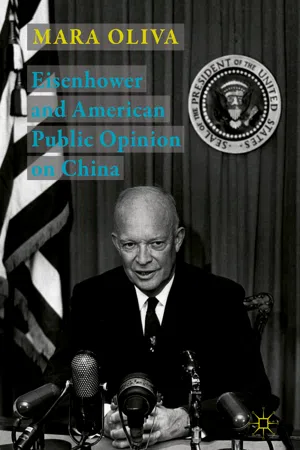
Eisenhower and American Public Opinion on China
About this book
In the 1950s, most of the American public opposed diplomatic and trade relations with Communist China; traditional historiography blames this widespread hostility for the tensions between China and the United States during Dwight D. Eisenhower's presidency. In this book, Mara Oliva reconsiders the influence of U.S. public opinion on Sino-American relations, arguing that it is understudied and often misinterpreted. She shows how the Eisenhower administration's hard line policy towards Beijing had been formulated in line with U.S. national security interests, not as a result of public pressure. However, the public did play a significant role in shaping the implementation, timing and political communication of Washington's strategy, ultimately hampering relations with the Communist giant and seriously heightening the risk of nuclear conflict. Drawing together an extensive array of published and unpublished sources, this book offers a new prism for understanding one of the most difficult decades in the history of both countries.
Information
Topic
StoriaSubtopic
Storia cinese© The Author(s) 2018
Mara OlivaEisenhower and American Public Opinion on Chinahttps://doi.org/10.1007/978-3-319-76195-4_11. Introduction
Mara Oliva1
(1)
Department of History, University of Reading, Reading, UK
Parts of this chapter were originally published in Mara Oliva, “Beaten at Their Own Game: Eisenhower, Dulles, US Public Opinion and the Sino-American Ambassadorial Talks of 1955–1957,” Journal of Cold War Studies 20 (2018): forthcoming.
End AbstractIn November 1943, Columbia University professor and China expert Nathaniel Peffer wrote an article for The New York Times Magazine entitled: “Our Distorted View of China ,” in which he accused missionaries, businessmen, and other Americans who had lived in China of having a sentimental predisposition about everything Chinese . In his view, that had led to the construction of an idealized image of China, as a country willing to embrace American Christianity, medical aid, and political ideas, that in the end, “more harm than good would come out to Sino-American relations.”1
Peffer’s ill-fated prediction came true on October 1, 1949, when the Communists took over mainland China and forced US ally, Nationalist leader Generalissimo Jiang Jieshi (Chiang Kai-shek),2 to withdraw to the island of Taiwan (Formosa). America’s self-centered image of China prevented it from realizing that Chinese politics were far more complex than was imagined. It was absolutely inconceivable to Americans that the Chinese people had voluntarily chosen communism. The only plausible explanation was that Communism had been imposed on them because they had fallen victims to an international conspiracy orchestrated by Moscow . That belief triggered a painful witch-hunt that was famously and shamefully exploited by Wisconsin Republican Senator Joseph McCarthy .3
McCarthy’s search for culprits for the “loss of China ” combined with the Truman administration’s negative propaganda campaign against the People’s Republic of China (PRC) to rally support for the American effort in the Korean War and the terrible stories of atrocities from the front strengthened the already hostile feelings among the American people toward the Chinese Communists . According to several National Opinion Research Center surveys and Gallup polls conducted in the first half of 1950, 62–12% of the general public opposed diplomatic recognition of the Beijing (Peiping) regime, 78% of the respondents opposed the PRC’s admission into the United Nations and 76% opposed trade relations with Communist China .4
The vast historiography on the presidency of Dwight D. Eisenhower and China policy in the 1950s has often blamed that hostile public opinion for the tensions and the lack of diplomatic relations between the US and the PRC . For example, political scientist Hans Morgenthau described US policy toward mainland China as “irrational.” He believed that Washington officials, including the President, wanted to recognize Beijing’s regime, but the administration was prevented “by its fears of public opinion from devising and executing a positive policy of its own.” Similarly, political scientist Leonard Kusnitz, in his extensive quantitative study of US public opinion and America’s China policy between 1949 and 1979, has argued that Eisenhower tried to push changes in China policy, particularly during his second term, but popular hostility blocked any openings toward the Chinese Communists .5
More recently, David Mayers and Rosemary Foot have contended that conservative opinion in the US, represented by the Republican right wing in Congress , was also very influential in preventing alteration in policy toward the PRC . According to both, the President understood as early as 1953 that a review of China policy was necessary. However, pursuing a policy even remotely hinting of conciliation with Mao Zedong (Mao Tse-tung) would have meant challenging McCarthy’s wing of the Republican party, something Eisenhower was not willing to do. Foot further argues that the White House had to wait until the mid-1960s to reassess China policy. It took the Sino-Soviet split combined with Beijing’s newly acquired nuclear capability and the perception that the American strategy had become ineffective for Congress to finally launch its own investigation and the Council of Foreign Relations to initiate a series of studies on the PRC .6
Historian Nancy Bernkopf Tucker went even further in arguing that China was not a major concern for Eisenhower. The President was first and foremost an Atlanticist and believed that the most serious challenge for the US would come from the Soviet Union , not the PRC . His minor interest in Communist China was reflected in a lack of an adequate understanding of the American public’s views of Beijing . He therefore “pursued policies toward China that he did not believe in wholeheartedly because he thought public opinion wanted a hard line stance against Beijing .” This ultimately led to a muddled and disappointing approach to China policy.7
The historiography has also put more emphasis on the role played by Secretary of State John Foster Dulles in shaping China policy. Many, including Tucker and Steven Goldstein, argued that Dulles was the major force in formulating China policy. Similar to the President, he was a prisoner of pressure groups, such as the Committee of One Million against the Admission of the PRC in the United Nations , which had replaced the China Lobby in Congress to advocate support for the Nationalist regime on the island of Taiwan since 1953.8
The purpose of this book is to show that the role that domestic public opinion played in shaping US-China relations in the 1950s has been greatly understudied and misinterpreted. Contrary to traditional historiography, it argues that the Eisenhower administration’s hard line policy toward Beijing had been formulated in line with US national security interests and not as a result of pressure from popular feelings. While public opinion opposed relaxing tensions with the PRC until the middle of 1955, the first Taiwan crisis of 1954–1955 combined with Senator McCarthy’s fall from grace marked a turning point in US popular attitudes toward Beijing . The military crisis particularly forced a significant change in public opinion, not so much a change in how Americans saw the Chinese Communists , but a change in how to deal with the enemy. In the summer of 1954, an overwhelming number of the public, 85%, saw Moscow as the main US enemy. In the spring of 1955, immediately after the threat over the Straits ended, the State Department reported that six out of 10 Americans interviewed considered Communist China to be more dangerous than the Soviet Union and thought World War III would “break out” fairly soon because of the PRC . The same survey also found that 73% of Americans interviewed believed that rather than continuing to antagonize Beijing , it would be better to enter into talks “in order to avoid another global conflict.” President Eisenhower was fully aware of the changing public opinion. An investigation of his public and private papers clearly shows that he kept a careful eye on public opinion in general and more specifically on its views on China. Had he wanted to implement a more flexible policy toward Beijing , he knew he had enough public support.9
Revisionist and post-revisionist scholars such as Fred Greenstein, Stephen Ambrose, and Martin Medhurst have already amply demonstrated how the President intentionally projected an image of warmth and used garbled syntax to deflect criticism, avoid polarization, and retain flexibility to implement his policies. Likewise, they have also dispelled the myth of a US foreign policy being dominated by John Foster Dulles . As historian Richard Immerman asserts, the two men ‘were in a real sense a team,’ because they both shared the same fundamental outlook about international relations and the role the US should play in it. While in public, the President might have given the impression that the GOP and popular feelings or Dulles’ beliefs shaped his China policy, he was in reality in full control of the foreign policy making process.10
Eisenhower believed that the US position in the Far East had considerably weakened since the end of World War II. First, the outcome of the Korean War had elevated Communist China’s image within the Soviet sphere and in Southeast Asia, thereby diminishing US prestige. Second, the PRC was an emergent threat to the US in Asia and had widened the divisions among Western allies. This re-evaluation of China’s role in international relations meant that the “bipolarity which distinguished the immediate post-hostilities period was losing much of its rationale” and Beijing had become a power to be reckoned with. Although a strong China could also create problems for the Kremlin, ultimately, the President believed that the Chinese Communists , as Communists, would continue to maintain a basic hostility for the West in general, and particularly the US.11
Secretary of State Dulles concurred with the President. A Communist China, whether allied with the Soviet Union or not, represented a national security issue for the US in Asia. The US goal was therefore to secure, through a hard line policy, a re-orientation of the Chinese Communist Regime that would not be hostile to the US. That was not possible in the 1950s because China’s military capacities made the invasion of its territory costly and required a commitment of forces that the US was not ready to make after the Korean W...
Table of contents
- Cover
- Front Matter
- 1. Introduction
- 2. America’s Distorted Image of China
- 3. Keeping Promises
- 4. Challenge One: Dien Bien Phu and the Geneva Conference of 1954
- 5. Challenge Two: The First Taiwan Crisis of 1954–1955
- 6. A Missed Opportunity
- 7. Hard Line Until the End
- 8. Conclusions
- Back Matter
Trusted by 375,005 students
Access to over 1.5 million titles for a fair monthly price.
Study more efficiently using our study tools.
Frequently asked questions
Yes, you can cancel anytime from the Subscription tab in your account settings on the Perlego website. Your subscription will stay active until the end of your current billing period. Learn how to cancel your subscription
No, books cannot be downloaded as external files, such as PDFs, for use outside of Perlego. However, you can download books within the Perlego app for offline reading on mobile or tablet. Learn how to download books offline
Perlego offers two plans: Essential and Complete
- Essential is ideal for learners and professionals who enjoy exploring a wide range of subjects. Access the Essential Library with 800,000+ trusted titles and best-sellers across business, personal growth, and the humanities. Includes unlimited reading time and Standard Read Aloud voice.
- Complete: Perfect for advanced learners and researchers needing full, unrestricted access. Unlock 1.5M+ books across hundreds of subjects, including academic and specialized titles. The Complete Plan also includes advanced features like Premium Read Aloud and Research Assistant.
We are an online textbook subscription service, where you can get access to an entire online library for less than the price of a single book per month. With over 1.5 million books across 990+ topics, we’ve got you covered! Learn about our mission
Look out for the read-aloud symbol on your next book to see if you can listen to it. The read-aloud tool reads text aloud for you, highlighting the text as it is being read. You can pause it, speed it up and slow it down. Learn more about Read Aloud
Yes! You can use the Perlego app on both iOS and Android devices to read anytime, anywhere — even offline. Perfect for commutes or when you’re on the go.
Please note we cannot support devices running on iOS 13 and Android 7 or earlier. Learn more about using the app
Please note we cannot support devices running on iOS 13 and Android 7 or earlier. Learn more about using the app
Yes, you can access Eisenhower and American Public Opinion on China by Mara Oliva in PDF and/or ePUB format, as well as other popular books in Storia & Storia cinese. We have over 1.5 million books available in our catalogue for you to explore.