eBook - ePub
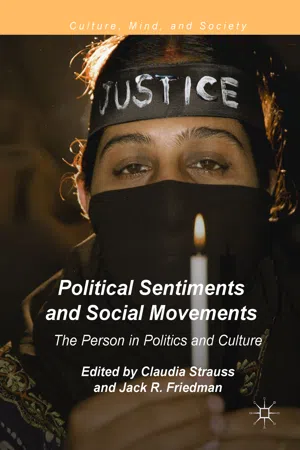
Political Sentiments and Social Movements
The Person in Politics and Culture
- English
- ePUB (mobile friendly)
- Available on iOS & Android
eBook - ePub
Political Sentiments and Social Movements
The Person in Politics and Culture
About this book
Information
© The Author(s) 2018
Claudia Strauss and Jack R. Friedman (eds.)Political Sentiments and Social MovementsCulture, Mind, and Societyhttps://doi.org/10.1007/978-3-319-72341-9_11. Introduction: The Person in Politics and Culture
Jack R. Friedman1 and Claudia Strauss2
(1)
University of Oklahoma, Norman, OK, USA
(2)
Pitzer College, Claremont, CA, USA
Keywords
Political subjectivitiesSocial movementsCulture theoryPsychological anthropologyEmotionsWe are grateful for the feedback of Peter Stromberg, several contributors to this volume, and an anonymous reviewer for Palgrave.
End AbstractThe papers in this volume show how people construct political meanings and become involved—or not involved—in political actions. The stories, commentary, and actions of people in diverse cultural settings provide a deeper understanding of behaviors that are often confusing from a distance. In this introduction, we explain our person-centered approach to politics, place it in relation to other work on politics and social movements, and argue for the insights to be gained from drawing upon the theories and methods of psychological anthropology.
Politics, Culture, and Persons
As many scholars have noted, defining “politics” is tricky. Some definitions limit the realm of politics to issues involving “government as mediator, target, or claimant” (McAdam et al. 2001, p. 5). This would narrowly cast politics as being about what disputants think governments should do. At the other extreme, we could follow the lead of feminists , including many cultural anthropologists, who, in defining politics, point out the way “power is both structured and enacted in everyday activities–notably, in relations of kinship, marriage, and in inheritance patterns, rituals, and exchange systems” (Ginsburg and Rapp 1991, p. 312). This politics of everyday life deliberately highlights the “political” in nearly all interactions. Research from both the narrow and broad paradigms has been extremely valuable, but neither corresponds to the notion of the political we use in this volume. For our purposes, the politics of everyday life is too broad. That research importantly points to power relations that are often hidden, but our focus is on what is disputed. Following Swartz, Turner, and Tuden, we agree “politics always involves public goals” (Swartz et al. 2002 [1966], p. 105), and add that it is about contention regarding goals for some collectivity. Those goals could be material ones about “the allocation of scarce resources in the face of conflict of interests,” as March and Olsen (1989) explain political systems (quoted in Aronoff and Kubik 2013, p. 23), or they could involve competing understandings of collective identities or the grounds for social respect. We believe there is much that can be productively explored by looking at how persons draw upon learned meanings to interpret, psychologically manage, and engage–with varying degrees of hesitation or enthusiasm–with disputed goals and identities in their society. In so doing, however, we keep in mind the contribution of scholars who have shown the way powerful ideas and entrenched structures prevent or obstruct disputes from ever arising about legitimate authority and about the distribution of material and symbolic rewards.
The papers in this volume study politics through case studies of people engaged in (or disengaged from) political contests in Denmark, India, Israel, Jamaica, Kuwait, Nigeria, Romania, and the United States. Many of these cases concern social movements, for example, the Tea Party and Occupy Wall Street in the United States, third gender activism in India, Rastafari in Jamaica, and Salafi movements in northern Nigeria and Kuwait. Snow et al. (2004) define social movements as collective actions for social change that have some longevity and operate outside of established institutions. They argue that social movements are increasingly prevalent and can be considered “a kind of fifth estate in the world today” (Snow et al. 2004, pp. 4–5), so a better understanding of them is essential. Several of the chapters focus on change over time in people’s sense of themselves as movement actors; some others consider the way people interpret social movements or are shaped by them.
We believe a better approach lies in an improved understanding of the forces shaping people’s outlooks, feelings, and actions. Outside of cultural anthropology, the place of culture in studies of politics, including social movements, has been growing (Aronoff and Kubik 2013; Polletta 2008). This “cultural turn,” as it has been called, is positive. A necessary next step, however, is a better understanding of culture and its relation to individuals. As the sociologist James Jasper (2010) explains cogently, it is not enough to gesture vaguely at “social construction” or “collective interpretation” without explaining who is constructing or interpreting and how those people think and feel. He calls for building better theories of social movements by starting at the micro-level with a deeper understanding of social actors. We agree with him that “we need to insert individuals into our models, along with their decisions, dilemmas, defections, and so on” (Jasper 2010, p. 967).
A better understanding of social actors meshes well with one current in mainstream ways of thinking about culture in contemporary anthropology. Brightman (1995) summed up theories at the end of the twentieth century, which critique an older “image of culture [and society] as an autonomous system,” like “a grammar … independent from the individuals who followed their rules’” (Rosaldo 1989 cited in Brightman 1995, p. 513). Outlining the rules of the system took precedence over understanding how people recreate, improvise within, and sometimes change that system. Seeing culture as an autonomous system typically minimized historical change and the impact of external influences, underplaying the diversity of ideas and practices present in a society.
By contrast with culture as an autonomous system, “anthropological writing has increasingly focused upon culture as … constructed, reproduced, and transformed in and through the ideation and practices of agents” (Brightman 1995, p. 514). Culture is central to understanding agents’ ideas and practice, but this is not culture as an abstract system. Instead, it is culture as what is experienced, then enacted, by different members of society. For most anthropologists, cultural meanings “should not be understood as a separate domain of human activity, contrasted for example with politics or economy”; instead, they are “a dimension of all social interactions since as humans we always traffic in meaning” (Aronoff and Kubik 2013, p. 60). The meanings in which we traffic, however, may not be the same from one person to the next .
Psychological anthropologists theorize acting subjects, studying the sociocultural contexts in which cognitions, emotions, and motivations are formed and the psychological factors that are important in culture learning and expression. We focus on the personal, affectively invested meanings of public discourses, structures, and collective actions, and how those meanings develop over time and motivate or demotivate people’s action. Individuals’ meanings shape the practices that reproduce and change social structures and public culture. Psychological anthropologists study people’s narratives, subjective identities, phenomenological experiences, emotions, memories, discourses, explicit and implicit beliefs, conscious goals and unconscious desires, conceptual structures, and psychological development in diverse social and cultural contexts (Strauss 2015). These aspects of people’s subjectivities and expressions can be applied to politics.
Distinctive to psychological anthropology are “person-centered ” methods and ethnographic descriptions that focus on “the individual and on how the individual’s psychology and subjective experience both shapes, and is shaped by, social and cultural processes” (Hollan 2001, p. 48; see also LeVine 1982). It is rare, in contemporary psychological anthropology , for “culture ” to be a generalization based solely on mass phenomena, surveys, or public cultural symbols. What is typical, instead, are studies based on specific people whose outlooks (spoken or tacit), feelings, desires, and actions provide insight into the interaction between culture in its multiple manifestations in the world and culture as complexly incorporated—and contested—in persons. Observation, interviews that give people maximal opportunities to tell their own stories and express their personal outlooks and concerns and experiences, and other forms of conscious and unconscious self-expression are key tools (e.g., Hollan 2003; Mageo 2011; Quinn 2005).
In many ways, though, the very features of person-centered research that have allowed it to shed light on unexpected and under-mentioned aspects of political subjectivity are also the ones that have been critiqued as being poorly adapted to the study of politics. Specifically, some have argued that person-centered research is so focused on the emergence of subjectivities in individuals that it fails to account for the broader, structural forces at play in politics including global and local power structures, economics, structural inequalities, and legal systems. We insist, however, that a deep understanding of structural conditions is, in fact, critical in the analysis and interpretation of person-centered research because it is only through this broader knowledge that a person’s story can be understood (cf. Friedman 2007). Person-centered research cannot replace the vitally important study of structural conditions, public culture, and history, but it complements it by focusing on the personal meanings of those conditions, messages, and events. Furthermore, approaches to the study of politics that fail to account for person-centered data—including, accounting for deep and difficult to understand contradictory or inconsistent data—will be incapable of predicting or even understanding how and why a political climate can seem to change so rapidly (see also Mageo and Knauft 2002). Still, this approach to research has its own political hazards, to which we will return at the end of this introduction.
Person-centered research is not only a method of data gathering and form of ethnographic writing; but it also includes a set of theories for understanding how social...
Table of contents
- Cover
- Front Matter
- 1. Introduction: The Person in Politics and Culture
- Part I. Political Sentiments
- Part II. Becoming a Political Actor
- Back Matter
Trusted by 375,005 students
Access to over 1.5 million titles for a fair monthly price.
Study more efficiently using our study tools.
Frequently asked questions
Yes, you can cancel anytime from the Subscription tab in your account settings on the Perlego website. Your subscription will stay active until the end of your current billing period. Learn how to cancel your subscription
No, books cannot be downloaded as external files, such as PDFs, for use outside of Perlego. However, you can download books within the Perlego app for offline reading on mobile or tablet. Learn how to download books offline
Perlego offers two plans: Essential and Complete
- Essential is ideal for learners and professionals who enjoy exploring a wide range of subjects. Access the Essential Library with 800,000+ trusted titles and best-sellers across business, personal growth, and the humanities. Includes unlimited reading time and Standard Read Aloud voice.
- Complete: Perfect for advanced learners and researchers needing full, unrestricted access. Unlock 1.5M+ books across hundreds of subjects, including academic and specialized titles. The Complete Plan also includes advanced features like Premium Read Aloud and Research Assistant.
We are an online textbook subscription service, where you can get access to an entire online library for less than the price of a single book per month. With over 1.5 million books across 990+ topics, we’ve got you covered! Learn about our mission
Look out for the read-aloud symbol on your next book to see if you can listen to it. The read-aloud tool reads text aloud for you, highlighting the text as it is being read. You can pause it, speed it up and slow it down. Learn more about Read Aloud
Yes! You can use the Perlego app on both iOS and Android devices to read anytime, anywhere — even offline. Perfect for commutes or when you’re on the go.
Please note we cannot support devices running on iOS 13 and Android 7 or earlier. Learn more about using the app
Please note we cannot support devices running on iOS 13 and Android 7 or earlier. Learn more about using the app
Yes, you can access Political Sentiments and Social Movements by Claudia Strauss, Jack R. Friedman, Claudia Strauss,Jack R. Friedman in PDF and/or ePUB format, as well as other popular books in Psychology & Comparative Politics. We have over 1.5 million books available in our catalogue for you to explore.