This book traces the role of Budapest building managers or concierges during the Holocaust. It analyzes the actions of a group of ordinary citizens in a much longer timeframe than Holocaust scholars usually do. Thus, it situates the building managers' activity during the war against the background of the origins and development of the profession as a by-product of the development of residential buildings since the forming of Budapest. Instead of presenting a snapshot from 1944, it shows that the building managers' wartime acts were influenced and shaped by their long-term social aspiration for greater recognition and their economic expectations. Rather than focusing solely on pre-war antisemitism, this book takes into consideration other factors from the interwar period, such as the culture of tipping. In Budapest, during June 1944, the Jewish residents were separated not into a single closed ghetto area, but by the authorities designating dispersed apartment buildings as 'ghetto houses'. The almost 2,000 buildings were spread throughout the entire city and the non-Jewish concierges serving in these houses represented the link between the outside and the inside world. The empowerment of these building managers happened as a side-effect of the anti-Jewish legislation and these concierges found themselves in an intermediary position between the authorities and the citizens.
Istvan Pal AdamBudapest Building Managers and the Holocaust in HungaryThe Holocaust and its Contexts10.1007/978-3-319-33831-6_1
Begin Abstract
1. Building Managers Caught in the Middle: The Social History of Budapest Concierges Until 1943
Istvan Pal Adam1
(1)
Budapest, Hungary
End Abstract
This [reform] would be necessary, even if the building managers were the best characters, even if they were ministers or university professors. But they are none of these. They are simply building managers as God created them. And God created this type badly: to be rough, rude and unpleasant, who are keen on getting more and more power.1 (Andor Gábor, 1911/12)
1 The Emergence of a Metropolis and the Rising Number of Building Managers
Budapest was formed as late as in November 1873 from three settlements: Pest, which had at that time 200,000 inhabitants, Buda with 54,000 residents and the much smaller Óbuda with 16,000 persons. In this newly created city the number of buildings doubled within 25 years. In the year 1895 alone, 595 tenement houses were built, with 12,783 rooms in them.2 Hardly any of these buildings were higher than five stories, and almost all of them were constructed around a square courtyard, in an open-corridor system.3 This meant that corridors were open on the courtyard side, allowing anyone walking or standing on these corridors to be seen from any other point of the building. This form of construction was a fast and cheap way of building, but its downside was that poorer tenants—factory workers and other labourers—shared the common space, the courtyard, with the bourgeoisie.4 The richest lived on the first floor, the upper middle classes on the second and sometimes on the third, while the poorest inhabited the top of the apartment buildings. The concierge lived on the ground floor, and this was the location of various shops and workshops as well. The clearest indication of poorer social status was the shrinking size of apartments and rooms on the upper floors, where the top-floor room-and-kitchen apartments lacked the space designed for maids, and often even toilets and bathrooms.5 This intimacy of the shared courtyard, where the tenants could observe the differences in their wealth, and the open-corridor system, is something which later gained importance during the war years, and especially in the yellow-star house period.
At the turn of the century Budapest was the most rapidly developing metropolis of the world with its population growing by 78 percent between 1890 and 1910, up to 880,000 inhabitants.6 This was largely the result of internal migration, which is even more obvious if we take into consideration that in the same timeframe the overall Hungarian population grew only by 20 percent. This process changed the ethnic composition of the city too, resulting in a rapid Hungarianization. Whereas in 1880 only 51.7 percent of the inhabitants were Hungarian speakers—many of the residents had German or Slovak origins—by 1910 eight out of ten Budapest workers had Hungarian as their mother tongue.7 The influx of rural Hungarians made accommodation prices skyrocket, a situation which only worsened after World War I, when millions of ethnic Hungarians found themselves outside the country’s borders thanks to the Paris Peace Treaties.8 In addition, as a result of the war, building construction slowed down dramatically. While in 1900 670 new tenement houses were finished, in 1917 only 37 were under construction, a number which fell to seven in 1919.9 In 1921, overcrowding reached a new peak, with an average of six people per room in Budapest.10 This process further increased the level of rental fees, which around 1910 were the highest in the entire continent.11 The only restriction which limited this process was that rental fees could not be raised more often than once per year, but no cap was imposed on the rate of these fees.12 When World War II broke out there were 26,988 buildings in the Hungarian capital, with almost the same number of building managers serving in them.13
Holding an apartment, a room or at least a bed was the key in establishing an urban life for those freshly arrived from the countryside and also for those locals who started a new life. The mother of a newly married Budapest woman, for instance, was so desperate that she offered duvets as an incentive to anyone able to get an apartment for the couple.14 Building managers were in a better position than an average newcomer in the city, since they were provided with free lodging by the landlord. Therefore, this position served as a springboard for thousands who otherwise were left short of the financial means or opportunities necessary for renting an apartment. Usually the building manager lived in a lodge next to the entrance gate, from where he or she could keep an eye on everyone exiting or entering the building. They had to keep the entrance of the apartment building closed between 10 p.m. and 6 a.m., to prevent robberies. This spatial control was the most important part of the concierge’s role. Additionally, concierges were also responsible for cleaning the inside of the building and the pavement just in front of it. They also dealt with the postman and with other officials. In the early years of the city successful candidates for the concierge post were usually handymen whom the landlords could entrust with minor repairs.15 In these days, being a concierge represented only a part-time post, where the holder of this post received his major income from other professional activities, such as running a workshop, being a security guard and so on.16 In the 1920s and 1930s, with the emergence of large apartment buildings, this changed, and a growing number of házmester started to live solely from earnings received from landlords and tenants (Figure 1.1).
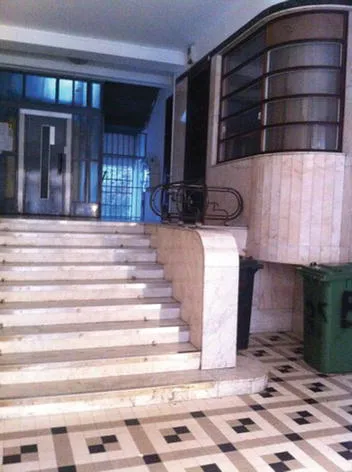
Figure 1.1
The location of a building manager’s lodge in a modern Budapest apartment building built in 1937. The window of the lodge provides a view onto the entrance lobby (Photo taken by the author, 2014)
Building managers gained a reputation for being unkind and often hostile, an attitude that was probably due to the fact that they needed to keep order without formal authority.17 In any case, the building managers were concerned about their negative image from very early on. In July 1905, their journal complained that concierges had gained notoriety for being rude. The article also warned that if a building manager was found guilty of professional misconduct, then this affected the reputation of all the 10,000 házmester working at that time in Budapest.18 A resident of Almássy tér 8 for instance described the házmester as a wild and surly person, who once went as far as slapping a tenant.19 Interestingly, despite the incident he kept his job, as the landlord appreciated his ability to maintain stability in the building.20 Thus brutality was to some extent tolerated, if not encouraged by the building owners. However, the tenants—being on the receiving end of this anger—suffered because of the hostility. Furthermore, the negative effects of urbanization, and especially a break in their social ties, could play a part in the concierges’ potential aggression. It was Zygmunt Bauman who pointed to the dismantling of traditional rural communities as one of the factors that allowed the Holocaust to happen.21
2 En route from Poverty to the Middle Classes
Written at the time when being a building manager was only a part-time job, László Németh’s account of the contemporary Hungarian school system is a sociographical study which gives us an insight into the nature of the concierges’ post as a transitional social position. Németh later made a name for himself as a writer, but at this time he was primarily a medical practitioner in various schools, among others the Medve utca civic school.22 Because of his employment he had access to the social milieu studies the school prepared about the parents it dealt with.23 Using these files, Németh gave a precise description of the parental backgrounds of the pupils attending the Medve utca civic school between 1873 and 1934, but especially in the 1920s and 1930s. Civic school was a step between the elementary school and the grammar school.24 It was a place where tuition fees were affordable for the lower middle classes too, and from where a talented and hardworking student could even reach the baccalaureate with some luck.25 Therefore, this was an important step for those wanting to acculturate into the bourgeoisie, and at the same time it represented a necessary but painful step down for those children, whose families had suffered significant fina...
Table of contents
Cover
Frontmatter
1. Building Managers Caught in the Middle: The Social History of Budapest Concierges Until 1943
2. The Concierges of the Ghetto Buildings
3. Building Managers, Bystanders and Perpetrators
4. Turning the Yellow Star Houses into Protected Houses
5. The Building Managers’ Role in Rescue, and Their Ways to Enrichment
6. Calling the Building Manager to Account: The Colourful Palette of Retribution in Early Post-War Budapest from People’s Court to Justificatory Committee
Backmatter
Trusted by 375,005 students
Access to over 1.5 million titles for a fair monthly price.
Study more efficiently using our study tools.
Frequently asked questions
Yes, you can cancel anytime from the Subscription tab in your account settings on the Perlego website. Your subscription will stay active until the end of your current billing period. Learn how to cancel your subscription
No, books cannot be downloaded as external files, such as PDFs, for use outside of Perlego. However, you can download books within the Perlego app for offline reading on mobile or tablet. Learn how to download books offline
Perlego offers two plans: Essential and Complete
Essential is ideal for learners and professionals who enjoy exploring a wide range of subjects. Access the Essential Library with 800,000+ trusted titles and best-sellers across business, personal growth, and the humanities. Includes unlimited reading time and Standard Read Aloud voice.
Complete: Perfect for advanced learners and researchers needing full, unrestricted access. Unlock 1.5M+ books across hundreds of subjects, including academic and specialized titles. The Complete Plan also includes advanced features like Premium Read Aloud and Research Assistant.
Both plans are available with monthly, semester, or annual billing cycles.
We are an online textbook subscription service, where you can get access to an entire online library for less than the price of a single book per month. With over 1.5 million books across 990+ topics, we’ve got you covered! Learn about our mission
Look out for the read-aloud symbol on your next book to see if you can listen to it. The read-aloud tool reads text aloud for you, highlighting the text as it is being read. You can pause it, speed it up and slow it down. Learn more about Read Aloud
Yes! You can use the Perlego app on both iOS and Android devices to read anytime, anywhere — even offline. Perfect for commutes or when you’re on the go. Please note we cannot support devices running on iOS 13 and Android 7 or earlier. Learn more about using the app
Yes, you can access Budapest Building Managers and the Holocaust in Hungary by Istvan Pal Adam in PDF and/or ePUB format, as well as other popular books in History & European History. We have over 1.5 million books available in our catalogue for you to explore.