eBook - ePub
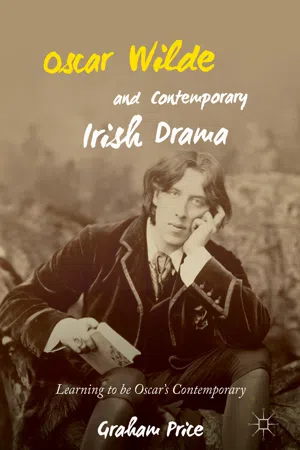
Oscar Wilde and Contemporary Irish Drama
Learning to be Oscar's Contemporary
- English
- ePUB (mobile friendly)
- Available on iOS & Android
eBook - ePub
About this book
Information
Subtopic
European Literary Criticism© The Author(s) 2018
Graham PriceOscar Wilde and Contemporary Irish Dramahttps://doi.org/10.1007/978-3-319-93345-0_11. Introduction: ‘The Future Is What Artists Are’
Graham Price1
(1)
University of Limerick, Limerick, Ireland
Graham Price
Oscar Wilde the Sometimes Irishman
In Oscar Wilde’s satiric political essay ‘The Soul of Man Under Socialism’, Wilde contends that humanity should always be future-oriented if it is to realise better realities and ways of being than those which are currently in existence: ‘[T]he past is of no importance. The present is of no importance. It is with the future that we have to deal. For the past is what man should not have been. The present is what man ought not to be. The future is what artists are’.1 According to Wilde, perpetually thinking in the future tense is the ideal state of being and artists are those that are always engaged in living in the temporal state of futurity. Wilde’s own life and work have gone on to testify to the validity of that assertion through the importance that they have held for future literatures and cultures throughout the world and, as this book shall argue, in Wilde’s native home of Ireland, this debt is very evident but in need of further explication.
At the beginning of Richard Ellmann’s celebrated biography of James Joyce , Ellmann asserts: ‘We are still learning to be James Joyce’s contemporaries , to understand our interpreter’.2 This book shall argue that the same is equally true of Irish drama’s relationship with Oscar Wilde. It shall be argued that Wilde’s shadow looms large over theatre, and Irish playwrights over the last 50 years have used the Wildean aesthetic in very productive ways in an attempt to create compelling and innovative plays for present-day Ireland. The importance of Wilde’s life and work for early to mid-twentieth-century Irish writers such as Yeats, Joyce, and Synge has been examined extensively, but this study shall consider how their successors engage with Wilde in different and/or similar ways depending on the personal, political, and social contexts in which these dramatists found themselves during the late twentieth and early twenty-first centuries. First, this chapter shall outline the important features of Wilde’s critical and artistic theories and aesthetic practices and how they are relevant to an analysis of many major works of contemporary Irish drama.
The key areas of the Wildean aesthetic that shall be focussed on as being of primary importance to contemporary Irish dramatists are as follows: Wilde’s aestheticising of experience self-conscious performance and theatricality. The notion of the dandy in Wildean texts and how such a figure is engaged with in today’s dramas. How Wilde’s contribution to the concept of a ‘verbal theatre’ has proved influential to his dramatic successors shall also be considered. Lawrence Danson has characterised Wilde’s oeuvre as one in which ‘words construct the world and society is a text to be rewritten’, and this book shall consider how this aesthetic has lived on in Irish drama up to the present day. An important point that this book shall make is that each playwright engages with Wilde’s legacy in different and unique ways rather than in a uniform and programmatic fashion. As Stephen Watt said in relation to Beckett, so I shall assert as regards Wilde and Ireland: ‘he is our contemporary in a myriad of ways’.3 In the last 20 years, Wilde’s importance to the life and art of James Joyce, W.B. Yeats , and J.M. Synge (the generation of writers that came immediately after him) has been attested to and examined. However, the persistence of Wilde’s relevance to Irish art has not been given its due acknowledgement. This book shall be the first extensive examination of a Wildean aesthetic that has had a lasting impact on Irish drama and whose presence still permeates Irish theatrical production. While there have been perceptive and invaluable essays and book chapters written by such critics as Richard Pine , Anthony Roche, Noreen Doody, and Declan Kiberd that acknowledge Wilde’s relevance to Ireland’s drama, the full extent of his importance to contemporary Irish playwrights has not yet been fully appreciated.
Wilde’s influential status within the history of the Irish literary canon has only been relatively recently acknowledged, along with his own right to be regarded as an ‘Irish writer’. When Vivian Mercier wrote his influential study, The Irish Comic Tradition (1962), Wilde was one of several Anglo-Irish writers to be excluded from serious consideration. Mercier made the following justification for these omissions: ‘I have virtually ignored many of the Anglo-Irish writers who neither lived most of their lives in Ireland nor continued to write much about Ireland after they had left her…Shaw, Wilde, Sheridan…belong essentially to English literature’.4 Mercier was a believer in the idea that critics and historians of Irish literature needed to create a narrative of Irish literary history that privileged works which focussed on questions of Irish national and racial identity. Thus, an urbane author such as Wilde who is most famous for writing dramatic comedies of manners and one Gothic novel (all of which were set in England and focussed on English characters) would seem out of place in such a literary history. Regardless of this relatively widespread critical blind spot regarding Wilde’s Irishness and his importance to other Irish writers, many of these succeeding Irish writers and dramatists seem to have appreciated the radical and progressive nature of his work and theories and have used them in a myriad of different ways in the century following Wilde’s death. Like Wilde, these artists are attuned to the future and have recognised and helped to realise Wilde’s value to those years and generations that are yet to come.
The view of Oscar Wilde as being what James Joyce called ‘a court jester to the English’ was further testified to by the publication of The Field Day Anthology of Irish Writing (1991) in which editors Seamus Deane and Christopher Murray disregard Wilde as an important Irish writer because, in their opinions, Wilde’s poetry and drama were far too trapped in the English literary tradition to be of any value to the Irish literary tradition that was beginning to emerge in the 1890s.5 It is ironic, therefore, that it was one of the co-founders of Field Day, Brian Friel, whose play Philadelphia, Here I Come! in the 1960s created a trend towards Wildeanism in contemporary Irish drama which came to be emulated by succeeding generations of Irish playwrights. Philadelphia, Here I Come! inaugurated modern Irish drama in 1964 and did so via a distinctly Wildean note. The term ‘contemporary Irish drama’ shall be used in this book as a concept that refers to Irish plays from Philadelphia onwards because it is the opinion of this author that the first production of that play at the Gaiety acted as the inauguatory moment of contemporary Irish theatre and dramaturgy.
Declan Kiberd’s essay, ‘Oscar Wilde: The Resurgence of Lying’, is the work that first argued for Wilde’s enduring importance for Irish playwrights from Synge up to the present day. Kiberd contends that Wilde’s aesthetic of lying, his privileging of style over ‘naturalness’, and the importance he placed on controlling the means of narration and representation proved to be highly influential for colonial and postcolonial writers in Ireland in the twentieth century, and now, I would argue, in the twenty-first century, ‘In an age when Marxians preached that ownership of the means of production was the key to progress, Wilde correctly sensed that ownership and understanding of the means of expression would be the question of real consequence in the century to come. Subsequent history has proven just how right he was’.6 Although Kiberd’s writing on Wilde in Field Day and Inventing Ireland has gained more attention than the above-quoted essay, I would argue that ‘Oscar Wilde: The Resurgence of Lying’ is the work of his that has been more important in highlighting the influential and radical nature of Wilde’s lifelong artistic project.
Following on from and expanding upon some of Kiberd’s ideas concerning Wilde as influential Irishman, Eibhear Walshe’s The Wilde Shadow considers the contextual reasons concerning why Wilde has become so explicitly relevant to modern Ireland in the last 50 years: ‘Ireland experienced radical economic, legal and social change during the last half of the twentieth century and into the twenty-first century and so the name of Oscar Wilde was refashioned to suggest or even invent a more inclusive sense of Irishness . In an unproblematic way, his name was gradually re-appropriated by contemporary writers and critics, and within cultural discourse as a symbol of modernity and new-found tolerance’.7 The contemporary Ireland that is described by Walshe is markedly different from the era of Yeats , Joyce , and other Irish modernists, and those specific cultural changes are reflected in the different ways that contemporary Irish dramatists engage with Wilde’s legacy. The evolving acceptance of same-sex desire in Ireland has also led to a greater willingness among Irish writers to engage with Wilde’s sexual inclinations, and this is reflected in the drama of playwrights such as Thomas Kilroy and Frank McGuinness. Before beginning the examination of specific playwrights, it elucidat...
Table of contents
- Cover
- Front Matter
- 1. Introduction: ‘The Future Is What Artists Are’
- 2. Brian Friel: The Liar as Artist
- 3. Tom Murphy: ‘We Are All in the Gutter but Some of Us Are Looking at the Stars’
- 4. Thomas Kilroy: Biography but with the Facts Changed
- 5. Frank McGuinness: ‘To Hell with the Truth So Long as It Rhymes’
- 6. Marina Carr: ‘All Women Become Like Their Mothers; That Is Their Tragedy. No Man Does, That’s His’
- 7. Epilogue: Being Wild(ean) in the Twenty-First Century
- Back Matter
Trusted by 375,005 students
Access to over 1.5 million titles for a fair monthly price.
Study more efficiently using our study tools.
Frequently asked questions
Yes, you can cancel anytime from the Subscription tab in your account settings on the Perlego website. Your subscription will stay active until the end of your current billing period. Learn how to cancel your subscription
No, books cannot be downloaded as external files, such as PDFs, for use outside of Perlego. However, you can download books within the Perlego app for offline reading on mobile or tablet. Learn how to download books offline
Perlego offers two plans: Essential and Complete
- Essential is ideal for learners and professionals who enjoy exploring a wide range of subjects. Access the Essential Library with 800,000+ trusted titles and best-sellers across business, personal growth, and the humanities. Includes unlimited reading time and Standard Read Aloud voice.
- Complete: Perfect for advanced learners and researchers needing full, unrestricted access. Unlock 1.5M+ books across hundreds of subjects, including academic and specialized titles. The Complete Plan also includes advanced features like Premium Read Aloud and Research Assistant.
We are an online textbook subscription service, where you can get access to an entire online library for less than the price of a single book per month. With over 1.5 million books across 990+ topics, we’ve got you covered! Learn about our mission
Look out for the read-aloud symbol on your next book to see if you can listen to it. The read-aloud tool reads text aloud for you, highlighting the text as it is being read. You can pause it, speed it up and slow it down. Learn more about Read Aloud
Yes! You can use the Perlego app on both iOS and Android devices to read anytime, anywhere — even offline. Perfect for commutes or when you’re on the go.
Please note we cannot support devices running on iOS 13 and Android 7 or earlier. Learn more about using the app
Please note we cannot support devices running on iOS 13 and Android 7 or earlier. Learn more about using the app
Yes, you can access Oscar Wilde and Contemporary Irish Drama by Graham Price in PDF and/or ePUB format, as well as other popular books in Media & Performing Arts & European Literary Criticism. We have over 1.5 million books available in our catalogue for you to explore.