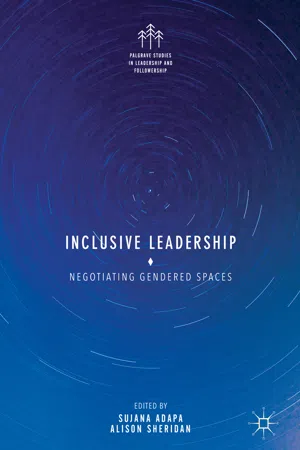
Examining perceptions of leaders which are dependent on social and cultural contexts, this edited collection argues that in order to thrive and to understand the future business landscape, leaders must be inclusive and create followership. With existing research tending to conflate leadership roles with notions of masculinity and agency, this study provides examples of how to alter and challenge prevalent stereotypes and ultimately contribute to greater organisational effectiveness. Addressing the under-representation of women in leadership roles, contributions explore inclusivity and exclusivity in leading organisations, the politics of gendered differences and the value of leader-follower dynamics. Inclusive Leadership will be of great use to business leaders, employees, policy-makers, and academics seeking practical implications for formulating effective leader-follower strategies in organisations.
eBook - ePub
Inclusive Leadership
Negotiating Gendered Spaces
- English
- ePUB (mobile friendly)
- Available on iOS & Android
eBook - ePub
Inclusive Leadership
Negotiating Gendered Spaces
About this book
Information
© The Author(s) 2018
Sujana Adapa and Alison Sheridan (eds.)Inclusive LeadershipPalgrave Studies in Leadership and Followershiphttps://doi.org/10.1007/978-3-319-60666-8_11. Leadership from the Margins: Practising Inclusivity with ‘Outsiders Within’
Helena Liu1
(1)
Management Discipline Group, University of Technology, Sydney, NSW, Australia
Helena Liu
Keywords
GenderRaceOutsiders withinPatricia Hill CollinsHelena Liu
is a senior lecturer at the University of Technology Sydney (UTS) Business School in Sydney, Australia. A critical leadership scholar, her research focuses on the power dynamics that sustain our enduring romance with leadership. She is committed to subverting the imperialist white supremacist capitalist patriarchy through current projects on leadership among marginalised groups. Helena’s work has been published in Human Relations, Gender, Work & Organization, the Journal of Business Ethics, Leadership and Management Communication Quarterly.
Introduction
Proliferating prefixes of community-, shared-, peer-, thought- and self-leaderships in our culture have created the impression that anything and everything is leadership. This observation has led critics to suggest that leadership is an illusion of beautiful, seductive images constructed by theorists and practitioners to capture our desires and sell development programmes (Grint 2010; Liu and Baker 2016; Sinclair 2007; Śliwa et al. 2012). The inherent emptiness of leadership , however, provides a space where power can be exercised to decide whose interpretation of leadership matters most (Kelly 2014). As I have argued elsewhere (Liu 2015, 2016, 2017a, 2017b; Liu and Baker 2016), our enduring romance with leadership is in many ways a romance with white elite class masculinity . The subtle gendered , raced and classed ideals of ‘leadership’ mean that we have a tendency to venerate leaders for individualism , competition , aggression , rationalism and pragmatism , and to discount relationality , generosity and inclusion . Those who contravene the hegemonic models tend to be denied the mantle of leadership.
This chapter draws on the work of Black feminist , Patricia Hill Collins , to theorise on inclusive forms of leadership that are practised by those on the periphery of organisations and society . Locating her work in the experiences of Black women in the United States , Collins (1986) explores the sociological significance of people who occupy a marginal status and bear a unique standpoint on self, family and society. As ‘outsiders within’ , Black women are sensitised to the interlocking systems of domination and their violence that often elude insiders , and seek to resist oppression through redefining themselves and their cultures (Collins 1986, p. S14).
Collins’ work suggests the potential for leadership to be practised within an ethico-politics of inclusion by studying the attempts to lead from those relegated to the margins. Demonstrating the power of Collins’ theory to transfer across different forms of marginalisation , I draw on her framework to analyse a study of Chinese Australian leaders and their practices of inclusive leadership in the face of their own exclusion in organisations and Australian society. Illustrating through the profile of one leader in particular, this chapter presents the ways another group of outsiders within can work to reclaim self-defined identities , expose interlocking oppressions and redefine what it means to lead.
The chapter first outlines Collins’ ‘outsider-within’ theory and discusses its implications for leadership studies. It then introduces the study of Chinese Australian leaders and offers the case of one participant to illustrate the diverse , and sometimes ambivalent , ways inclusive leadership is practised. This chapter concludes with the claim that to develop radically inclusive forms of leadership in relation with followers , we may look beyond the spotlights into the margins towards those who are practising leadership otherwise. The margins may serve as liminal spaces in which leadership practices that subvert exclusionary white masculinist norms can be practised.
Outsiders Within in Leadership
Patricia Hill Collins’ (1986) landmark theory of ‘outsider within’ has made a lasting intellectual and political impact on critical sociological inquiry . A key achievement of this conceptual contribution was that it subverted the taken-for-granted marginalisation of Black women’s voices in the social sciences by articulating the sociological rationale for studying their experiences and other such forms of knowledge that were often overlooked (Baca Zinn 2012).
In developing the outsider-within theory, Collins (1986) reflected on the history of Black women’s lives in the United States and the intimate yet marginal positions Black women have held as domestic workers in white households. She proposed that this balance between being ‘insiders’ of white families yet ultimately remaining ‘outsiders’—the outsider within—offers Black women a unique standpoint from which to understand the self, family and society (Collins 1986).
The sustained exclusion of Black women’s voices in sociology has historically produced solipsistic knowledge where white lives, interests and identities have been allowed to define what is considered normal and legitimate social science (Bonilla-Silva 2012; Grimes 2001; Leonardo 2009; Levine-Rasky 2013; Sullivan 2006). Collins (1986) challenged the devaluation of Black women’s subjectivity and drew on the rich examples of Black women’s art, intellectualism, community and culture to demonstrate the processes by which Black women assert their full humanity in spite of their dehumanisation in the wider society.
Collins (1986) offers three dimensions of Black feminist thought that bears importance for sociological analyses: (1) Black women’s self-definition and self-valuation; (2) the interlocking nature of oppression; and (3) Black women’s culture. First, Collins establishes that externally-defined stereotypes of people of colour pervade our cultures. Controlling images like the ‘angry Black woman’ are designed to denigrate Black women’s assertiveness and mitigate the ways they may threaten the status quo . A key dimension of Black feminist intellectualism is to develop self-definitions of their identities and their own standards for evaluating Black womanhood beyond racist stereotypes.
Second, Black women’s marginalisation in both the Civil Rights and the Women’s Rights movements raised their awareness of the interlocking nature of gender, race, class and other axes of power . Their experiences revealed that the struggle for racial equality can overlook the patriarchal domination between Black men and Black women, while the struggle for gender equality can reproduce white domination and racism. From this perspective, social justice cannot be won on single axis issues. Also understood under the term intersectionality, Black feminist thought pioneered the analysis of simultaneous oppressions, turning their attention to the links between multiple systems of power (Collins 1986, 2012; Crenshaw 1991; hooks 1984, 2012).
Third, Black feminist thought has advanced social research that centres the lived experiences of Black women, illuminating their cultural practices around sisterhood and solidarity (Collins 1986). Embedded in the outsider-within theory is the assumption that one cannot separate the content of thought from the historical and material conditions that shape the lives of its producers (Collins 1986). In detailing the...
Table of contents
- Cover
- Frontmatter
- 1. Leadership from the Margins: Practising Inclusivity with ‘Outsiders Within’
- 2. Champions for Charities: Exploring Inclusive Leadership in the Non-profit Sector in Australia
- 3. Female Leadership Within the Military: The Influence of Neoliberal Institutionalism
- 4. Small and Medium-Sized Accounting Firms in India: Inclusive or Exclusive Leadership?
- 5. The Same or Different: How Women Have Become Included in Corporate Leadership in Australia
- 6. Examining the Politics of Gendered Difference in Feminine Leadership: The Absence of ‘Female Masculinity’
- 7. Leaders and Followers: Co-constructing a Creative Identity
- 8. Promoting Healthy Leader–Follower Dynamics to Enhance Workplace Equality
- 9. Revisiting the Strategic Leadership Paradigm: A Gender Inclusive Perspective
- Backmatter
Trusted by 375,005 students
Access to over 1.5 million titles for a fair monthly price.
Study more efficiently using our study tools.
Frequently asked questions
Yes, you can cancel anytime from the Subscription tab in your account settings on the Perlego website. Your subscription will stay active until the end of your current billing period. Learn how to cancel your subscription
No, books cannot be downloaded as external files, such as PDFs, for use outside of Perlego. However, you can download books within the Perlego app for offline reading on mobile or tablet. Learn how to download books offline
We are an online textbook subscription service, where you can get access to an entire online library for less than the price of a single book per month. With over 1.5 million books across 990+ topics, we’ve got you covered! Learn about our mission
Look out for the read-aloud symbol on your next book to see if you can listen to it. The read-aloud tool reads text aloud for you, highlighting the text as it is being read. You can pause it, speed it up and slow it down. Learn more about Read Aloud
Yes! You can use the Perlego app on both iOS and Android devices to read anytime, anywhere — even offline. Perfect for commutes or when you’re on the go.
Please note we cannot support devices running on iOS 13 and Android 7 or earlier. Learn more about using the app
Please note we cannot support devices running on iOS 13 and Android 7 or earlier. Learn more about using the app
Yes, you can access Inclusive Leadership by Sujana Adapa, Alison Sheridan, Sujana Adapa,Alison Sheridan in PDF and/or ePUB format, as well as other popular books in Business & Business Strategy. We have over 1.5 million books available in our catalogue for you to explore.