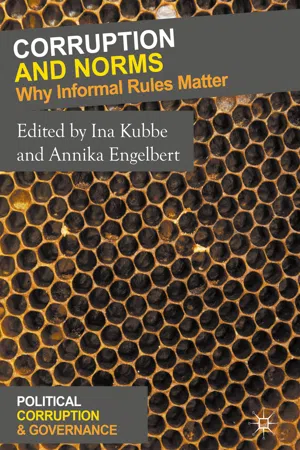
This book focuses on the role of norms in the description, explanation, prediction and combat of corruption. It conceives corruption as a ubiquitous problem, constructed by specific traditions, values, norms and institutions. The chapters concentrate on the relationship between corruption and social as well as legal norms, providing comparative perspectives from different academic disciplines, theoretical and methodological backgrounds, and various country-studies. Due to the nature of social norms that are embedded in personal, local, and organizational contexts, the contributions in the volume focus in particular on the individual and institutional level of analysis (micro and meso-mechanisms). The book will be of interest to students and scholars across the fields of political science, public administration, socio-legal studies and psychology.
eBook - ePub
Corruption and Norms
Why Informal Rules Matter
- English
- ePUB (mobile friendly)
- Available on iOS & Android
eBook - ePub
About this book
Information
© The Author(s) 2018
Ina Kubbe and Annika Engelbert (eds.)Corruption and NormsPolitical Corruption and Governancehttps://doi.org/10.1007/978-3-319-66254-1_2Democratic Norms, Political Money, and Corruption
The Deeper Roots of Political Malaise
Michael Johnston1
(1)
Colgate University, Hamilton, NY, USA
Michael Johnston
Michael Johnston
is Charles A. Dana Professor of Political Science Emeritus at Colgate University, having retired from active teaching in 2015. Michael has studied questions of corruption, democratization and reform since the 1970s, and has served as an expert to organizations such as the World Bank , United Nations, Organization of American States, and the US Agency for International Development. His most recent book, Corruption, Contention, Reform: The Power of Deep Democratization, deals with the need to build social and political foundations for reform in contrasting societies. His book Syndromes of Corruption: Wealth, Power, and Democracy won the 2009 Grawemeyer Award for Ideas Improving World Order.
1 I Know It When I See It
The overwhelming majority of Americans see political money as corrupting day-to-day political processes, and as debasing democratic values and principles in fundamental ways. Paradoxically, however, nearly all such money is raised, contributed, spent and publicly reported within the law—or, at least, not illegally. It may be that solid and lasting majorities of the American people are simply in error about the actual political clout of money, or do not understand the meaning of “corruption”. But the breadth, persistence, and intensity of those popular sentiments suggest that we should not dismiss them lightly. Might such public outlooks point to important gaps in our definitions of corruption and, if so, how might we address them?
Debates over definitions of corruption, over the years, have been as inconclusive as they have been extensive. We have often gotten hung up on two issues: what standards to apply, and—less widely seen as a problem, but arguably equally complex—what to apply them to. Most answers to the question of “what is corruption?” have attempted to classify specific actions or transactions as corrupt or non-corrupt by applying the law, public opinion and perceptions, or longer-standing cultural standards to draw relatively precise distinctions. The legal approach has been the most widely supported, but public opinion and perceptions (particularly when it comes to ranking countries on corruption indices) and cultural standards (particularly among scholars seeking to make, or to discourage, comparisons across significantly different social settings) also have their defenders. Joseph Nye’s definition is still the most widely used:
[Corruption is] behavior which deviates from the formal duties of a public role because of private–regarding (close family, personal, private clique) pecuniary or status gains; or violates rules against the exercise of certain types of private–regarding influence. (Nye 1967, p. 417)
But the long-running and inconclusive nature of the definitions debate suggests that gaps and disagreements remain. Laws , at least as standards for classifying behavior as corrupt or non-corrupt, may capture a number of core examples such as outright bribery, extortion, kickback schemes, and the like, but at times the law can seem incomplete, contradictory, or deficient in terms of some higher morality. The Rev. Martin Luther King, Jr. captured an important truth in his letter from Birmingham Jail (1963) when he argued that, since Alabama’s laws were enacted by a racially segregated, unjustly elected legislature, situations will arise when we not only have the right, but indeed the duty, to defy those laws and the regime that created them. Similarly, Nichols (2015), discussing the bribes paid by Oskar Schindler to save the lives of Jews in Nazi Germany , argues that payments made with the intent of avoiding, defying, or subverting an authoritarian regime may be justified as “good bribes” (although he hastens to apply a strict conception of “authoritarian”: it cannot merely mean officials or policies we do not like). On the obverse, numerous public figures ranging from Richard Nixon to the defenders of the late Joe Paterno to, quite possibly, a prominent orange-haired politician of recent note have highlighted another problem with sole reliance upon the letter of the law by arguing, in effect, “I have done nothing wrong—show me what law I have broken”. It may be tempting, out of a misplaced sense of neatness, to dismiss controversial cases as peripheral because they do not easily fit core conceptions of corruption. But to do so would be a mistake: such cases can be among the most politically significant precisely because they are hotly contested. They may tell us a great deal about how public expectations of government—and key relationships between wealth and power—are changing or coming under stress.
Adding Norms to the Mix
This is a chapter about democratic norms as a neglected aspect of defining corruption. I can scarcely settle the definitions debate once and for all, and make no claim of doing so. The goal, instead, is to ask how a focus on such norms might help us fill some gaps in current definitions. Further, it is to suggest that democratic norms point to some sources of the political malaise so apparent in many contemporary democracies.
We begin with two basic arguments. One is that corruption is not best conceptualized as an attribute of an action, transaction, or person, but rather as a continuing societal dilemma of justice—notably, of specifying and maintaining acceptable limits upon official power, relationships between wealth and power, and the roles and rights of both citizens and elites . The second is that the boundaries and principles defining such relationships are inherently controversial, changeable, often ambiguous, and reflective of a number of not-always-consistent standards—among them, the law, along with social values, but also basic democratic norms. Looked at this way, corruption is a contentious and unsettled concept precisely because of the clashing interests, norms, and values that give it importance (those arguments are developed in more detail in Johnston 2014, Chs. 1, 2).
Definitions of democracy are at least as numerous as definitions of corruption, and little more agreed upon (Collier and Levitsky 1997). For purposes of this discussion, I will simply use “democracy” and “democratic” to refer to regimes and systems of order that can plausibly claim to derive their powers, legitimacy, or at least their immediate mandates from the governed. Thus, France qualifies as a democracy, while the Democratic People's Republic of (North) Korea emphatically does not. The United Kingdom, in which the power to govern is said to reside in the Crown in Parliament, rather than flowing from the people themselves, nonetheless governs through a democratically elected parliamentary government. Democracies vary markedly among themselves, and over time, in terms of the actual quality of government (Rothstein 2011), whatever we take “quality of government” to mean, and by the consistency and equality of the ways they treat citizens. The key issue, however, remains the norms, guarantees, and principles defining relationships between regimes and citizens. That there can be yawning gaps between promises and performance—and between the promises citizens think they ought to enjoy, versus those they believe they do enjoy—is not so much a problem of definitions as the very issue on which I hope to focus. If citizens believe a democratic system promises certain rights and guarantees, but fails to honor those principles, I suggest that a popular sense of exclusion, and of the abuse of power, is a likely result.
By democratic norms , I mean the fundamental and relatively enduring values and principles by which a regime justifies its claims upon the loyalty of its citizens (for a classical treatment of that theme see Dobel 1978), and acknowledges the sources and limits of its own powers. Such norms are usually uncodified for the most part, and are not always clear-cut or internally consistent. But they are critical aspects of democracy, nonetheless—in effect, the main principles of a broad and fundamental political agreement among citizens and elite s. What guarantees and promises—if any—are extended to citizens? In some societies, there is a written enumeration of rights and limits upon official power. In addition to codified principles, there are usually other longstanding expectations—for example, that citizens are entitled to have a voice in decisions affecting their lives, to have their dignity respected, and their views and interests taken seriously. Where such norms have broken down, or where they are so clearly at odds with reality that they are losing credibility, a would-be democracy is in serious trouble.
Those norms are by ...
Table of contents
- Cover
- Front Matter
- Introduction
- Part I. How Social Norms Shape Our Understanding of Corruption
- Part II. Norms and Corruption from Country-Specific Perspectives
- Part III. Norms and the Global Anti-corruption Framework
- Back Matter
Trusted by 375,005 students
Access to over 1.5 million titles for a fair monthly price.
Study more efficiently using our study tools.
Frequently asked questions
Yes, you can cancel anytime from the Subscription tab in your account settings on the Perlego website. Your subscription will stay active until the end of your current billing period. Learn how to cancel your subscription
No, books cannot be downloaded as external files, such as PDFs, for use outside of Perlego. However, you can download books within the Perlego app for offline reading on mobile or tablet. Learn how to download books offline
Perlego offers two plans: Essential and Complete
- Essential is ideal for learners and professionals who enjoy exploring a wide range of subjects. Access the Essential Library with 800,000+ trusted titles and best-sellers across business, personal growth, and the humanities. Includes unlimited reading time and Standard Read Aloud voice.
- Complete: Perfect for advanced learners and researchers needing full, unrestricted access. Unlock 1.5M+ books across hundreds of subjects, including academic and specialized titles. The Complete Plan also includes advanced features like Premium Read Aloud and Research Assistant.
We are an online textbook subscription service, where you can get access to an entire online library for less than the price of a single book per month. With over 1.5 million books across 990+ topics, we’ve got you covered! Learn about our mission
Look out for the read-aloud symbol on your next book to see if you can listen to it. The read-aloud tool reads text aloud for you, highlighting the text as it is being read. You can pause it, speed it up and slow it down. Learn more about Read Aloud
Yes! You can use the Perlego app on both iOS and Android devices to read anytime, anywhere — even offline. Perfect for commutes or when you’re on the go.
Please note we cannot support devices running on iOS 13 and Android 7 or earlier. Learn more about using the app
Please note we cannot support devices running on iOS 13 and Android 7 or earlier. Learn more about using the app
Yes, you can access Corruption and Norms by Ina Kubbe, Annika Engelbert, Ina Kubbe,Annika Engelbert in PDF and/or ePUB format, as well as other popular books in Política y relaciones internacionales & Política comparada. We have over 1.5 million books available in our catalogue for you to explore.