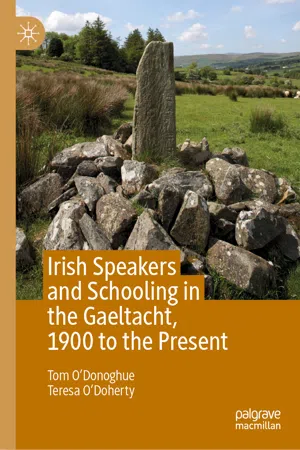
This book offers the first full-length study of the education of children living within the Gaeltacht, the Irish-speaking communities in Ireland, from 1900 to the present day. While Irish was once the most common language spoken in Ireland, by 1900 the areas in which native speakers of Irish were located contracted to such an extent that they became clearly identifiable from the majority English-speaking parts. In the mid-1920s, the new Irish Free State outlined the broad parameters of the boundaries of these areas under the title of 'the Gaeltacht'. This book is concerned with the schooling of children there. The Irish Free State, from its establishment in 1922, eulogized the people of the Gaeltacht, maintaining they were pious, heroic and holders of the characteristics of an invented ancient Irish race. Simultaneously, successive governments did very little to try to regenerate the Gaeltacht or to ensure Gaeltacht children would enjoy equality of education opportunity. Furthermore, children in the Gaeltacht had to follow the same primary school curriculum as was prescribed for the majority English speaking population. The central theme elaborated on throughout the book is that this schooling was one of a number of forces that served to maintain the people of the Gaeltacht in a marginalized position in Irish society.
eBook - ePub
Irish Speakers and Schooling in the Gaeltacht, 1900 to the Present
- English
- ePUB (mobile friendly)
- Available on iOS & Android
eBook - ePub
Irish Speakers and Schooling in the Gaeltacht, 1900 to the Present
About this book
Information
© The Author(s) 2019
T. O'Donoghue, T. O'DohertyIrish Speakers and Schooling in the Gaeltacht, 1900 to the Presenthttps://doi.org/10.1007/978-3-030-26021-7_11. The Gaeltacht: Constructed, Located and Promoted
Tom O’Donoghue1 and Teresa O’Doherty2
(1)
Graduate School of Education, University of Western Australia, Perth, WA, Australia
(2)
Marino Institute of Education, An Associated College of Trinity College Dublin, Dublin, Ireland
A central term introduced already is that of “the Gaeltacht”. In 1926, the Irish State established the boundaries of the districts to which this anglicised collective noun referred. By then, however, it had only been in use in the sense of referring to defined geographical areas for about 25 years. Accordingly, it is apposite to present in this chapter an outline of its evolution as a construct. A brief overview follows of the social, economic and education realities of the lives of the people of the Gaeltacht at the turn of the twentieth century, which was a time when Irish language preservationists and revivalists were showing mounting concern that children residing there were not benefiting from education because English was the medium of instruction. Equally, these preservationists and revivalists came to highlight for the majority English-speaking population the actual existence of the Gaeltacht as a distinct place and to involve them in the learning of Irish, including in new “Irish colleges” that largely were located in Gaeltacht districts, and that came to give these a particular defining property in succeeding decades.
The Construction of “the Gaeltacht” as a Term Referring to a Defined Set of Places
In a pioneering work published in 2005, Ó Torna detailed the results of an in-depth investigation she had conducted on the use of the term An Ghaeltacht (the Gaeltacht) in Ireland. 1 In it, she argues that while today we use the term to denote the geographical location of communities whose normal everyday language is Irish, matters were not always thus. Rather, she points out, the term was for long associated largely with such notions as “lucht labhartha na Gaeilge” and “an dúchas Gaelach”. 2 The former referred to speakers of Irish regardless of location and the latter referred to those who had a Gaelic nature or a Gaelic outlook on life shaped by the fact that they made sense of the world through the prism of the Irish language.
The lexicographer, Fr. Ó Duinnín, in the original 1904 edition of his Irish-English dictionary, implied in the following definitions that the “modern” version of the term “the Gaeltacht”, or An Ghaeltacht, had still not come into common usage in Ireland by this point in time:
Gaedhealcht, -a, f., the state of being Irish or Scotch: Gaeldom, Irishry, the native race of Ireland; bean de’n Ghaedhealcht, a woman of the Irishry (Art MacC.); G. Alban, the Highlands of Scotland. 3
The situation was different in Gaelic-speaking Scotland and had been so since the beginning of the eighteenth century. There, the term An Ghaeltacht had long been in use, not only in the sense outlined by Ó Duinnín in the extract presented above, but also to refer to geographical areas where those who spoke Scottish Gaelic resided.
Ó Torna identified the following extract as being the first instance in print of use of the term in Irish to refer to a geographical area:
….whether the object be to see beautiful scenery or to obtain a period of salutary rest, there are no places within reach better worth visiting than those which the Gaodhaltacht [sic] of Ireland abundantly provides. 4
This statement appeared in an article written in the English language and entitled “The Gaelic League”, that was published in an issue of the League’s magazine, Irisleabhar na Gaedhilge. Ó Torna also went on to say that the first time the term An Ghaeltacht may have appeared in an Irish language piece of writing in the sense of referring to a geographical area, was in a note in a 1902 issue of the Gaelic League’s newspaper, An Claidheamh Soluis. This contained an announcement that a branch of the organisation had been established in the Bóthar Buí (Boherbue) district in County Cork, which was described as being “istigh i gceart lár na Gaedhealtachta” 5 (“located in the heart of the Gaeltacht”).
Over the next 25 years, speakers of both Irish and English came to use the term An Ghaeltacht, or “the Gaeltacht”, to refer almost exclusively to a particular place or set of places. Indeed, acceptance in this sense was such that, by 1927, Fr. Ó Duinnín, in a new edition of his dictionary published that year, felt confident enough to offer the following definition, which was different to the one he gave in 1904:
Gaedhealcht, -a, f., the state of being Irish or Scotch: Gaeldom, Irishry, the native race of Ireland; Irish-speaking district or districts; the Gaeltacht; bean de’n Gh, a woman of the Irishry (Art MacC.); G. Alban, the Highlands of Scotland. 6
The extension of meaning in this definition over the earlier one was inspired by international as well as national developments, including the European-wide “Romantic movement”, that had grown as a counter-force to the Industrial Revolution and that led to individuals from urbanised areas visiting the countryside to experience the beauties of nature.
A particular aspect of the “Romantic movement” in Ireland led to Irish-speaking communities along the western seaboard and its adjacent islands having “their image bolstered through the work of antiquarians, academics and novelists” and by artists seeking to depict the “unspoilt scenery and rural life”. 7 A related influence, that had its origins in the idealisation by the French intellectual, Jean Jacque Rousseau, perceived “the peasant”, as one who leads a simple yet noble rural life, but was worthy of study so as to reveal the possibilities of improving human nature. In considering associated developments, Nowlan elaborated as follows:
The French Revolution and the Romantic Movement had helped to give a new significance to long neglected languages and popular traditions in many parts of Europe. Men [sic] began to look on the traditions and languages of the forgotten nationalities, especially among the Slavs and the Baltic peoples, not as quaint survivals but as fresh, creative contributions to European culture, somehow morally better than the offerings of a tired, cosmopolitan civilization.
The Celtic fringe was one of the areas influenced. On this, Jones 8 has drawn attention to the rise of the idea of the Eisteddfod or national festival of Welsh language-based culture in Wales from the 1860s.
From the latter half of the nineteenth century, a growing interest also emerged in Scotland in relation to literary and antiquarian connections with Scottish Gaelic. In a similar vein, Irish-speaking districts in Ireland, partly because of their geographical isolation, came to be the focus of related interest, especially following the visits of European scholars. These individuals believed they would be likely to witness in the districts in question “the most ancient features of Gaelic culture”. 9 In particular, German and Scandanavian researchers who were contributing to the flowering academic fields of descriptive and comparative linguistics came to see them as reservoirs of fascinating speech. 10
Equally influential from about the 1870s onwards were the debates of the Irish intelligentsia on establishing a nation state in Ireland. By 1905, the year when D.P. Moran crystalised these ideas in his “Irish-Ireland” treatise, 11 the overriding notion being promoted was that Irish identity rested upon “Gaelicism” and Catholicism. In relation to Gaelicism, a number of organisations concerned with restoring imagined Gaelic elements of a previous identity eroded through Anglicisation were well rooted by now. As indicated already, both the Gaelic Athletic Organisation, 12 established in 1884, and the Gaelic League, established in 1893, 13 were chief amongst these. 14
A significant portion of the work conducted by the Gaelic League focused on the Irish-speaking districts scattered throughout the country. Branches of the organisation established there generated a perspective in the minds of their populations that culturally they constituted a unique group in Ireland. This perspective was amplified when speakers from the predominantly English language speaking parts of the country arrived to spend time living in the Gaeltacht in order to learn the language.
From 1926, “the Gaeltacht” became an official term of the independent Irish State following the publication of a report entitled Coimisiún na Gaeltachta (the Co...
Table of contents
- Cover
- Front Matter
- 1. The Gaeltacht: Constructed, Located and Promoted
- 2. Education and the Irish Language in the Longue Durée
- 3. “Saving the Child”: The Gaelic League’s Campaign for Bilingual Education for Irish-Speaking Districts
- 4. Shifting Concern for “Saving the Child” to Concern About “Saving the Language”: 1918–1926
- 5. Schooling of Students from the Gaeltacht and the National Policy of “Saving the Language” Through All Primary Schools, 1922–1965
- 6. Marginalised Amongst the Marginalised: An Overview of Schooling in the Gaeltacht Up to the Mid-1960s
- 7. “You Don’t Want to Be a Gaelic Dafty in This Town”: Memories of Gaeltacht Residents on Their Schooling
- 8. From Cultural Nationalism to Human Capital Production: Schooling in the Gaeltacht in a Changing Ireland, 1967–1998
- 9. A New Multilingual Ireland and Schooling in the Gaeltacht: 1998 to the Present
- 10. Looking Backwards
- Back Matter
Trusted by 375,005 students
Access to over 1.5 million titles for a fair monthly price.
Study more efficiently using our study tools.
Frequently asked questions
Yes, you can cancel anytime from the Subscription tab in your account settings on the Perlego website. Your subscription will stay active until the end of your current billing period. Learn how to cancel your subscription
No, books cannot be downloaded as external files, such as PDFs, for use outside of Perlego. However, you can download books within the Perlego app for offline reading on mobile or tablet. Learn how to download books offline
Perlego offers two plans: Essential and Complete
- Essential is ideal for learners and professionals who enjoy exploring a wide range of subjects. Access the Essential Library with 800,000+ trusted titles and best-sellers across business, personal growth, and the humanities. Includes unlimited reading time and Standard Read Aloud voice.
- Complete: Perfect for advanced learners and researchers needing full, unrestricted access. Unlock 1.5M+ books across hundreds of subjects, including academic and specialized titles. The Complete Plan also includes advanced features like Premium Read Aloud and Research Assistant.
We are an online textbook subscription service, where you can get access to an entire online library for less than the price of a single book per month. With over 1.5 million books across 990+ topics, we’ve got you covered! Learn about our mission
Look out for the read-aloud symbol on your next book to see if you can listen to it. The read-aloud tool reads text aloud for you, highlighting the text as it is being read. You can pause it, speed it up and slow it down. Learn more about Read Aloud
Yes! You can use the Perlego app on both iOS and Android devices to read anytime, anywhere — even offline. Perfect for commutes or when you’re on the go.
Please note we cannot support devices running on iOS 13 and Android 7 or earlier. Learn more about using the app
Please note we cannot support devices running on iOS 13 and Android 7 or earlier. Learn more about using the app
Yes, you can access Irish Speakers and Schooling in the Gaeltacht, 1900 to the Present by Tom O'Donoghue,Teresa O'Doherty in PDF and/or ePUB format, as well as other popular books in History & History of Education. We have over 1.5 million books available in our catalogue for you to explore.