Bringing together a collection of interdisciplinary chapters on China's Belt and Road Initiative (BRI), this book offers a comprehensive overview of the topic from a business and management perspective. With a focus on the China Pakistan Economic Corridor (CPEC), Volume II provides theoretical and empirical analyses of the opportunities and challenges facing businesses. With contributions covering economics, agriculture, energy, value chain, ethics, governance, and security, this collection is a useful tool for academics as well as policy-makers and practitioners in China, Pakistan, and other countries along the new Silk Road.
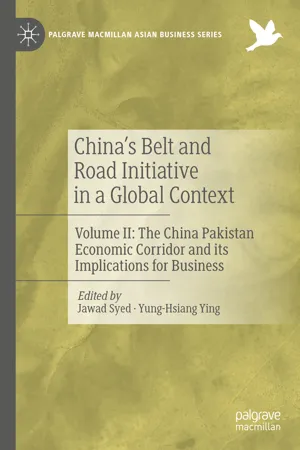
eBook - ePub
China’s Belt and Road Initiative in a Global Context
Volume II: The China Pakistan Economic Corridor and its Implications for Business
- English
- ePUB (mobile friendly)
- Available on iOS & Android
eBook - ePub
China’s Belt and Road Initiative in a Global Context
Volume II: The China Pakistan Economic Corridor and its Implications for Business
About this book
Information
© The Author(s) 2020
J. Syed, Y.-H. Ying (eds.)China’s Belt and Road Initiative in a Global ContextPalgrave Macmillan Asian Business Serieshttps://doi.org/10.1007/978-3-030-18959-4_11. Introduction: Examining the Belt and Road Initiative in the China–Pakistan Context
Jawad Syed1 and Yung-Hsiang Ying2
(1)
Suleman Dawood School of Business, Lahore University of Management Sciences, Lahore, Pakistan
(2)
College of Management, National Taiwan Normal University, Taipei City, Taiwan
Keywords
Belt and Road Initiative (BRI)China Pakistan Economic Corridor (CPEC)EthicsGovernanceSilk RoadThe China Pakistan Economic Corridor (CPEC ) is arguably the most significant part of China’s Belt and Road Initiative (BRI), not only in economic terms but also socially and politically. China is implementing BRI in South Asia and beyond by establishing connectivity with Pakistan’s Seaport of Gwadar, providing access to the Arabian Sea and beyond. CPEC is claimed to offer promising prospects for Pakistan’s progress and its successful development and execution may mean that Pakistan and China are closer and more meaningfully connected to other countries in the region.
Volume II of China’s Belt and Road Initiative in a Global Context offers a comprehensive overview of CPEC from a business and management perspective, and provides theoretical and empirical analyses of the opportunities and challenges facing businesses in relation to CPEC. Key topics covered include economics, project management, industrial zones, agriculture, value chain, ethics, governance and security, creating a useful tool for academics as well as policymakers and practitioners in China, Pakistan and other countries along the new Silk Road.
Pakistan is a country of immense potential not only by virtue of the size of its population (more than 207 million, the world’s sixth largest nation in 2019), but also due to economic and geopolitical reasons. The country is listed among the Next 11 countries that, along with the BRICS nations (Brazil, Russia, India, China and South Africa), have a high potential of becoming one of the world’s largest economies in the twenty-first century. Nearly 50% of the country’s population comprises youth under 25 years of age and the country is rich in agriculture and natural resources. With adequate development and utilization of human capital and industry, the country can expect to reap the full benefits of increased connectivity to China and other countries in the region under the auspices of the BRI.
In geopolitical terms, Pakistan is situated at the apex of the Arabian Sea and at the mouth of the Persian Gulf, and is connected to China, India, Iran and Afghanistan. There is a historical tension with India, particularly owing to the longstanding dispute on Kashmir, and relations with Afghanistan are not too congenial either due to reciprocating allegations of cross-border terrorism by both countries. While China and Iran are friendly allies, both of them face subtle and open economic and political hostility from the USA. Over the course of several decades, Pakistan’s relations with the USA have been unsteady.
Although Pakistan has historically had very friendly relations with China, the latter’s growing presence in Pakistan, in particular through the CPEC initiative and the associated window for trade and the advancement of geostrategic interests, has given Sino–Pakistan relations a new dimension. However, Pakistan also faces a host of internal and external challenges, which include but are not limited to effective and responsible governance, fiscal deficit, balance of payments, young people’s needs and unemployment, low literacy and skill, gender and ethnic inequalities and changing external environments.
In this context, the development of road and railways infrastructure along with energy plants and the Gwadar seaport could catalyse the much-needed economic and human development in Pakistan. Moreover, the country may establish linkages with China to develop medium-sized and small enterprises as part of the massive supply chain that has shaped China’s industrial base. The CPEC is likely to open China’s western provinces to economic advances and the new trading route will link China to Central Asia, Africa and Eastern Europe, thus putting western China on the international economic map.
Scholars have also pointed towards issues of transparency and accountability in CPEC’s execution. For a programme of this scale and importance, the status reporting available for implementation is very limited. The CPEC website of the Government of Pakistan provides limited basic information. Detailed information is not available on performance targets, percentage completion or disbursements. By late 2018, seven early harvest projects (US $4.6 billion) had been completed and 12 projects ($16.7 billion) were under construction. Most of these projects were in the energy sector. Only three infrastructure projects and two Gwadar projects were being implemented. Other projects, related to special economic zones (SEZs ), agriculture or social development, were at the planning stages. According to reports, nearly 62% of the allocated CPEC funding is for the energy sector, 36% for road/railways infrastructure and 2% for Gwadar seaport. No funding allocation has been made yet for industry, agriculture or social sectors. Much of the investment in infrastructure in the CPEC programme supports the Eastern route, thus ignoring the Western and Central alignments.
Little direct investment has been made directly in the ongoing CPEC programme to alleviate poverty, reduce regional disparities and improve sustainability. Productive and socioeconomic sectors have not been given their due attention. The absence of budget and programmes to alleviate poverty, generate income and create jobs indicates that these sectors have been given a low priority.
There is, however, significant potential to increase the impact of CPEC through agriculture and commerce. The demand for food in China is enormous—$1 trillion per year, which is expected to rise to $1.5 trillion over the next ten years. Pakistan’s market share in China’s food imports is minute and declining. There is a clear inconsistency in Pakistan’s agricultural exports and China’s import needs.
While the main thrust of CPEC seems to be on the development of an ‘east–west’ corridor between western China and the Indian Ocean seaport of Gwadar, there is also potential to expand the ‘north–south’ linkages with Iran, Afghanistan, Central Asian countries in the north and India in the south. This may boost China and Pakistan’s regional network of commerce, trade and energy. Pakistan may further leverage land-based commerce in coordination with the Eurasian Economic Union and Economic Cooperation Organization. This in turn will need urgent attention to human capital development in Pakistan to improve quality and productivity in order to be able to access and compete in international markets.
In addition to human capital, local industry may be supported through the development of SEZs. Pakistan–China cooperation in industrial development and agriculture may improve Pakistan’s potential in these sectors.
Early completion of CPEC projects may bring significant socioeconomic opportunities to the people. Pakistan could greatly benefit from China’s experience of extricating its people from the poverty trap. Regardless of Pakistan’s ability to realize economic benefits from projects undertaken under CPEC, experts argue that business as usual may not prevail in the years to come. We are expecting to see structural changes in how policy is devised, projects are implemented, negotiations are carried out and collaborations transpire in the national socioeconomic landscape in the coming years. Businesses and industries need to be aware of these expected changes and devise responses to the challenges they pose.
This book looks at such issues from a management perspective to inform practitioners and to assist them in rising to the challenge. It comprises inter-disciplinary chapters on China’s BRI in South Asia. It focuses on topics as diverse as the economy, business environment, energy, agriculture, education, value chain, industrial zones, ethics and security. Written by regional experts and scholars, the book includes theoretical and empirical chapters exploring business- and management-related opportunities and challenges related to CPEC.
Overview of Book Chapters
In Chap. 2, Jawad Syed offers a critical overview of BRI as a Chinese development strategy that focuses on economic, cultural and political cooperation between China and the world through the land-based and maritime Silk Road. In particular, the chapter discusses the Pakistani section of the BRI, known as the CPEC. It discusses the financial and other aspects of CPEC, highlights its significance for China and Pakistan, and also outlines some key issues and challenges.
Chapter 3, by Syed M. Hasan, Hamza Ali, Fatima Azmat and Suniya Raza, applies social cost benefit analysis (SCBA)—an appraisal based on the economic costs and benefits faced by society—to the early harvest component of CPEC energy projects. The requisite steps of SCBA are explained in the context of important issues such as the social discount rate and social cost of carbon emissions . The authors use this approach on the Sahiwal Coal Power Project to gauge the extent to which the environmentally detrimental impact of the plant is offset by the potential benefits of overcoming the energy shortfall in Pakistan. The analysis includes not only the private costs and benefits of setting up the plant, but also the related economic, environmental and social implications, duly monetized and discounted over a 30-year period; the usual life of such plants. The results indicate that the power plant generates a net economic benefit if the lower bound of social cost of carbon is used and a net loss if the upper bound is considered. Findings from the case study i...
Table of contents
- Cover
- Front Matter
- 1. Introduction: Examining the Belt and Road Initiative in the China–Pakistan Context
- 2. China’s Belt and Road Initiative: A Pakistani Perspective
- 3. Economic Assessment of CPEC: The Case of a Power Project
- 4. Ethics and Governance Norms in Cross-Cultural Projects: Implications for CPEC and Other China–Pakistan Projects
- 5. Linking Ambitions, Transparency and Institutional Voids to South–South Funded CPEC Project Performance
- 6. CPEC and Its Potential Benefits to the Economy of Azad Jammu and Kashmir, Pakistan
- 7. Security and the Belt and Road: A Critical Analysis of Threats to Chinese Nationals and Businesses in Pakistan
- 8. Belt and Road Initiative: Misgivings and Resolve
- 9. Aligning the Global Value Chains of China and Pakistan in the Context of the Belt and Road Initiative, and China Pakistan Economic Corridor
- 10. Developing a Competitive Agriculture and Agro-based Industry under CPEC
- 11. The Construction Sector Value Chain in Pakistan and the Sahiwal Coal Power Project
- 12. Special Economic Zones under the CPEC and the Belt and Road Initiative: Parameters, Challenges and Prospects
- 13. Cooperation among Business Schools across the Belt and Road: A CPEC Perspective
- Back Matter
Trusted by 375,005 students
Access to over 1.5 million titles for a fair monthly price.
Study more efficiently using our study tools.
Frequently asked questions
Yes, you can cancel anytime from the Subscription tab in your account settings on the Perlego website. Your subscription will stay active until the end of your current billing period. Learn how to cancel your subscription
No, books cannot be downloaded as external files, such as PDFs, for use outside of Perlego. However, you can download books within the Perlego app for offline reading on mobile or tablet. Learn how to download books offline
Perlego offers two plans: Essential and Complete
- Essential is ideal for learners and professionals who enjoy exploring a wide range of subjects. Access the Essential Library with 800,000+ trusted titles and best-sellers across business, personal growth, and the humanities. Includes unlimited reading time and Standard Read Aloud voice.
- Complete: Perfect for advanced learners and researchers needing full, unrestricted access. Unlock 1.5M+ books across hundreds of subjects, including academic and specialized titles. The Complete Plan also includes advanced features like Premium Read Aloud and Research Assistant.
We are an online textbook subscription service, where you can get access to an entire online library for less than the price of a single book per month. With over 1.5 million books across 990+ topics, we’ve got you covered! Learn about our mission
Look out for the read-aloud symbol on your next book to see if you can listen to it. The read-aloud tool reads text aloud for you, highlighting the text as it is being read. You can pause it, speed it up and slow it down. Learn more about Read Aloud
Yes! You can use the Perlego app on both iOS and Android devices to read anytime, anywhere — even offline. Perfect for commutes or when you’re on the go.
Please note we cannot support devices running on iOS 13 and Android 7 or earlier. Learn more about using the app
Please note we cannot support devices running on iOS 13 and Android 7 or earlier. Learn more about using the app
Yes, you can access China’s Belt and Road Initiative in a Global Context by Jawad Syed, Yung-Hsiang Ying, Jawad Syed,Yung-Hsiang Ying in PDF and/or ePUB format, as well as other popular books in Business & Human Resource Management. We have over 1.5 million books available in our catalogue for you to explore.