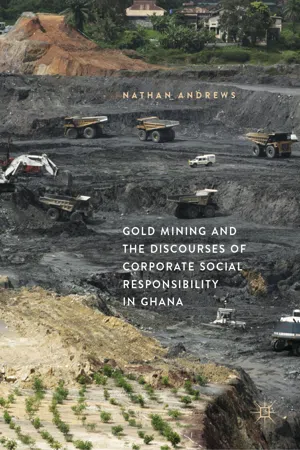
This book critically examines the practice and meanings of corporate social responsibility (CSR) and how the movement has facilitated a positive and somewhat unquestioned image of the global corporation. Drawing on extensive fieldwork material collected in Ghanaian communities located around the project sites of Newmont Mining Corporation and Kinross Gold Corporation, the monograph employs critical discourse analysis to accentuate how mining corporations use CSR as a discursive alibi to gain legitimacy and dominance over the social order, while determining their own spheres of responsibility and accountability. Hiding behind such notions as 'social licence to operate' and 'best practice,' corporations are enacted as entities that are morally conscious and socially responsible. Yet, this enactment is contested in host communities, as explored in chapters that examine corporate citizenship, gendered perspectives, and how global CSR norms institutionalize unaccountability.
eBook - ePub
Gold Mining and the Discourses of Corporate Social Responsibility in Ghana
- English
- ePUB (mobile friendly)
- Available on iOS & Android
eBook - ePub
Gold Mining and the Discourses of Corporate Social Responsibility in Ghana
About this book
Information
© The Author(s) 2019
Nathan AndrewsGold Mining and the Discourses of Corporate Social Responsibility in Ghanahttps://doi.org/10.1007/978-3-319-92321-5_11. Gold Mining and CSR: Responsibility to Whom and for What
Nathan Andrews1
(1)
Department of Global and International Studies, University of Northern British Columbia, Prince George, BC, Canada
In contemporary discussions surrounding global governance , private authority has become of interest to the field of international development . The reduction of the state, due to its purported inability to provide goods and services to its populations (at least in some contexts), has increased the influence of private actors in global efforts to address the ‘wicked problems’ of our time. In sub-Saharan Africa , generations of reforms pushing countries to liberalize their economies as means of attracting foreign investment—from Structural Adjustment Programs (SAPs) to Poverty Reduction Strategy Papers (PRSPs) —have contributed to this phenomenon. Even though these reforms are often premised on a potential ‘win–win’ outcome, there is disagreement as to whether they have led or can lead to broader socio-economic development . The extractive industry maintains centrality in these debates due to the so-called ‘resource curse’ or ‘paradox of plenty’. In the 1990s, evidence emerged suggesting natural resource abundance or the rate of investment in the exploitation of such resources does not necessarily lead to economic growth (e.g. Auty 1993). As the scholarly and policy debate regarding the existence and nature of the resource curse continues, private authority, and in particular the extractive sector, has re-positioned itself in a manner that shifts attention from its potential contribution to the ‘curse’, instead characterizing natural resources as a ‘blessing.’
This book is about two Transnational Mining Companies (TMCs) operating in Ghana , namely Newmont Ghana Gold Ltd. (Newmont from here on) and Chirano Gold Mines Ltd. (Kinross from here on). As part of their quest to attain a ‘social licence to operate’, these companies have gone beyond their legal requirements to pay taxes and royalties , embarking on a variety of development projects and initiatives. Such beyond-law or ‘post-legal’ actions are broadly captured in company reports, websites, magazines, and are defined in the scholarly literature as Corporate Social Responsibility (CSR). Extractive activities often have multiple ramifications for host communities, including the appropriation of land normally used for subsistence living, the alteration of social relations, human rights concerns , socio-economic marginalization , and the general absence of alternative livelihood options, among others. As a result, mining corporations have adopted the notion of CSR to deal with this apparent contradiction wherein extractive practices and policies actually serve to undermine poverty reduction efforts already in place in local communities. To resolve this tension, Newmont , for instance, has put in place a development foundation that receives one dollar from every ounce of gold sold, as well as one per cent of the company’s net pre-tax profit from the Ahafo Mine, amounting to approximately $12 million at the end 2016. 1 Kinross, on the other hand, has invested about seven million dollars in a malaria control program that is meant to safeguard both workers and non-workers in its catchment areas from the deadly disease.
The fact that these and many other activities are done in the name of CSR is not in question. The interesting point is this: despite the reported prominence of CSR endeavours, they do not measure up in terms of their utility for purported beneficiaries ‘on the ground’. Thus, while CSR advocates attest that “good corporations are good for society” (Merino and Valor 2011, p. 159), CSR represents a false developmental promise . Notwithstanding the discretionary and voluntary nature of CSR initiatives, the global CSR movement has enacted private authority in an unquestionable manner. This book seeks to challenge CSR as a discourse . Some scholars have described CSR as elusive, rhetorical or even oxymoronic (De Bakker et al. 2005; Sahlin-Andersson 2006; Van Oosterhout and Heugens 2008; Utting and Marques 2010). Discussions surrounding whether or not CSR exists, however, offer very little in terms of analytical and empirical contributions to what we know about the corporation, especially how it becomes constituted via particular discourses to perform specific material functions. Nonetheless, engaging with CSR as a ‘real thing’ enables us to expose the multiple enactments of the corporation and reveals how CSR becomes an instrumental tool in moralizing the existence of the corporation in society (Shamir 2008).
This book argues that CSR as a discourse responsibilizes the corporation by legitimizing its moral authority over the political and socio-economic order while simultaneously making the corporation answerable to itself. In exploring the important question of how corporations gain/assert moral authority over the political and socio-economic order, the book turns to several material manifestations of CSR ‘on the ground’. For instance, rhetoric and actual mechanisms of intervention are used by the corporation to convince relevant stakeholders that its social responsibility efforts are more than merely window dressing. Within this framework, CSR serves as an extension of corporate knowledge, capital, and power—enabling private authority to construct a certain dominant knowledge around the corporation’s own spheres of influence, responsibility, and accountability . As used in this book, corporate knowledge refers to the kinds of talk and texts that underpin the CSR discourse while corporate capital entails the amount of money that goes into material CSR activities or mechanisms of intervention in various sites of implementation . Together, both knowledge and capital enhance corporate power by facilitating its dominance and legitimacy in the particular milieu where the corporation operates.
As a powerful discourse, CSR has won the ‘battle of ideas’ by being very much alive and well in the host countries and local communities where extraction occurs, including the World Wide Web. 2 A Google search of the term ‘Corporate Social Responsibility ’ on 27 September 2018 garnered 658 million hits within 0.52 seconds, displaying a plethora of government and company websites, civil society campaigns, wiki sites, and images, among others. A similar search on Google Scholar on the same day resulted in 2.7 million entries consisting of several journal articles, working papers, conference papers, book chapters, and over 800,000 books, encyclopaedia, and other volumes published on the topic. In addition to CSR’s impressive presence online and in scholarly material, the discourse pervades corporate practices and publicity efforts, evidenced by the monetary contributions and human resource allocations given to both CSR and community/public relations departments. There has also been a proliferation of global consultancies and think-tank groups devoted to the practice of CSR. Together, these factors indicate that the idea of CSR, at the very least, is of interest to many people and is indeed a ‘real’ and wide-ranging phenomenon.
Having said that, this book also posits that CSR is a contested discourse. In practice, CSR often fails to fulfil its promises to targeted beneficiaries. The audiences of the discourse , specifically the stakeholders in host country and in the mining communities , have contradictory perceptions of CSR initiatives and their achievements. The contested nature of CSR is akin to looking into one mirror but seeing different images of the same object. In the ‘mind’ of the corporation, they are doing all the ‘good’ and ‘virtuous’ deeds. The communities I engaged with during field research in Ghana , however, have different perceptions of these ‘good deeds’ and what they have tangibly accomplished. Exploring the disparity between the discourse of CSR and its impacts on the intended audience 3 (i.e. the targeted populations) is a central focus of this book. While identifying the shortcoming of CSR is vital, this book goes beyond a micro critique to examine how, despite its shortcomings, the discourse of CSR manages to enact a corporation with enormous dominance over the socio-economic and political arenas of its host communities.
The material aspects of the CSR discourse involve those policies and practices embraced by corporations to create their responsibilized selves. These CSR-related policies and practices are highly contested due to the sharp contrast that exists between aspiration and effectiveness. As a discourse, “CSR also takes the form of new means of corporate governmentality , an object of intervention, with the idea of legitimizing the way in which corporate capital does business” (Raman 2010, p. 6). Advanced by Michel Foucault , the concept of governmentality illuminates how specific representations, knowledges, power demonstrations , and expertise are used to control the governed. In context of CSR , governmentality reveals the complex relationship that exists between the object (the corporation) and subject (primarily host communities) and highlights the contestation that results from differing perceptions regarding the meaning of ‘responsibility’.
There are multiple ways a mining corporation may be enacted, for instance, as an employer, a patron, a promoter of development, a provider of goods and services for vulnerable populations, a religious sponsor, a socio-environmental threat or a foreign imperialist (see Soederberg 2010; Rajak 2011; Welker 2014; Butler 2015) . However, its enactment as a ‘responsible’ entity via the CSR discourse is the primary concern of this book. This book describes the ways in which the CSR discourse manifests itself by responsibilizing the corporation, rendering it immune from government regulation and making it accountable to itself. In material terms, the CSR discourse creates the impression of a ‘responsible’ corporation by characterizing its projects and activities as ‘best practice ’. This characterization implies a double meaning of responsibility involving the public staging of the corporation as an ethical entity on the one hand, and its constitution as responsibilized authority in a neo-liberal self-governing sense on the other. As such, the CSR discourse is intertwined with neo-liberal capitalism . While t...
Table of contents
- Cover
- Front Matter
- 1. Gold Mining and CSR: Responsibility to Whom and for What
- 2. “We Need Social Licence to Actually Mine and We Believe Communities Are Part of What We Do”: Contested Corporate Citizenship
- 3. “We Want to Bring Everyone on Board but It’s Quite Difficult”: Responsibilization via the Newmont Ahafo Development Foundation
- 4. “A Woman Can Also Speak Out”: Gendered Perspectives on Responsibilization
- 5. “There Is No Yardstick to Measure [Our Performance] With”: A Global Movement for Institutionalizing Unaccountability
- 6. The Bigger Picture: Implications for ‘Engendering’ CSR, De-responsibilization and Re-responsibilization
- Back Matter
Trusted by 375,005 students
Access to over 1.5 million titles for a fair monthly price.
Study more efficiently using our study tools.
Frequently asked questions
Yes, you can cancel anytime from the Subscription tab in your account settings on the Perlego website. Your subscription will stay active until the end of your current billing period. Learn how to cancel your subscription
No, books cannot be downloaded as external files, such as PDFs, for use outside of Perlego. However, you can download books within the Perlego app for offline reading on mobile or tablet. Learn how to download books offline
Perlego offers two plans: Essential and Complete
- Essential is ideal for learners and professionals who enjoy exploring a wide range of subjects. Access the Essential Library with 800,000+ trusted titles and best-sellers across business, personal growth, and the humanities. Includes unlimited reading time and Standard Read Aloud voice.
- Complete: Perfect for advanced learners and researchers needing full, unrestricted access. Unlock 1.5M+ books across hundreds of subjects, including academic and specialized titles. The Complete Plan also includes advanced features like Premium Read Aloud and Research Assistant.
We are an online textbook subscription service, where you can get access to an entire online library for less than the price of a single book per month. With over 1.5 million books across 990+ topics, we’ve got you covered! Learn about our mission
Look out for the read-aloud symbol on your next book to see if you can listen to it. The read-aloud tool reads text aloud for you, highlighting the text as it is being read. You can pause it, speed it up and slow it down. Learn more about Read Aloud
Yes! You can use the Perlego app on both iOS and Android devices to read anytime, anywhere — even offline. Perfect for commutes or when you’re on the go.
Please note we cannot support devices running on iOS 13 and Android 7 or earlier. Learn more about using the app
Please note we cannot support devices running on iOS 13 and Android 7 or earlier. Learn more about using the app
Yes, you can access Gold Mining and the Discourses of Corporate Social Responsibility in Ghana by Nathan Andrews in PDF and/or ePUB format, as well as other popular books in Politics & International Relations & Business Ethics. We have over 1.5 million books available in our catalogue for you to explore.