This book is an interdisciplinary study of the human drama of replacement. Is one's irreplaceability dependent on surrounding oneself by a replication of others? Is love intrinsically repetitious or built on a fantasy of uniqueness? The sense that a person's value is blotted out if someone takes their place can be seen in the serial monogamy of our age and in the lives of 'replacement children' – children born into a family that has recently lost a child, whom they may even be named after. The book investigates various forms of replacement, including AI and doubling, incest and bedtricks, imposters and revenants, human rights and 'surrogacy', and intertextuality and adaptation. The authors highlight the emotions of betrayal, jealousy and desire both within and across generations. On Replacement consists of 24 essays divided into seven sections: What is replacement?, Law & society, Wayward women, Lost children, Replacement films, The Holocaust and Psychoanalysis. The book will appeal to anyone engaged in reading cultural and social representations of replacement.
eBook - ePub
On Replacement
Cultural, Social and Psychological Representations
- English
- ePUB (mobile friendly)
- Available on iOS & Android
eBook - ePub
On Replacement
Cultural, Social and Psychological Representations
About this book
Information
Subtopic
Film & Video© The Author(s) 2018
Jean Owen and Naomi Segal (eds.)On Replacementhttps://doi.org/10.1007/978-3-319-76011-7_11. Introduction
Naomi Segal1 and Jean Owen2
(1)
Birkbeck, University of London, London, UK
(2)
Independent Researcher, London, UK
Naomi Segal
Jean Owen (Corresponding author)
‘We have learnt from psycho-analysis’, wrote Freud in 1910, ‘that the notion of something irreplaceable, when it is active in the unconscious, frequently appears as broken up into an endless series: endless for the reason that every surrogate nevertheless fails to provide the desired satisfaction’ (2001a: 169) . Two years later he returns to this pessimistic conclusion, in somewhat different terms:
as a result of the diphasic onset of object-choice, and the interposition of the barrier against incest , the final object of the sexual instinct is never any longer the original object but only a surrogate for it. Psycho-analysis has shown us that when the original object of a wishful impulse has been lost as a result of repression, it is frequently represented by an endless series of substitutive objects none of which, however, brings full satisfaction. (2001d: 189)
The contemporary media are full of accounts of the pain of replacement. Vanessa Nicolson writes about an impulsive Facebook message she sent, after the sudden death of her nineteen-year-old daughter, to the latter’s boyfriend who had started a relationship with another woman: ‘I was on Rosa’s Facebook page when I saw a conversation between Adam and Lucie that made it clear they were in a serious, loving relationship. It was six months after Rosa had died. I instantly felt the most unimaginable pain, as if my daughter’s life had meant nothing, as if she had already been replaced’ (3) . When she invites Adam over to apologise eight years later, she explains: ‘“I think I felt you didn’t love Rosa any more because you had transferred your love to someone else”.’ Compounded by herself ventriloquising her daughter’s Facebook voice, this act of anger was a replacement to avenge a replacement, but such reactions always express the same thing: the feeling that a person’s value is blotted out if someone else is now in the place where they once were.
The drama of replacement in human relations is both complex and dynamic; it is potentially damaging to all the dramatis personae. In the film 45 Years (2015), a couple about to celebrate forty-five years of marriage learn of the recovery of the body of the husband’s long-dead girlfriend – whose name was Katya , almost identical to that of the wife, Kate – preserved in alpine ice. This discovery implicitly affects the two differently: it appears that the man is shocked at reminders of his lost youth, while the woman is affected by the vivid idea of a rival who seems to have a permanent kind of precedence. In 2017 the female lead, Charlotte Rampling , reappeared in The Sense of an Ending , in which another ageing man gets a blast from the past when he is left a friend’s diary in the will of his ex-girlfriend’s mother . Rampling plays the girlfriend, now also in her seventies, suffering as silently as ever – but this time she plays the replacee rather than the replacer. The implication of both films is that moving the pieces around (as life inevitably seems to do) can cause only loss and bitterness.
An interesting, and perhaps not unconnected, gendering of the replacement drama appears in another set of recent fictions, more directly concerned with the dangers of doubling. In March 2017, a BBC TV series named The Replacement ran in three episodes, focusing on the disruption to the life of architect Ellen when she becomes pregnant and is ‘replaced’ at work – only temporarily, she is assured – by Paula, a similarly talented, dedicated and attractive woman a few years older. Like the almost identical plot of another TV fiction, The Kindness of Strangers (2006), this hangs on the idea of the threat to a woman’s sense of reality when she gets or loses a baby. Indeed, there are echoes in both these series of feature films The Hand That Rocks the Cradle (1992) and Fatal Attraction (1987), in which, again, the woman who comes to disrupt the apparently smoothly-functioning life of another woman is by definition made mad by the fact that she cannot have or keep a child of her own. Whether male- or female-authored, when this compulsive contemporary legend is focalised on a pair of female protagonists, its crux is maternity and the supposed overweeningness of our ‘wanting to have it all’. Even though the male characters commit acts of violence, the danger is only tangentially, it seems, from men; the stake is implied more viscerally as being between women engaged in a divide-and-rule catfight.1
Two recent novels named The Replacement , one American (Yovanoff 2010) and the other British (Redmond 2014) , are both set in the traditional creepy village and centre on a male figure. Like a number of 1990s films (see Segal 2009, chap. 7) , they show what happens to one man when he is placed ‘inside the skin’ of another. In these fictions, replacement is a career move; women in today’s replacement fictions, meanwhile, find their own skins invaded by maternity and then recovered by someone else’s envy, like a garment that no longer fits after a too-drastic diet.
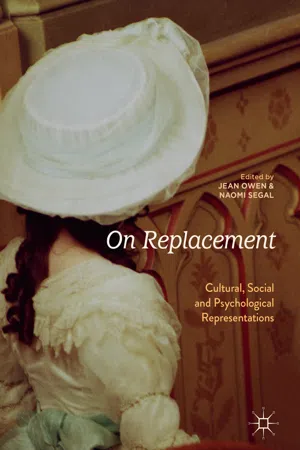
The fiction Rebecca can be seen as part of a replacement chain, positioned between Jane Eyre and Wide Sargasso Sea (see this volume, Chap. 11), not to mention many less distinguished fantasies of the plain-girl-conquers-dashing-rogue variety. It has given rise not only to the ‘classic’ Hitchcock adaptation of 1940 but to many small-screen avatars as well. In 1962 a black-and-white version ran in the American TV series ‘Theatre ’62’, slashed to under one hour and starring Joan Hackett , later the doomed Dottie of The Group; in 1969 there was an Italian version, Rebecca, la prima moglie, followed by another under the same title in 2008, in which the otherwise universally unnamed protagonist is called Jennifer. Two British TV miniseries not only appeared in the echoing years 1979 and 1997 but have mother and daughter in the parallel role of the second Mrs de Winter – Joanna David and Emilia Fox . The 1979 version also stars Jeremy Brett and Anna Massey , seventeen years divorced at the time, who, their son reports, ‘ignored each other for the entire filming’ (Huggins, n.p.) . Another parallel can be found in the subsequent careers of two Mrs Danvers , Judith Anderson and Diana Rigg , both later celebrated for playing Medea . But the differences are as instructive as the parallels – Joanna David wears Caroline de Winter’s wig pinned up and hatless, while Emilia Fox faces the wrath of her husband in a splendid bonnet (as our cover image shows). The ending is especially varied. In every version Manderley burns down, but whereas in du Maurier’s novel Mrs Danvers has simply ‘cleared out’ (421), in most other versions we see her raving among the flames like a latter-day Miss Havisham or Bertha Mason. Here and there Maxim and his loyal wife are exculpated: for Hitchcock , whose hands were tied by the Hays Code, he has not actually murdered Rebecca , only knocked her down; and as Charles Dance in 1997 he plunges into the fire to rescue Mrs Danvers , tumbling down the staircase with her in his arms. Just once, startlingly, we get to see Rebecca – in the same production, her eyes, hands and head are glimpsed bewitchingly in the shape of Lucy Cohu .
Her earliest avatar was surely that of du Maurier’s short story ‘The Doll’, written when she was barely twenty-one, published in 1937 and then ‘lost’ until its rediscovery and republication in 2011. In it an inaugural Rebecca , the desperate narrator’s love-object, is much more in line with the traditional vamp as la belle juive – a Hungarian violinist herself crazily obsessed with a male sex doll called Julio.
Of course, Daphne du Maurier’s Rebecca (1938) makes a virtue of the inaccessibility of the first wife, decisively dead and thus ensconced in the attic of other people’s certain memories and uncertain desires. A man marries once; a man marries twice. The second wife enters a house dominated by her predecessor and the obsessive enigma surrounding her. Yet her torment is curiously reversible. Mrs Danvers taunts her: ‘She’s the real Mrs de Winter , not you. It’s you that’s the shadow and the ghost’ (273), but...
Table of contents
- Cover
- Front Matter
- 1. Introduction
- Part I. What is replacement?
- Part II. Lost children
- Part III. Wayward Women
- Part IV. Law and Society
- Part V. Replacement films
- Part VI. The Holocaust
- Part VII. Psychoanalysis
- Back Matter
Trusted by 375,005 students
Access to over 1.5 million titles for a fair monthly price.
Study more efficiently using our study tools.
Frequently asked questions
Yes, you can cancel anytime from the Subscription tab in your account settings on the Perlego website. Your subscription will stay active until the end of your current billing period. Learn how to cancel your subscription
No, books cannot be downloaded as external files, such as PDFs, for use outside of Perlego. However, you can download books within the Perlego app for offline reading on mobile or tablet. Learn how to download books offline
Perlego offers two plans: Essential and Complete
- Essential is ideal for learners and professionals who enjoy exploring a wide range of subjects. Access the Essential Library with 800,000+ trusted titles and best-sellers across business, personal growth, and the humanities. Includes unlimited reading time and Standard Read Aloud voice.
- Complete: Perfect for advanced learners and researchers needing full, unrestricted access. Unlock 1.5M+ books across hundreds of subjects, including academic and specialized titles. The Complete Plan also includes advanced features like Premium Read Aloud and Research Assistant.
We are an online textbook subscription service, where you can get access to an entire online library for less than the price of a single book per month. With over 1.5 million books across 990+ topics, we’ve got you covered! Learn about our mission
Look out for the read-aloud symbol on your next book to see if you can listen to it. The read-aloud tool reads text aloud for you, highlighting the text as it is being read. You can pause it, speed it up and slow it down. Learn more about Read Aloud
Yes! You can use the Perlego app on both iOS and Android devices to read anytime, anywhere — even offline. Perfect for commutes or when you’re on the go.
Please note we cannot support devices running on iOS 13 and Android 7 or earlier. Learn more about using the app
Please note we cannot support devices running on iOS 13 and Android 7 or earlier. Learn more about using the app
Yes, you can access On Replacement by Jean Owen, Naomi Segal, Jean Owen,Naomi Segal in PDF and/or ePUB format, as well as other popular books in Media & Performing Arts & Film & Video. We have over 1.5 million books available in our catalogue for you to explore.