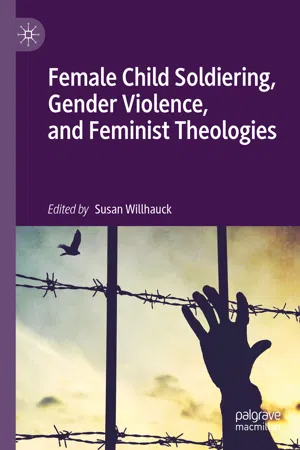
This book examines the phenomenon of female child soldiering from various theological perspectives. It is an interdisciplinary work that brings Christian feminist theologies into dialogue to analyze the complex ethical, geopolitical, social, and theological issues involved in the militarization of girls and women and gender-based violence. With contributions from a range of interdisciplinary and multicultural authors, this book offers reflections and perspectives that coalesce as a comprehensive overview of feminist theological insights into child soldiering.
- English
- ePUB (mobile friendly)
- Available on iOS & Android
eBook - ePub
Female Child Soldiering, Gender Violence, and Feminist Theologies
About this book
Information
Topic
Teologia e religioneSubtopic
Filosofia etica e morale© The Author(s) 2019
S. Willhauck (ed.)Female Child Soldiering, Gender Violence, and Feminist Theologieshttps://doi.org/10.1007/978-3-030-21982-6_11. Violence, Power, Resistance and Resilience: An Introduction
Susan Willhauck1
(1)
Atlantic School of Theology, Halifax, NS, Canada
A student of mine from Sierra Leone told me that she spent most of her teenage years living in daily terror, as two of her close relatives had been snatched (or “taken up” in her words) by roving militia and never returned. In our class on feminist theology , she voiced frustration at the lack of responsiveness on the part of feminists, theologians and people of faith. She pleaded for feminists to stand with girls and women everywhere against this violence and abuse. The student returned to humanitarian work in Sierra Leone and we corresponded until her death from cancer last year. As a long-time child advocate and practical theologian, I felt compelled to bring together scholar activists to examine and speak out on this moral issue through the lens of feminist theology . While I acknowledge my own inadequacy to interpret this complex issue and my social position of privilege, at the same time I seek to learn more in order to not leave to others to do what I can do. For me, it is more than an academic exercise to gather strong definitive voices to elevate women’s resistance, healing and peace-building. I have learned that we need to really listen to the first-person accounts and critical discourse contained in these pages. At a time when the US political leadership engages in belligerent and divisive denigration of certain countries and of heightened awareness of sexual exploitation, and when women who disclose it are publicly ridiculed, we are overdue for critical examination of ideologies, policies and practices that lead to gender violence, genocide and the forced militarization of girls and women. Girls’ experiences of war have accounted for “the smallest percentage of scholarly and popular work on social and political violence” (Nordstrom 1997, 5). This volume is an interdisciplinary work that brings together feminist voices, including Latina, Korean, Womanist, Caribbean and Africana perspectives, to help rectify the void. I looked to the resources of the Circle of Concerned African Women Theologians and the Caribbean Women Theologians for Transformation as well as other Womanist and feminist scholars to engage their various disciplines of ethics, education, sociology and pastoral care.
There are approximately 300,000 child soldiers worldwide and about 40 percent of them are female.1 Many armed groups and some government forces operating in regions of conflict have actively sought out underage female recruits. Girls are often subjected to sexual slavery, receive weapons training and are deployed in combat. The phenomenon of child soldiers has been discussed in an expanding body of literature and popular media and non-profit organizations have been mobilized to respond to the crisis.2 Child soldiering is not a new phenomenon. Consider the Hitlerjugend of World War II, and in Chap. 4 of this book, Traci C. West discusses the use of children in the Civil Rights movement, but of late, the number of child combatants has risen dramatically. Children in armed conflict is a complex issue and several studies have examined the root causes and explanations.3 Myriam Denov, in Girls in Fighting Forces: Moving Beyond Victimhood (2007), notes how in certain war-torn regions of Africa, girls are particularly valued because “they are perceived as highly obedient and easily manipulated, they can swell the ranks if there is a shortage of adults, and ensure a constant pool of forced and compliant labor” (2007, 4). Mostly, girls enter into armed groups after being forcibly abducted and torn apart from their families. However, some girls have been known to voluntarily join militias, sometimes motivated by ideology. In other circumstances, girls hope armed groups will provide protection from poverty, sexual abuse, forced marriages, and state- or rebel-inflicted violence.
Violence has itself been a means of resistance at times, and that girls and women would heed its call as a means of survival or to better their circumstances is no surprise. One would not want to downplay the historic role of women in struggles for liberation. I would not want to suggest that girls and women are less violent or ought to be than men because of their nature—a growing phenomenon of “girls with guns” does not bear out that notion. Some feminists themselves have applauded images of the strong female warrior that permeates culture (including children’s programming). Of course, boys are also forced into combat and abused. Girls and women, however, face unique challenges, according to scholars Emeline Ndossi (2010, 133) and Therese Tinkasiimire (2010, 165, 167) as well as Beverly Mitchell and Mary Nyangweso in this volume, because of the inferior status projected onto them by culture, their vulnerability and increased stigmatization in their communities. Because females are abducted, sexually violated and forced into combat in an extreme form of oppression with a particular sense of urgency, this work explores what feminist theology could provide that would witness against such atrocity. While child soldiering takes place in many countries across the globe, I have found African feminist theologies to be a hopeful resource. Many African feminist theologians, however, articulate western Christianity as one of the sources of their oppression. Essays in this volume provide important critique of some assumptions of liberal Christian feminism. To bring ideas born of white western privilege to bear on child soldiering, as in “I know what is good for you,” smacks of colonialism. I have had to examine and re-think my own assumptions during this project. In the diversity of African cultures, African Christian feminists localize their concerns to inculcate their experiences into doing theology (Kasomo and Maseno 2011). Yet African feminists in my experience welcome alliance with others seeking similar reformation. We need to ask what can white women and women of color say and do to address the problem, as several of the contributors here attest that race is at the heart of the matter. I am cognizant of the glaring racism of the “white savior” trope, yet identity politics around who is allowed to speak about what only serve to divide us further. This book represents the reflections of a diverse group of feminist theologians and researchers in search of understanding the complexities of sexual violence in conflict and the militarization of girls and women. It confronts privileged detachment and the “danger of a single story” (Adichie 2009). To begin the conversation, I will present here some ways that feminist theory and epistemology have conceived power and the role of power in resisting sexual violence, and elaborate on how the authors in this volume take on specific aspects of the issue to point out what could provide a way forward in understanding and dismantling another form of gender injustice.
Christian Feminist Theory and Power
Serene Jones has written that feminist theory has the goal of the liberation of women (2000, 3). One could expect that includes the liberation of female child soldiers. In her groundbreaking work, Wounds of the Spirit: Black Women, Violence, and Resistance Ethics, Christian ethicist Traci C. West asserts that “at the core of Christian tradition is a call to morally engage this world by demonstrating opposition to social injustice and human suffering” (1999, 1). Jones claims that feminist theory offers an opportunity to consciously analyze oppression and the possibility of imagining and training for a different future. It allows the opportunity to deconstruct understandings of power and unjust power relations that give rise to oppression (2000, 5). Christian feminist theology, Womanist and Latina theology bring feminist theory to bear on many theological concepts, moral questions and practices.
Despite these claims, Christian feminist scholarship has been curiously muted on the issue of female child soldiering, being occupied with gender study, equality, critique of patriarchy, ordination rights and so on, issues that could be perceived as residing in white privilege (work that I myself have done). Also, awareness of Christianity’s flawed history of colonialism causes feminists to tread lightly at best or render us paralyzed at worst. We may tend to suspend thinking about it because we perceive it to be distanced from our concerns and we are reluctant to get into somebody else’s business. Yet the suffering of girls and women in this way affects all Christians and calls for resistance. I suggest that feminist resistance theory with its analysis and reconstruction of unjust power relations offers a basis for such moral engagement and preventative actions.
Amy Allen in The Power of Feminist Theory writes that it is the work of feminists to critique, challenge, subvert and aim to overthrow the “multiple axes of stratification affecting women in contemporary western societies” (1999, 1–2). But what about non-western societies? As feminist theory impacts Christian theology, feminist theology and praxis have always gone together. It is not enough for feminist theologians to talk about changing the world; they are usually directly involved in attempts to change it. Feminist theologians work in many different arenas of advocacy, some directly focused on gender and some emphasizing other issues with a feminist critique. The authors in this volume consider how the power of feminist theology unleashes in women the audacity to resist the violence.
Allen offers a critique of some understandings of power that I think is helpful to this work. She rejects understanding power as a resource because it assumes that it is something that can be possessed, distributed and re-distributed, and if we just re-distribute power in certain places, all will be well. It seems to assume a power-over relationship—that someone always has power over ...
Table of contents
- Cover
- Front Matter
- 1. Violence, Power, Resistance and Resilience: An Introduction
- 2. Human Rights, Dignity, and Female Child Soldiers: A Theological Approach
- 3. Sexual Violence in Conflict: Understanding the Experience of Child Soldiers
- 4. Confronting US Moral Hypocrisy on Child Soldiers, Inventing Antiracist Solidarity
- 5. “I’d Rather Die than Wrestle”: Gender, Spirituality, and Agency Amongst the Luba Mai-Mai
- 6. Education in Resistance to Child Soldiering: A Latina Liberation Theology Perspective
- 7. “Some Girls Are So Vicious that Even the Boys Fear Them”: Girls and Gangs in Jamaica
- 8. Factory Girls and ‘Comfort’ Girls: A Feminist Theo-Ethical Reflection on Korean Girl Soldiers in Japanese Empire
- 9. Battling a ‘War within a War’: Challenges of Being Female in Africa
- 10. Pastoral Care in the Trauma of Gender Violence
- 11. Divine Fortitude: A Reflection on the Incarnation of the Black Female Child Soldier
- Back Matter
Trusted by 375,005 students
Access to over 1.5 million titles for a fair monthly price.
Study more efficiently using our study tools.
Frequently asked questions
Yes, you can cancel anytime from the Subscription tab in your account settings on the Perlego website. Your subscription will stay active until the end of your current billing period. Learn how to cancel your subscription
No, books cannot be downloaded as external files, such as PDFs, for use outside of Perlego. However, you can download books within the Perlego app for offline reading on mobile or tablet. Learn how to download books offline
Perlego offers two plans: Essential and Complete
- Essential is ideal for learners and professionals who enjoy exploring a wide range of subjects. Access the Essential Library with 800,000+ trusted titles and best-sellers across business, personal growth, and the humanities. Includes unlimited reading time and Standard Read Aloud voice.
- Complete: Perfect for advanced learners and researchers needing full, unrestricted access. Unlock 1.5M+ books across hundreds of subjects, including academic and specialized titles. The Complete Plan also includes advanced features like Premium Read Aloud and Research Assistant.
We are an online textbook subscription service, where you can get access to an entire online library for less than the price of a single book per month. With over 1.5 million books across 990+ topics, we’ve got you covered! Learn about our mission
Look out for the read-aloud symbol on your next book to see if you can listen to it. The read-aloud tool reads text aloud for you, highlighting the text as it is being read. You can pause it, speed it up and slow it down. Learn more about Read Aloud
Yes! You can use the Perlego app on both iOS and Android devices to read anytime, anywhere — even offline. Perfect for commutes or when you’re on the go.
Please note we cannot support devices running on iOS 13 and Android 7 or earlier. Learn more about using the app
Please note we cannot support devices running on iOS 13 and Android 7 or earlier. Learn more about using the app
Yes, you can access Female Child Soldiering, Gender Violence, and Feminist Theologies by Susan Willhauck in PDF and/or ePUB format, as well as other popular books in Teologia e religione & Filosofia etica e morale. We have over 1.5 million books available in our catalogue for you to explore.