Highlights lessons from Botswana's economic history that are relevant for understanding historical as well as contemporary experiences of economic growth and (lacking) structural transformation in natural resource abundant and dependent countries
Provides an in-depth study identifying drivers of inequality taking place during the diamond-led economy
Considers consequences of colonial economic strategies including taxes and government transfers
Discusses what could happen when the diamonds run out and the window of opportunity has not been used to create sustainable economic development
eBook - ePub
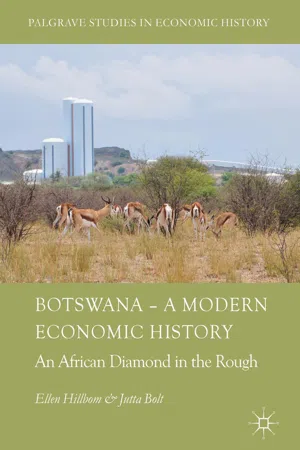
Botswana – A Modern Economic History
An African Diamond in the Rough
- English
- ePUB (mobile friendly)
- Available on iOS & Android
eBook - ePub
About this book
Information
© The Author(s) 2018
Ellen Hillbom and Jutta BoltBotswana – A Modern Economic HistoryPalgrave Studies in Economic Historyhttps://doi.org/10.1007/978-3-319-73144-5_11. An African Diamond in the Rough
Ellen Hillbom1 and Jutta Bolt2, 3
(1)
University of Lund, Lund, Sweden
(2)
Lund University, Lund, Sweden
(3)
University of Groningen, Groningen, The Netherlands
1.1 Introduction
Botswana is, in terms of population, a small African country, and overall it has played a modest role in the economic and political history of the region. At the same time, its exceptional diamond-led economic growth record since independence has generated significant attention from both scholars and the policy community. The reason for this lies not only in a will to understand how a country that used to be among the poorest in the world, situated in a region often characterized by underdevelopment and conflict, has managed to achieve consistent long-run economic growth. It is also spurred by an interest in unravelling and explaining an uncharacteristic case of a natural resource-rich developing country that has managed to pair natural resource dependency with economic progress, substantial social development , and peaceful political maturity. The common experience, globally as well as in Africa, is that natural resource wealth has been negatively correlated with economic growth (Auty, 2001; Sachs & Warner, 1995). In many developing countries, the abundance of valuable natural resources has even been transformed into a curse characterized by economic crisis, corruption, and political instability including violence. In contrast to this overall discouraging experience, Botswana constitutes a positive and unique example from which we can extract lessons in terms of how to ensure that natural resource wealth becomes a driver of economic growth and not a pitfall for development.
Existing explanations frequently found in the literature for Botswana’s successful management of diamond incomes and subsequent growth miracle can crudely be divided into four main lines of argument. First, it is stated that limited European settlement during the colonial era and the fact that most resources remained in the hands of the indigenous population meant that the country suffered little from the adverse consequences of colonial influence. This argument ties to the second claim that precolonial political institutions characterized by accountability and broad-based negotiations persisted throughout the colonial period up until today. Third, the persistence of good precolonial institutions is said to explain a development-enabling quality found in contemporary political institutions, and this has catered for a prudent management of natural resource incomes and sound economic policies. Finally, in the midst of the institutional explanation, the country is said to be fortunate in that it has had wise leaders from independence onwards who have promoted political stability and national development instead of appropriating the state, turning it into a source for personal enrichment at the expense of national poverty and unrest. (For this literature, see, e.g. Acemoglu et al., 2003; Acemoglu & Robinson, 2010; Beaulier & Subrick, 2006; Harvey & Lewis, 1990; Iimi, 2006; Leith, 2005; Masire, 2006; Mpabanga, 1997; Owusu & Ismail Samatar, 1997; Robinson & Parsons, 2006; Samatar, 1999.)
We agree that an investigation into long-term institutional development is key for understanding Botswana’s development trajectory and that the first generation of independence leaders played a decisive role in instigating the country’s specific growth experience. At the same time we claim that the above cited explanations constitute an oversimplification of both the dynamics inherent in Botswana’s economic history generally, and of the remaining challenges for the diamond-led growth miracle specifically. To start with, colonial influence was limited only during the first half of the colonial period, and we will show that from the 1930s onwards with the establishment and growth of the cattle export sector colonial policies actually had a profound effect on socioeconomic development. In addition, structures that were developed during the colonial era have persisted until today and continue to be part of the challenges for the future. Specifically, this refers to the continuous mono-product natural resource-dependent economy and the high levels of inequality. The long term effect of precolonial legacies also needs to be carefully considered. While several precolonial structures indeed have survived, they have been transformed over time and have been not only enabling but also hindering development progress depending on which groups in society we are considering. The precolonial legacy is much more complex than a straightforward causality between specific precolonial institutions and contemporary development-enhancing government policies. Further, while Botswana had leaders during the first decades of independence who ensured that diamond wealth benefitted the large majority of the population, the more recent political elite is increasingly criticized for corruption and elite capturing. Finally, it can be debated whether political continuity and stability, that is, the Botswana Democratic Party consistently ruling the country since independence, has come at the price of lacking change in socioeconomic structures towards inclusive economic development .
In this book we aim to give recognition to these and many more aspects of the complexities entrenched in both Botswana’s long-term economic history and its contemporary growth miracle. Such an elaborate and critical examination is necessary if we are to draw accurate conclusions from our case that can constitute lessons relevant for other natural resource-rich developing countries. Our study offers evidence on which we base our arguments that in the midst of progress, the country remains with two overarching challenges. First, its economy is stuck in a natural resource trap and has yet to figure out how to move away from natural resource-based growth to a more diversified economy where additional high-productive sectors are playing a role in generating employment and stimulating growth. Second, the persistent high levels of inequality, in terms of income as well as division of resources and opportunities, give cause for concern. Botswana has a dual society where exceptional growth, substantial wealth, high rates of urbanization, social development , and socioeconomic modernization are found next to high unemployment rates, lingering poverty, and neglected rural areas. Further, we show that neither natural resource-dependent growth nor lack of diversification and high levels of inequality are unique to the current diamond economy. They are part of Botswana’s long-term development trajectory and can be traced back to the equally relevant, though far less spectacular, cattle-led growth period during the colonial era. The relevance of this first growth period does not lie in the magnitude of growth or size of incomes and investments. Instead, it is the development of an economy and a society characterized by natural resource dependency with reliance on export revenues from a single resource as well as lack of inclusion and equitable access to opportunities for the broader population that makes the period important to analyse. These characteristics have remained and are still found in the current diamond economy.
While much of Botswana’s fame relates to the last four decades of spectacular economic growth, our comprehensive study into the country’s economic history stretches over more than one and a half century. Our period of investigation starts when the Tswana groups of contemporary Botswana settled in their present area...
Table of contents
- Cover
- Front Matter
- Part I. Part 1
- Part II. Part 2
- Part III. Part 3
- Part IV. Part 4
- Back Matter
Trusted by 375,005 students
Access to over 1.5 million titles for a fair monthly price.
Study more efficiently using our study tools.
Frequently asked questions
Yes, you can cancel anytime from the Subscription tab in your account settings on the Perlego website. Your subscription will stay active until the end of your current billing period. Learn how to cancel your subscription
No, books cannot be downloaded as external files, such as PDFs, for use outside of Perlego. However, you can download books within the Perlego app for offline reading on mobile or tablet. Learn how to download books offline
Perlego offers two plans: Essential and Complete
- Essential is ideal for learners and professionals who enjoy exploring a wide range of subjects. Access the Essential Library with 800,000+ trusted titles and best-sellers across business, personal growth, and the humanities. Includes unlimited reading time and Standard Read Aloud voice.
- Complete: Perfect for advanced learners and researchers needing full, unrestricted access. Unlock 1.5M+ books across hundreds of subjects, including academic and specialized titles. The Complete Plan also includes advanced features like Premium Read Aloud and Research Assistant.
We are an online textbook subscription service, where you can get access to an entire online library for less than the price of a single book per month. With over 1.5 million books across 990+ topics, we’ve got you covered! Learn about our mission
Look out for the read-aloud symbol on your next book to see if you can listen to it. The read-aloud tool reads text aloud for you, highlighting the text as it is being read. You can pause it, speed it up and slow it down. Learn more about Read Aloud
Yes! You can use the Perlego app on both iOS and Android devices to read anytime, anywhere — even offline. Perfect for commutes or when you’re on the go.
Please note we cannot support devices running on iOS 13 and Android 7 or earlier. Learn more about using the app
Please note we cannot support devices running on iOS 13 and Android 7 or earlier. Learn more about using the app
Yes, you can access Botswana – A Modern Economic History by Ellen Hillbom,Jutta Bolt in PDF and/or ePUB format, as well as other popular books in Economics & Business General. We have over 1.5 million books available in our catalogue for you to explore.