The Levellers sought to restructure the state in 1647-9 around popular consent and liberty for conscience, especially in their Agreement of the People. Following the Levellers, Volume Two examines the later political efforts of Leveller spokesmen like John Lilburne, John Wildman, and Richard Overton, and their followers. Far from ending in the 1649 troop revolts, the Leveller impact continued in the Interregnum climacterics of 1653 and 1659-60, times of acute political and religious unsettlement. Indeed, Leveller ideas resurfaced in Restoration political and religious crises in 1678-83 and again in 1687-8 and flourished in populations that once followed the Levellers. Analysis of London, army, and county Levellers reveals connections to subsequent outbursts of unrest. Sectarian communities in London's peripheral neighbourhoods and nearby counties sustained the Leveller ethos, and ordinary people like those who followed the Levellers remained active in petitioning and protest about political and religious liberties through the Glorious Revolution.
eBook - ePub
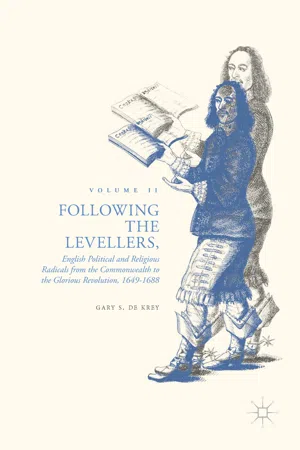
Following the Levellers, Volume Two
English Political and Religious Radicals from the Commonwealth to the Glorious Revolution, 1649–1688
- English
- ePUB (mobile friendly)
- Available on iOS & Android
eBook - ePub
Following the Levellers, Volume Two
English Political and Religious Radicals from the Commonwealth to the Glorious Revolution, 1649–1688
About this book
Information
© The Author(s) 2018
Gary S. De KreyFollowing the Levellers, Volume Twohttps://doi.org/10.1057/978-1-349-95330-1_11. Introduction: Finding the Levellers and Their Successors
Gary S. De Krey1
(1)
Department of History, St. Olaf College, Northfield, MN, USA
Since the beginning of Leveller scholarship, historians have wondered whether the Levellers of 1647–1649 had successors in subsequent decades who continued to articulate the Leveller programme. Most have thought not. Twentieth-century historians who placed the Levellers in the historical narrative of seventeenth-century England generally thought the Leveller impulse died after 1649. They regarded the Levellers as an immediate, short-term response to the collapse of Stuart government into civil war and political acrimony: the Levellers were a structured party, movement, or organization of 1647–1649 with a fixed agenda embedded in the Agreement of the People. Their chances of success were never great because Leveller ideas about democracy and contractual government were far ahead of their time. Furthermore, according to this view, the Levellers’ hopes were too dependent on their support in the New Model Army . When the army rebellion was ‘crushed’ at Burford , so too were the Levellers. 1 Other political radicals, republicans , and sectarian visionaries appeared in the 1650s; but their impact was similarly brief; and civil war and Interregnum radicalism were largely repudiated in the Stuart Restoration of 1660. As the eminent historian Conrad Russell opined in the mid-1980s: ‘the defeat of 17th-century radicalism was long-lasting and apparently complete.’ 2
Lack of familiarity with the composition of the Leveller following reinforced the scholarly termination of the Leveller story in 1649. Murray Tolmie’s pioneering study of 1977 linked the London Levellers to individual London Baptists and separatists . However, Tolmie also interpreted the 1649 break between the Leveller leaders and notable urban separatist pastors as heavily damaging to the urban sectarian audience that had provided the Levellers with support for their campaign of petitions and demonstrations on behalf of the Agreement . Tolmie provided much biographical evidence about who among the urban sectarians supported the Levellers, but he did not trace those associations beyond 1649. Other recent work has reinforced the emphasis on the sectarian origins of the Leveller following, but without an extensive prosopographic reconstruction of who followed the Levellers before 1649, following the Levellers after 1649 has not been feasible. 3
The purpose of this volume is to integrate the story of the 1647–1649 Levellers with that of their Interregnum and Restoration successors. It proposes that Leveller arguments and ideas can, in fact, be found in subsequent times of significant unsettlement (or climacterics ) like that of 1647–1649 in which the Levellers first arose. This contention rests upon the identification of as many individual Leveller followers as possible in London, the army, and other localities. It also rests upon analysis of how radical political perspectives shaped the lives of both Leveller followers who survived after the 1640s and Leveller successors. My findings draw from the work of many scholars who have investigated the worlds of Interregnum republicanism and Restoration radicals, generally without linking their subject matter to the Levellers. My approach also draws upon a more malleable understanding of the Levellers than that of most previous Leveller historiography.
The history of the Levellers is a history of spontaneous outbursts of political creativity on behalf of political and religious freedom at critical intervals in 1647–1649. Those political outbursts recurred episodically over the next forty years, provoked by political disappointments and by the imposition of political and religious constraints. The Levellers and their immediate followers should be interpreted as adaptable and non-doctrinaire proponents of accountable government, popular rights, and liberty of conscience. When they are so understood, their pre-1649 efforts can be tied to republican opposition to the Cromwellian Protectorate , to popular support for the revived Commonwealth of 1659, to sectarian hostility to the re-establishment of religious coercion in the reign of Charles II (1660–1685), and even to approval of a fundamental law in the reign of James II (1685–1688) that would have established religious toleration and placed it beyond parliamentary repeal.
Thirty years ago, Prof. J.G.A. Pocock wrote about a continuing ‘London-based radicalism’—one with its own political language about both ‘natural rights and historic birthrights ’ embedded in an ancient constitution of ‘frequent or annual parliaments.’ Pocock suggested that this political radicalism connected the Levellers and the army radicals of the 1640s to an urban Restoration ‘radical underground’ that openly emerged again in 1678–1683. 4 He thought this radical ‘ancient constitutionalism ’ was widespread among the more ‘violent Shaftesbureans,’ that it linked them to their ‘Commonwealth antecedents,’ and that even John Locke ‘moved’ among men inclined to these views in London and Amsterdam. The present volume follows Pocock’s lead in seeking to position this continuing stream of urban radicalism that originated with the Levellers firmly in the history of both the Interregnum and the Restoration . It does so by tracing the Leveller followers and those who succeeded them—and who refashioned and rearticulated their ideas—in every crisis of English government through the Glorious Revolution . The primary focus is London, which continued to generate a politically assertive population outside its walls, a population that often found in sectarianism a vehicle for its participatory values and that was also open to social and political change. This investigation of Leveller followers and successors is not restricted to London, however: it also examines the Leveller following and Leveller successors in other localities that seem to have been particularly hospitable to radical perspectives, and it seeks to explain why these communities also fostered such attitudes.
Analysis of post-1649 Levellers is most manageable for the era of the Commonwealth , 1649–1653, when so many Leveller activists of the previous two years remained visible in urban and national affairs. Chapter 2 explains how the Leveller leaders sought to relaunch their agenda of accountable government, popular rights, and liberty of conscience in the wake of the distraction produced by the spring 1649 troop disorders, only to see another mutiny—one more closely linked to the Leveller agenda—upend their efforts. In the Oxford mutiny of September 1649 the Commonwealth regime found further evidence with which to stigmatize the Levellers and to justify regulation of the ‘licence’ of the press that had facilitated the Levellers’ propagation of their views. By October 1649, the climacteric of 1647–1649 was resolving, as the Commonwealth government finally established itself more securely through the suppression of rebellion in Ireland , mutiny in the army, and printed Leveller and royalist criticism. Yet the October 1649 treason trial of John Lilburne proved that Leveller ideas had not lost their audience within London and the adjacent counties. The astonishing acquittal of the man whom many Independent leaders considered the prime mover behind all their 1649 troubles freed him, his associates, and his followers to challenge the unelected government of the English Revolution another day.
That day did not come immediately: the released Leveller leaders made their peace with a regime they had tried but failed to reform. But as the years passed, and as neither promised reforms nor parliamentary elections materialized, the Leveller impulse again became notable. When Oliver Cromwell precipitated another climacteric of unsettlement in April 1653 by dissolving what was left of the Long Parliament and imposing the Nominated Parliament on the country, the Levellers burst onto the political scene again. They rearoused the same urban and county populations as in 1647–1649 on behalf of the political agenda previously digested in different versions of the Agreement of the People. The second Commonwealth treason trial of John Lilburne, which a Council of State dominated by Cromwell devised to end the Leveller challenge, instead demonstrated how little genuine support this transitional regime enjoyed, even among the gathered churches , which were its intended base. The transition from the Commonwealth to the Cromwellian Protectorate that followed was quite messy, and the Levellers and their followers contributed significantly to the mess.
But who were the Leveller followers of 1647–1653? Chapter 3 provides an extensive scholarly analysis of Leveller followers. It examines the religious, occupational, and geographic dimensions of the London Leveller following, confirming the Levellers’ roots in urban sectarianism. The chapter also addresses the question of Leveller support among the personnel of the New Model Army by separating out those agitators and militants of 1647–1649 who remained committed to Leveller principles after the appearance of the first Agreement of the People. It traces the careers of some army Levellers through the 1650s, while also acknowledging that not all in the army who embraced Leveller principles before 1649 continued to do so thereafter. Finally, Chap. 3 offers the first extensive analysis of Leveller support outside London by examining the local politics and concerns that prompted petitions on behalf of the Levellers and their leaders in such counties as Hertfordshire and Buckinghamshire . Few names associated with local petitions have survived, but those that do survive point again to the sectarian outlook of Leveller supporters in the counties.
Chapter 4 addresses one of the thorniest questions of post-1649 Leveller history. What roles did Levellers and Leveller-inclined sectarians play in the emergence of the ‘commonwealthmen ’ of the 1650s and in their opposition to the Cromwellian Protectorate for the sake of popular liberties and regularly elected parliaments? The chapter argues that rigid categorization of Cromwellian opponents into different camps under mutually exclusive labels is unhelpful. Different opposition camps clearly existed, but cooperation among camps that were only in the process of differentiation was also clear. The cross currents of politics under the Protectorate could bring together opponents of the regime as seemingly different as those whose republicanism was derived from classical and Renaissance sources and those whose ‘Fifth Monarchist ’ views stemmed from visions of saintly rule in the final or fifth world monarchy prophesied in ...
Table of contents
- Cover
- Front Matter
- 1. Introduction: Finding the Levellers and Their Successors
- 2. The Levellers and the Commonwealth, 1649–1653
- 3. Leveller Followers in London, the Army, and the Counties
- 4. Leveller Successors and the Protectorate, 1654–1659
- 5. Leveller Successors and the Climacteric of 1659–1660
- 6. The Leveller Ethos and the Restoration
- 7. Leveller Successors of the 1680s
- Back Matter
Trusted by 375,005 students
Access to over 1.5 million titles for a fair monthly price.
Study more efficiently using our study tools.
Frequently asked questions
Yes, you can cancel anytime from the Subscription tab in your account settings on the Perlego website. Your subscription will stay active until the end of your current billing period. Learn how to cancel your subscription
No, books cannot be downloaded as external files, such as PDFs, for use outside of Perlego. However, you can download books within the Perlego app for offline reading on mobile or tablet. Learn how to download books offline
Perlego offers two plans: Essential and Complete
- Essential is ideal for learners and professionals who enjoy exploring a wide range of subjects. Access the Essential Library with 800,000+ trusted titles and best-sellers across business, personal growth, and the humanities. Includes unlimited reading time and Standard Read Aloud voice.
- Complete: Perfect for advanced learners and researchers needing full, unrestricted access. Unlock 1.5M+ books across hundreds of subjects, including academic and specialized titles. The Complete Plan also includes advanced features like Premium Read Aloud and Research Assistant.
We are an online textbook subscription service, where you can get access to an entire online library for less than the price of a single book per month. With over 1.5 million books across 990+ topics, we’ve got you covered! Learn about our mission
Look out for the read-aloud symbol on your next book to see if you can listen to it. The read-aloud tool reads text aloud for you, highlighting the text as it is being read. You can pause it, speed it up and slow it down. Learn more about Read Aloud
Yes! You can use the Perlego app on both iOS and Android devices to read anytime, anywhere — even offline. Perfect for commutes or when you’re on the go.
Please note we cannot support devices running on iOS 13 and Android 7 or earlier. Learn more about using the app
Please note we cannot support devices running on iOS 13 and Android 7 or earlier. Learn more about using the app
Yes, you can access Following the Levellers, Volume Two by Gary S. De Krey in PDF and/or ePUB format, as well as other popular books in History & British History. We have over 1.5 million books available in our catalogue for you to explore.