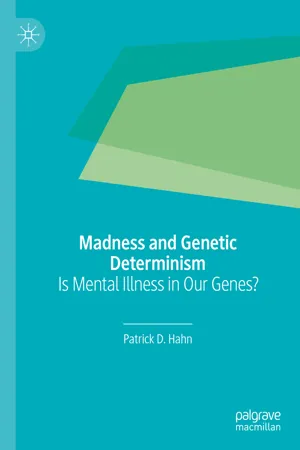
The book covers important topics in the psychiatric genetics (PG) field. Many of these have been overlooked in mainstream accounts, and many contemporary PG researchers have omitted or whitewashed the eugenic and "racial hygiene" origins of the field. The author critically analyzes PG evidence in support of genetic claims which, given the lack of gene discoveries, are based mainly on the results of psychiatric twin and adoption studies. Given that the evidence in favor of genetic influences is much weaker than mainstream sources report, due to serious issues in twin and adoption research, the author points to environmental factors, including trauma, as the main causes of conditions such as schizophrenia.
- English
- ePUB (mobile friendly)
- Available on iOS & Android
eBook - ePub
About this book
Information
© The Author(s) 2019
Patrick D. HahnMadness and Genetic Determinismhttps://doi.org/10.1007/978-3-030-21866-9_11. The Beginning
Patrick D. Hahn1
(1)
Biology, Loyola University Maryland, Baltimore, MD, USA
Patrick D. Hahn
L’Enfant Plaza, Washington DC, mid-January, two weeks after the polar vortex brought record-breaking low temperatures to the area. It’s a bright clear day, but a bitterly cold wind is stinging my face. Accompanied by my daughter and her friend, I open the door and we enter the United States Holocaust Memorial Museum.
After passing through the metal detectors we enter the cavernous lobby, which is jam-packed with students. A guard passes by, holding a black Labrador retriever at the end of a leash.
We take the elevator to the fourth floor and step out to find ourselves facing an image of skeletons, bits of dried flesh clinging to the bones, all stacked like cordwood outside one of the Nazi death camps. Everyone else around us appears to be of high school age, but the natural exuberance and boisterousness of youth has been put on pause. People speak in hushed tones, or not at all.
We pass exhibits chronicling Hitler’s rise to power, then pause in front of a bed frame, its coat of white paint peeling away to reveal the bare metal underneath. It’s from the Sachsenberg Clinic, where children were killed by starvation, lethal injections, or overdoses of medication. Behind it is a photomural of the Hadamar Psychiatric Institute, black smoke roiling forth from the chimney.
In 1941, the staff of Hadamar held a gathering to celebrate the murder of the 10,000th patient.1 Psychiatrists, nurses, secretaries, and staff all participated. The naked body of a murdered patient lay on a stretcher, covered with flowers, and a staff member dressed as a priest performed a mock ceremony.
The hospital supervisor gave a speech, and then the beer and wine flowed freely. A local polka band provided entertainment.2 All this was part of the Nazi program of “racial hygiene,” set in motion by some of Germany’s most prominent scientists and medical doctors.
The Nazi campaign to eradicate the mentally ill was a dress rehearsal for the Holocaust, but the idea that mental illness is a matter of faulty inheritance goes back much farther than that.
The Roots of the Problem
Bethlem Hospital of London (from which we get the term “Bedlam,” a synonym for madness) was founded in 1247 to raise funds for the Church of the Nativity of Bethlehem in the Holy Land.3 An audit conducted in 1403 revealed that the place served as refuge for six inmates judged mente capti, or “mentally ill” in today’s parlance—making it Europe’s oldest psychiatric institution, having functioned in this capacity for at least 600 years.4
Over the years, similar institutions were established across continental Europe and the United States,5 and every such institution required its own medical superintendent. Colloquially these men were known as “madhouse doctors.” In 1808 Johann Christian Reil, Professor of Medicine at the University of Halle in Lower Saxony, coined the term “psychiatrie” for this specialty, from the ancient Greek roots psyche, or soul, and iatreia, or healing.6
It had been known for a long time that madness tended to run in families. John Haslam, an apothecary at Bethlem Hospital, published in 1809 his work Observations on Insanity, in which he discussed the causes of these conditions:
The causes which I have been enabled most certainly to ascertain, may be divided into physical and moral.Under the first are comprehended repeated intoxications; blows to the head; fever, particularly when accompanied by delirium; mercury largely or injudiciously administered; the suppression of periodical or occasional discharges and secretions; hereditary disposition; and paralytic affections.7
Haslam’s eclectic approach, with hereditary factors being only one cause of insanity working in conjunction with a multiplicity of others, showed more sophistication than that of many of his twentieth-century successors—who had access to far more information about the process of heredity than Haslam did.
Many of these early medical superintendents at hospitals for the insane reported great success with what was called “moral therapy8”: cleanliness, fresh air, sunlight, exercise, order, structure, discipline, kindness. (A number of them, Reil included, also stressed the importance of keeping the patients’ families away from them.)
But then these hospitals became dumping grounds for those with syphilitic dementia, senile dementia, mental retardation, criminals, vagrants, orphans—the whole spectrum of the downtrodden and the despised. Hence these institutions, which by then were known as “asylums,” morphed into the crowded, filthy “snake pits” of popular imagination.9
As the asylums became more crowded, psychiatrists became more desperate, and their remedies for mental illness more drastic—the spinning chair, ice baths, fever therapy, chemically-induced convulsions, insulin coma, electroshock, lobotomy, and perhaps most egregious of all, Henry Cotton’s wholesale program of literal disembowelment of patients at Trenton State Hospital.10
The swelling of the asylum population was fueled by the industrial revolution, with the migration of a large portion of the rural population to the cities, and the concomitant decline of multi-generation households which once cared for those unable to care for themselves.11 But it is not too hard to understand how these asylum doctors, faced with what must have looked like a growing flood tide of the dregs of humanity, began to suspect they were witnessing the degeneration of the entire human race.
Guided by Lamarckian views of inheritance, most nineteenth-century medical professionals viewed hereditary insanity as a kind of snowballing process—dissolution led to madness, and the germs of madness were passed on to the next generation, which led to even more dissolute behavior, and so on. Benedict Augustin Morel, director of the mental asylum at Saint-Yon in the North of France, wrote in 1857 “The degenerate human being, if he is abandoned to himself, falls into a progressive degradation.”12
This was a time when French psychiatry was facing a crisis of identity that seemed to threaten its very existence as a medical specialty. Other branches of medicine were making great strides in elucidating the causes of disease, but psychiatry had come up empty-handed; no credible evidence had been found for any organic lesion underlying any of the conditions commonly treated by psychiatrists.13 Moreover, psychiatry was the subject of relentless attacks in the press, and magistrates were deriding psychiatrists’ claims to expertise in legal matters.14
By attributing mental illness to hereditary factors causing some kind of unspecified lesion in the nervous system, one that was too subtle to be measured, psychiatrists were able to reaffirm their identity as real doctors treating real diseases, without having to demonstrate any evidence of any kind of disease process in their patients.15
Morel’s ideas enjoyed wide currency throughout Europe. In 1895, two French psychiatrists, Valentin Magnan and Maurice Paul Legrain, authored The Degenerates, in which they threw down the gauntlet:
Degeneracy is more than an individual disease, it is a social menace: It is important to combat it with a rigorous form of social hygiene. One must not forget that the degenerate is often a dangerous individual against whom society should and must reserve the right to defend itself.
Their opus ended with the grim admonition that society must “cut off the problem at the roots.”16
But the efforts of nineteenth-century psychiatrists to understand the hereditary basis of madness came to naught, for a simple reason: researchers lacked a basic understanding of the mechanisms of heredity itself.17
A Call to Arms
On 8 March 1865, a monk named Gregor Mendel18 gave a talk...
Table of contents
- Cover
- Front Matter
- 1. The Beginning
- 2. Ernst Rüdin and Family Studies
- 3. Franz Kallmann and Twin Studies
- 4. The Story of the Genain Sisters
- 5. Adoption Studies
- 6. The Mass-Marketing of Mental Illness
- 7. The Human Genome Project Era
- 8. The Story of January Schofield
- 9. Trauma and Psychosis
- 10. The Asylum Era and Moral Therapy
- 11. Frieda Fromm-Reichmann and Chestnut Lodge
- 12. Ronald Laing and Kingsley Hall
- 13. Soteria House and Open Dialogue Therapy
- 14. The Ghosts of Rüdin and Kallmann
- Back Matter
Trusted by 375,005 students
Access to over 1.5 million titles for a fair monthly price.
Study more efficiently using our study tools.
Frequently asked questions
Yes, you can cancel anytime from the Subscription tab in your account settings on the Perlego website. Your subscription will stay active until the end of your current billing period. Learn how to cancel your subscription
No, books cannot be downloaded as external files, such as PDFs, for use outside of Perlego. However, you can download books within the Perlego app for offline reading on mobile or tablet. Learn how to download books offline
Perlego offers two plans: Essential and Complete
- Essential is ideal for learners and professionals who enjoy exploring a wide range of subjects. Access the Essential Library with 800,000+ trusted titles and best-sellers across business, personal growth, and the humanities. Includes unlimited reading time and Standard Read Aloud voice.
- Complete: Perfect for advanced learners and researchers needing full, unrestricted access. Unlock 1.5M+ books across hundreds of subjects, including academic and specialized titles. The Complete Plan also includes advanced features like Premium Read Aloud and Research Assistant.
We are an online textbook subscription service, where you can get access to an entire online library for less than the price of a single book per month. With over 1.5 million books across 990+ topics, we’ve got you covered! Learn about our mission
Look out for the read-aloud symbol on your next book to see if you can listen to it. The read-aloud tool reads text aloud for you, highlighting the text as it is being read. You can pause it, speed it up and slow it down. Learn more about Read Aloud
Yes! You can use the Perlego app on both iOS and Android devices to read anytime, anywhere — even offline. Perfect for commutes or when you’re on the go.
Please note we cannot support devices running on iOS 13 and Android 7 or earlier. Learn more about using the app
Please note we cannot support devices running on iOS 13 and Android 7 or earlier. Learn more about using the app
Yes, you can access Madness and Genetic Determinism by Patrick D. Hahn in PDF and/or ePUB format, as well as other popular books in Biological Sciences & Medical Theory, Practice & Reference. We have over 1.5 million books available in our catalogue for you to explore.