- English
- ePUB (mobile friendly)
- Available on iOS & Android
eBook - ePub
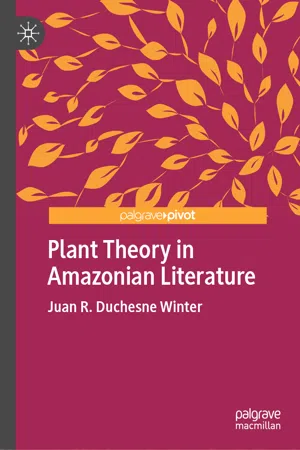
Plant Theory in Amazonian Literature
About this book
This book discusses new developments of plant studies and plant theory in the humanities and compares them to the exceptionally robust knowledge about plant life in indigenous traditions practiced to this day in the Amazonian region. Amazonian thinking, in dialogue with the thought of Eduardo Viveiros de Castro, Emanuele Coccia and others, can serve to bring plant theory in the humanities beyond its current focus on how the organic existence of plants is projected into culture. Contemporary Amazonian indigenous literature takes us beyond conventional theory and into the unsuspected reaches of vegetal networks. It shows that what matters about plants are not just their strictly biological and ecological projections, but the manner in which they interact with multiple species and cultural actors in continuously shifting bodies and points of view, by becoming-other, and fashioning a natural and social diplomacy in which humans participate along with non-humans.
Information
Print ISBN
9783030181062
© The Author(s) 2019
Juan R. Duchesne WinterPlant Theory in Amazonian LiteratureNew Directions in Latino American Cultureshttps://doi.org/10.1007/978-3-030-18107-9_11. Introduction: Amazoning the Theory
Juan R. Duchesne Winter1
(1)
Department of Hispanic Languages and Literatures, University of Pittsburgh, Pittsburgh, PA, USA
Abstract
Amazoning is an experience in thinking with the territory of the largest vegetal-oriented cosmopolitical entity in the planet, which bears a ubiquitous indigenous imprint thoroughly mixed with the heterogeneous cultures of global modernity. The exceptionally robust tradition of vegetal thinking in Amazonia can serve to bring plant theory in the humanities beyond the organic ontology of the plant, in dialogue with current developments of metaphysics like those of Viveiros de Castro, Emanuele Coccia, and others. Contemporary Amazonian indigenous literature takes us beyond conventional theory and into the extramodern reaches of vegetal networks. It shows that what matters about plants are not only their bio-ecological functions, and how they can be projected into cultural notions and vice versa, but the manner in which they enact an interspecies praxis of continuously shifting bodies and souls, becoming-other, and fashioning a cosmopolitical diplomacy to resist capture by any superior force.
Keywords
Plant theoryAmazonian literatureIndigenous literatureCosmopoliticsThis book belongs to an ongoing research project provisionally titled Amazoning Writing. The action word “amazoning” denotes a mode of thinking that engages writing. The Amazon basin acts here, not only as a place but also as an experience in thinking with the territory that involves many expressions: daily life-sustaining practices, oral traditions, ethnography, literature, and theory that carry the millennial thrust of human and multispecies societies who actually are the largest vegetal-oriented cosmopolitical entity in the planet. The ubiquitous indigenous imprint marks everything in the Amazon, and precisely for this reason it is thoroughly mixed with the heterogeneous cultures of a global modernity that Amerindian actors continue to share and contribute to shape together with non-indigenous actors in the midst of unending conflicts and alliances conditioned by persistent coloniality and resistances to it.
The study of indigenous literatures is an aspect of amazoning that can be pursued beyond the indigenous studies proper and onto the unexplored convergences of Amazonian thinking with traditions and emergent expressions of agroindustrial societies that also develop modes of territorial thinking. In this sense, we may assume amazoning as a practice of mixture. It leads to thinking with diverse cultural expressions acting in plural world-contexts, expressions that adopt identities as mixing potentials, overcoming categorical boundaries. Accordingly, when this volume refers to Amazonian thinking and the expressions that convey it, it includes indigenous oral traditions as registered personally, in available media, and in ethnographic and literary texts created and shaped by indigenous and non-indigenous authors to the extent that they all participate in the dialogue concerning life in the Amazonian territory, as forwarded by indigenous thinkers themselves and their non-indigenous interlocutors. There is no pretension here to portray perennial “native beliefs,” but instead to engage critically with indigenous philosophies in our shared contemporary world. This implies that rather than attributing either premodern or prophetic features to indigenous knowledge, we are concerned with the levels of complexity and subtlety it adds to our global modern predicament.
The essays presented here investigate the mutual penetration of plant thinking and literature in an Amazonian context. Plant theory has become the new “next big thing” after the “next big thing” of animal theory in the humanities, as Jeffrey Nealon (2016) implies in a book that sees, precisely in vegetal studies an occasion to expand the horizon of twenty-first-century humanities beyond a constricting competition to come up with ever more commanding posthuman heroes, be it the animal, the plant, the chthonic darkness, the solar plasma, and what next. My aim here is to find out how literary fabulation can fashion plant thinking through a speculative approach that resonates with philosophy but follows its own path and does not necessarily represent plants or talks about them, but joins existing traditions of thinking with them. As a Latin Americanist, the most robust tradition in that regard available to me is Amazonian thinking, which comprises a vegetal metaphysic. Rather than assuming the plant as the next standard bearer of cosmic emancipation, Amazonian tradition follows its territory-making connections as auxiliaries for thought and action. While some important advocates of plant theory in the humanities read in current developments of plant science a botanical teleology of human history with utopian overtones, indigenous literature and other expressions assume a realistic philosophy toward our vegetal denizens. As will be shown in the next chapters, shamans, writers, and other thinkers of the Big Forest assume that the fact that plants are absolutely ubiquitous and indispensable for almost all life in the planet should not infatuate us with them, but invite us to think beyond our supposedly absolute dependence on them. The fact that certain forms of life are a biological precondition for the existence of all other living species does not in-and-of-itself entail that the former posses or represent a unique moral or ethical paradigm or a path for a better existence in universal terms. Plants are great, yes, but just as potentially dangerous or beneficial as any other being. Plants are everything but inherent depositories of goodness and wellness in the sense purveyed by New Age characterizations of the spirituality and sacredness of plant knowledge. These conclusions can be drawn from the indigenous literatures of the region. In this regard, the realism of Amazonian vegetalism is closer to that of modern scientific practice than its more obvious coincidences with plant theory in the humanities would suggest.
Chapter 2 discusses convergences and divergences between plant theory and Amazonian thinking with the help of Emanuele Coccia’s metaphysics of mixture. The logic of mutual implication in Coccia’s mixture preempts fusion and composition of its aggregates by allowing their mutual penetration without suppressing their singularity (Coccia 2016). Plants are masters of mixture. In this context, I discuss how the exegesis of contemporary Amazonian indigenous literature takes us beyond conventional theory (with its all-too-human eudemonic horizon) and into the extramodern reaches of vegetal networks. 1
Chapter 3 explores the shape-shifting novel by Peruvian César Calvo, The Three Halves of Ino Moxo, Teachings of the Wizard of the Upper Amazon (2000). This work is written under the influence of a plant—ayahuasca—although it does not deal with plant life as such like do most works studied by plant theory. The truth is that most modern fiction with an important connection to plants relates to them as drugs while not really focusing on plant life itself. This is so because the cosmic reach of plants invariably leads us beyond them. Moreover, Calvo’s novel does not even focus on the effects of ayahuasca as such. While it may be read as a testimony of “hallucinatory” experiences with the master plant ayahuasca, I read it as a speculative novel that approaches Amazonian thinking through ayahuasca. It transforms what could be just another account of plant psychedelia in the jungle, or at best another phenomenology of the ayahuasca experience, into a speculation on the relationship between visionary experience, fiction, plural ontologies and challenges to the politics of sovereignty and capture of truth in the historical context of coloniality.
These essays are the continuation of an investigation that began in 2015 with two trips to the Mirití-Paraná River basin in the Colombian Amazon. The Matapi indigenous community, along with young artists and activist colleagues, invited my wife and I to the Palm Peach Masked Dance celebrated nonstop during two days and two nights at the community roundhouse (maloca). 2 In this event, I received crucial lessons about thinking-acting with the territory and the role of master plants in this modality. Dancers wear a body-mask outfit that covers face, head, and the rest of the body except hands and feet. They make their masks with rain forest materials like wood, bark, fiber, and paints. Particular sets of masks are built according to tradition to represent specific animals, plants, humans, artifacts, and meteorological phenomena. When the masked figures come in dancing and singing, each set of masks represents a particular species or entity of the forest. Each set of masks does a song and dance sequence that is characteristic of each species-person. These dancing and singing masks unleash a paradoxical chain reaction: The human actors perform a becoming-plant or a becoming-animal that involves a becoming-human of the plants and animals themselves. 3 In other words, they do not just represent non-humans, like Disney figures; they represent animals that mask themselves as humans, who engage in a becoming-human. The form of the mask as artifact enacts that paradox: it does not mimic animals or humans, but this simultaneous two way becoming-animal/becoming-human. We must add that the mask has a personality and life of its own, it is a person, quite distinct from the man that wears it. In this sense, masks are distinct participants in the event; they represent themselves. This ontology of the mask becomes quite complicated when we learn from our conversations with participants that the mask as artifact and the mask as performance (as dramatic song and dance) are each a distinct person with a distinct spirit, both of whom are distinct allies or helpers of the spirit of the particular species they enact. A dancer told me that he needs to have a good relationship with each of these mask persons (the spirit of the mask artifact, the spirit of the song and dance, and the spirit of the species) in order to do a good performance. It is mainly a diplomatic exchange of respect and reciprocity in which asking for permission is most important. We must bear in mind that in Amazonian ontology there is no categorical distinction between nature and artifice or nature and culture (Descola 2014). Moreover, all living species are out there to kill other species because we all thrive by eating each other (and in a way this includes plants, as we will see), so instances of respite, conviviality, and love are not a given, they need to be built and rebuilt constantly, 24/7, to assure survival and a meaningful existence. Diplomacy is a cosmic, existential imperative. 4
What does all this mean? Among other things it means that in this particular expressive complex of the Palm Pe...
Table of contents
- Cover
- Front Matter
- 1. Introduction: Amazoning the Theory
- 2. Plant Theory and Amazonian Metaphysics
- 3. Writing Under the Influence: The Three Halves of Ino Moxo
- 4. Conclusion: Contrast and Pattern
- Back Matter
Trusted by 375,005 students
Access to over 1.5 million titles for a fair monthly price.
Study more efficiently using our study tools.
Frequently asked questions
Yes, you can cancel anytime from the Subscription tab in your account settings on the Perlego website. Your subscription will stay active until the end of your current billing period. Learn how to cancel your subscription
No, books cannot be downloaded as external files, such as PDFs, for use outside of Perlego. However, you can download books within the Perlego app for offline reading on mobile or tablet. Learn how to download books offline
Perlego offers two plans: Essential and Complete
- Essential is ideal for learners and professionals who enjoy exploring a wide range of subjects. Access the Essential Library with 800,000+ trusted titles and best-sellers across business, personal growth, and the humanities. Includes unlimited reading time and Standard Read Aloud voice.
- Complete: Perfect for advanced learners and researchers needing full, unrestricted access. Unlock 1.5M+ books across hundreds of subjects, including academic and specialized titles. The Complete Plan also includes advanced features like Premium Read Aloud and Research Assistant.
We are an online textbook subscription service, where you can get access to an entire online library for less than the price of a single book per month. With over 1.5 million books across 990+ topics, we’ve got you covered! Learn about our mission
Look out for the read-aloud symbol on your next book to see if you can listen to it. The read-aloud tool reads text aloud for you, highlighting the text as it is being read. You can pause it, speed it up and slow it down. Learn more about Read Aloud
Yes! You can use the Perlego app on both iOS and Android devices to read anytime, anywhere — even offline. Perfect for commutes or when you’re on the go.
Please note we cannot support devices running on iOS 13 and Android 7 or earlier. Learn more about using the app
Please note we cannot support devices running on iOS 13 and Android 7 or earlier. Learn more about using the app
Yes, you can access Plant Theory in Amazonian Literature by Juan R. Duchesne Winter in PDF and/or ePUB format. We have over 1.5 million books available in our catalogue for you to explore.