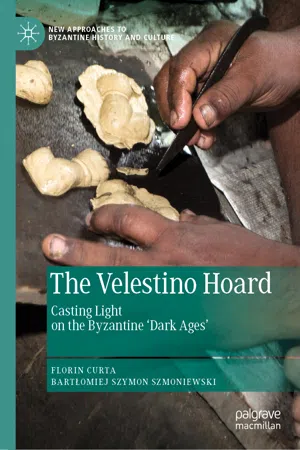
This book examines the remarkable Velestino hoard, found in Thessaly in the 1920s, and analyses the light that this collection of artifacts sheds on a poorly studied period of Byzantine history, and on largely neglected aspects of Byzantine civilization. Many collections of Byzantine gold- and silverware, such as Vrap and Seuso, have been surrounded by controversy. None, however, has been under more suspicion than the Velestino hoard, particularly with regards to its authenticity. The hoard contains no gold and no silver, and is in fact a collection of bronze and leaden plaques, some with human, and others with animal or geometric representations. The authors examine three distinct aspects of the hoard: the iconography of its components, the method of its production, and the function of those components. The conclusions that they reached provide valuable new insights into eighth-century Byzantine culture. The book explores the Byzantine cultural and political context of the Velestino hoard and will appeal to historians and art historians of early Byzantium, as well as archaeologists and historians of early medieval technologies.
eBook - ePub
The Velestino Hoard
Casting Light on the Byzantine 'Dark Ages'
- English
- ePUB (mobile friendly)
- Available on iOS & Android
eBook - ePub
The Velestino Hoard
Casting Light on the Byzantine 'Dark Ages'
About this book
Information
© The Author(s) 2019
Florin Curta and Bartłomiej Szymon SzmoniewskiThe Velestino HoardNew Approaches to Byzantine History and Culturehttps://doi.org/10.1007/978-3-030-04846-4_11. Introduction
Florin Curta1 and Bartłomiej Szymon Szmoniewski2
(1)
Department of History, University of Florida, Gainesville, FL, USA
(2)
Institute of Archaeology and Ethnology, Polish Academy of Sciences, Kraków, Poland
Florin Curta (Corresponding author)
Bartłomiej Szymon Szmoniewski
In spite of a great number of recent finds, some from archaeological excavations, others as the result of metal detector activity, metalworking in the Byzantine Empire is still poorly known. The number of workshops excavated systematically remains too small, and the quantity of tools and implements (such as moulds, crucibles and dies) is still not sufficient for comparative approaches to metalworking in any period of the Byzantine history. 1 Moreover, without any information about the archaeological context, numerous finds of artefacts pertaining to metalworking are of little, if any use in that respect. 2 Finds of Byzantine metalwork from outside territories that were part of the Empire at any moment in its history are of considerable importance, but it is often difficult, if not impossible to establish the manufacturing place of their origin. 3 Given the current state of research, the most vexing question is how to distinguish between authentically Byzantine artefacts in the so-called koiné style from imitations, reproductions and copies, several of which have been found in both Western and Eastern Europe. 4 Within the vast territory of the Empire, different metalworking traditions may be observed, all drawing inspiration from Antiquity. 5 While the main workshops that produced “inter-regional” types of jewellery were located in Constantinople, provincial centres, especially during the early Byzantine period, played an important role in the production and distribution not only of “pan-Byzantine” fashions, but also of strongly marked, specific local traditions. 6 To be sure, goldsmithing has been better studied for the early Byzantine period, especially for the sixth and seventh centuries, most likely because of a better definition of jewellery types and traces of manufacture (workshops). 7 Such techniques of the koiné style as opus interrasile (also known as diatreton) have been defined through studies of the characteristics of golden jewellery, especially of crescent-shaped earrings. 8 Equally important has been the study of dress accessories most typical for the Early Byzantine koiné style, particularly belt buckles and fittings, made of gold , silver , bronze and brass . 9 Such studies have identified local variations with regional characteristics related to production. 10 Moreover, recent finds of moulds, dies and crucibles confirm the idea of a local metalwork production in provincial workshops. Perhaps the most interesting line of current research in that direction has been the study of the Early Byzantine technological developments related to casting using a special channel system in moulds, into which an iron wire was later inserted. That allowed the casting of artefacts with holes and hollow spaces, without the need for later drilling into a cast product. A good, early example of that technique is the set of unfinished cast fibulas with bent stem found in Drobeta-Turnu Severin , in which such iron pins have been found. 11 The study of the Early Byzantine metalworking has also revealed the use of a great variety of metals and alloys, from gold and silver to copper alloys, particularly brass and lead and tin alloys. 12 The significant role of metalworking in copper and its alloys in the Early and Middle Byzantine industry has only recently become clear. 13 Analyses of dozens of metal objects dated to the Roman and Byzantine periods reveal a pattern, namely the “steady replacement of bronze by brass as the usual copper alloy through the first half of the first millennium AD, throughout the western part of the Old World, such that by the time of the Byzantine Empire and the Caliphates brass was universally prevalent”. 14 This is in sharp contrast to the impoverished picture of metalworking during the “Dark Ages” (seventh to ninth centuries). 15 Scholars usually point to the lack of finds from various parts of the Empire. 16 However, it is quite clear that until the ninth century , mainly copper alloys were used for the production of casts, with very rare examples of gold or silver items. 17 Unlike the Early Byzantine metalworking, fewer sophisticated types of jewellery are known from the Middle Byzantine period, and much simpler techniques were in use. 18 Finds of moulds point to casting as the principal production technique in the Byzantine Empire. In that context, the Velestino assemblage is of an exceptional importance, as nothing comparable is known for the entire Middle Byzantine period. Such a remarkable diversity of iconographic themes, technological solutions and alloys offers a unique opportunity to study the Middle Byzantine fine metalworking.
The assemblage, however, was rarely, if ever regarded as a source for the study of Byzantine metalworking. Instead, it became a key argument in debates surrounding early medieval, pre-Christian religious beliefs, particularly the mythology of the early Slavs. Joachim Werner first linked Velestino to Slavic pagan, even shamanistic practices, 19 an interpretation that had a strong influence on contemporary and later discussions of the Slavic presence in Greece. 20 More recently, Nikos Chausidis systematically developed the interpretation of the Velestino plaques and placed them squarely at the centre of any discussion of the religion and mythological system of the Southern Slavs. To prove his point, Chausidis employed an “autonomous research method” based on the analysis of the “material culture [of the Southern Slavs] from [their] arrival to [the] 20th century”. 21 That ultimately led him to far-reaching conclusions, that were based not on contemporaneous archaeological sources, but on the chronologically (and geographically) much more distant materials. 22 For example, Chausidis supported his interpretation of one of the Velestino plaques as an image of the Slavic God Perun by means of linking the image to the mention of a thunder god in the “Slavic excursus” of Procopius of Caesarea’s Wars. 23 There is no concern for the dubious character of the earliest references to the origin and character of the (pagan) Slavic religion, and repeated references to Polabian Slavs, Western Pomeranians or even medieval Rus’ do not inspire much confidence. Chausidis seems oblivious to the now widely acknowledged fact that, in the West Slavic lands, structured forms of cult (temples, cult images/idols and the prominent roles of priests) appeared only in the late tenth century (and no earlier) as a reaction to Christianity . 24 In relation to Velestino, several other scholars have referred to the so-called Zbruch idol (a three-headed stone statue found in the nineteenth century in what is now Western Ukraine), which is dated to the ninth or tenth century. Leaving aside the fact that the Zbruch idol has been associated only with the Eastern Slavs, never with the Belegezites , or any other Slavs from the Balkans , the idea has been recently put forward that the statue is in fact a nineteenth-century forgery . 25 The lack of any solid evidence of early Slavic religious organization or mythology makes it very hard to accept the interpretation of the Velestino plaques as directly associated with the early Slavs. 26 A critical approach to previous interpretations of the Velestino plaques, however, is no substitute for plausible answers to the question of what exactly those plaques represent after all, and what, if any, is the ideology behind such representations. As the following chapters will amply demonstrate, the unmistakable Christian symbolism of many representations and symbols, and the multiple parallels with Byzantine iconography show that the interpretation of the Velestino plaques has until now been on a wrong path. In selecting analogies, the authors of this book paid special attention to the context, and to stylistic parallels. The alternative interpretation of the historical circumstances of the hoard is therefore derived from the chronology and cultural links resulting from the archaeological and art historical analysis of the hoard’s components. Restoring Velestino to its late seventh- or early eighth-century context also means to open an until now unknown page of Middle Byzantine culture.
Notes
- 1.Perhaps the most notable exception is the work of the Greek archaeologist, who has published extensively on remains of workshops in, and finds from Thessaloniki . See A: Anastassios Ch. Antonaras, Arts, Crafts and Trades in Ancient and Byzantine Thessaloniki : Archaeological, Literary and Epigraphic Evidence (Mainz: Verlag des Römisch-Germanischen Zentralmuseums, 2016), 25–2...
Table of contents
- Cover
- Front Matter
- 1. Introduction
- 2. Forgery or Genuine?
- 3. Humans or Human-Like Figures
- 4. Real and Fantastic Animals
- 5. Ornaments
- 6. Style and Chronology
- 7. Production
- 8. Function: Dies or Models?
- 9. Historical Context
- 10. Conclusion
- Back Matter
Trusted by 375,005 students
Access to over 1.5 million titles for a fair monthly price.
Study more efficiently using our study tools.
Frequently asked questions
Yes, you can cancel anytime from the Subscription tab in your account settings on the Perlego website. Your subscription will stay active until the end of your current billing period. Learn how to cancel your subscription
No, books cannot be downloaded as external files, such as PDFs, for use outside of Perlego. However, you can download books within the Perlego app for offline reading on mobile or tablet. Learn how to download books offline
Perlego offers two plans: Essential and Complete
- Essential is ideal for learners and professionals who enjoy exploring a wide range of subjects. Access the Essential Library with 800,000+ trusted titles and best-sellers across business, personal growth, and the humanities. Includes unlimited reading time and Standard Read Aloud voice.
- Complete: Perfect for advanced learners and researchers needing full, unrestricted access. Unlock 1.5M+ books across hundreds of subjects, including academic and specialized titles. The Complete Plan also includes advanced features like Premium Read Aloud and Research Assistant.
We are an online textbook subscription service, where you can get access to an entire online library for less than the price of a single book per month. With over 1.5 million books across 990+ topics, we’ve got you covered! Learn about our mission
Look out for the read-aloud symbol on your next book to see if you can listen to it. The read-aloud tool reads text aloud for you, highlighting the text as it is being read. You can pause it, speed it up and slow it down. Learn more about Read Aloud
Yes! You can use the Perlego app on both iOS and Android devices to read anytime, anywhere — even offline. Perfect for commutes or when you’re on the go.
Please note we cannot support devices running on iOS 13 and Android 7 or earlier. Learn more about using the app
Please note we cannot support devices running on iOS 13 and Android 7 or earlier. Learn more about using the app
Yes, you can access The Velestino Hoard by Florin Curta,Bartłomiej Szymon Szmoniewski in PDF and/or ePUB format, as well as other popular books in History & European Medieval History. We have over 1.5 million books available in our catalogue for you to explore.