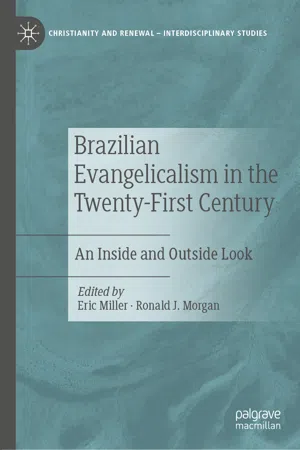
Over the past fifty years Brazil's evangelical community has increased from five to twenty-five percent of the population. This volume's authors use statistical overview, historical narrative, personal anecdote, social-scientific analysis, and theological inquiry to map out this emerging landscape. The book's thematic center pivots on the question of how Brazilian evangelicals are exerting their presence and effecting change in the public life of the nation. Rather than fixing its focus on the interior life of Brazilian evangelicals and their congregations, the book's attention is directed toward social expression: the ways in which Brazilian evangelicals are present and active in the common life of the nation.
eBook - ePub
Brazilian Evangelicalism in the Twenty-First Century
An Inside and Outside Look
- English
- ePUB (mobile friendly)
- Available on iOS & Android
eBook - ePub
Brazilian Evangelicalism in the Twenty-First Century
An Inside and Outside Look
About this book
Information
© The Author(s) 2019
Eric Miller and Ronald J. Morgan (eds.)Brazilian Evangelicalism in the Twenty-First CenturyChristianity and Renewal - Interdisciplinary Studieshttps://doi.org/10.1007/978-3-030-13686-4_11. Introduction
Eric Miller1 and Ronald J. Morgan2
(1)
Department of History, Geneva College, Beaver Falls, PA, USA
(2)
Department of History and Global Studies, Abilene Christian University, Abilene, TX, USA
At the 500th anniversary of the Protestant Reformation , The Washington Post sent its religion reporter not to Wittenberg or Geneva but to São Paulo . That the largest city in the world’s largest Roman Catholic country has become a focal point for global Protestantism points to an extraordinary historical reality: the rapid rise of evangelical Protestantism in Brazil. It’s this reality that this book seeks to explore.1
Grasping the sweeping, complex, indeed world-historical turn toward global evangelicalism requires, among other things, wide-ranging intelligence, and it’s this that we hope this book will offer. We are sixteen scholars working within, and often enough between, an array of disciplines. In this book, we bring each of these disciplines to bear on the phenomenon of Brazilian evangelical Protestantism , with particular attention to its relation to the broader Brazilian society. We seek both to understand the development of evangelical engagement in Brazilian public life and to evaluate its prospects for ongoing efficacious presence.
Of course, just what makes one an “evangelical” is no small scholarly question, as the first part of this book, “Framing,” makes clear. If David Bebbington’s famous “quadrilateral” has proved globally indispensable, it has also become clear that evolving regional and national variations of evangelicalism require the kind of particular attention we here intend to offer.2 In the Brazilian circumstance, the identity of the Protestant crente (literally, “believer”) emerged in a dialectical relationship with the nation’s historically Roman Catholic shape; to be crente, and later evangélico, became the primary non-Catholic Christian identity for many Brazilians. Accordingly, the term evangélico has carried political and cultural dimensions quite distinct from the North American and northern European evangelical variants. Brazil’s evangelical trajectory is thus inescapably entwined with its Catholic past, a story that calls for much more research. If, as scholars claim, the evangelical population of Brazil has risen from 5% of the nation in 1970 to more than 25% fifty years later, there is a huge, complex story—or, rather a host of them—waiting to be told.
We seek to tell parts of this story as Christians ourselves, in varying degrees of sympathy and connection to the evangelical world we are trying to understand. As evangelicals worldwide work toward the renewal of their respective worlds, so we too offer this book in the hope that it will foster the level of insight upon which such renewal depends. Through chapters that touch on concerns ranging from race to ecology to gender to poverty to politics , we present a prism through which to view and make sense of the vast, variegated evangelical movements that in Brazil—as in other parts of the Global South —have become impossible to miss.
Just how impossible they are to miss may fruitfully be illustrated by a look at the place of evangelicals amidst the nation’s recent political crisis that included, among other unsavory spectacles, the impeachment in 2016 of President Dilma Rousseff .
By June of that year, the turmoil of the Brazilian nation had become a repeating headline around the world. With the imminent arrival of the Rio Olympics, exotic images hit from all angles: of infants afflicted with the Zika virus and athletes skipping out due to its threat; of a president suspended from office even as her prosecutors were being charged with graft; of workers enduring an economic free fall superintended by a government spending millions to host the Games. Copacabana’s beaches never seemed like a more inviting distraction. Or illusion.
Brazil’s journalists, acutely preoccupied (as ever) with the nation’s condition and trajectory, flooded the newsstands with alternating waves of worry, anger, and hope. On June 27, the left-wing journal of opinion Carta Capital turned to hope of a gritty, war-torn variety. Embattled backers of Rousseff, Carta’s writers were trying to keep alive an alternate narrative, a narrative distinct from the one aggressively peddled by the Globo network, the nation’s uber-dominant center-right media empire that fueled the fight against Rousseff and her left-of-center Worker’s Party. “The New Face of the Political Struggle,” Carta’s headline ran that day, accompanied by a picture of the grim but resolute faces of two women: twenty-year-old Rita Souza, a leader of an organization fighting homelessness, and Sarah de Roure , a thirty-three year old active in the World March of Women and Christian Aid-Brazil. The article concluded by quoting de Roure on the prospect of progressive social change. “If we do not conceive of the struggle as carried out through a series of alliances, there will be no large transformation.”3
De Roure’s own series of alliances reveals much about the current shape of Brazilian politics, and particularly the enlarging presence of self-consciously religious actors on the stage. For de Roure, these alliances begin close to home. Her father, a recent President of the Legislative Chamber of the Federal District, is a longtime stalwart of the Worker’s Party, having held a variety of elected and appointed positions in the nation’s capital. He is an economist with a graduate degree from Oxford. And he is a Baptist, one of the leaders of a progressive bloc of evangélicos that, as Brazil returned to democracy in the mid-1980s after twenty-one years of military rule, was pushing vigorously for the advance of the nascent Worker’s Party . Sarah’s insistence that “faith can be an excellent gateway to the prevention of and fight against violence toward women” gives a keen sense of the kinds of networks dotting the political landscape of contemporary Brazil.4
This configuration of activists reflects just one of the many ways Brazil’s expansive Protestant sector is asserting its presence in the nation’s public life. From gigantic evangelical-owned television networks to tiny churches on the street corners, from soccer stars proclaiming their faith to youth workers toiling in the slums, evangelicals are effecting change not only in Brazilian society but in the nation’s very sense of identity. Whether the nation “rises,” as the title of a recent book on Brazil announces, or whether it falls, as many have of late prophesied, the number of evangelicals continues to surge, and in a far from quiescent way.5
Taking the measure of this evangélico phenomenon has become not just a demographic curiosity; it’s become a civic task. Earlier assumptions about the political and social presence of evangélicos are being challenged in the face of accumulating history. In fact, not long before its article on Sarah de Roure, Carta Capital published an essay calling for just such a reconsideration. Noting that evangelicals tended to be scorned (desprezado) among the educated classes, the author and anthropologist Juliano Spyer proceeded to provide counter-evidence that had turned up in his fieldwork among the working classes of Bahia. Spyer pointed out that “among the most vulnerable segments of the population, evangelical organizations are frequently more present and active than the government.” True, he conceded, they tend toward moral conservatism on issues like abortion and gay marriage. But the prevailing image is nonetheless misleading. When discussing evangelicals, the educated classes “underscore the fanaticism but disregard the way evangelicals value education (including higher education). They note the conservatism but forget about the reduction of domestic violence and alcoholism among evangelical families.” Given the genuine “contribution of evangelicals to society,” he urged his readers to see evangelicals with more “generous and interested eyes.”6
It’s just such an understanding that this book seeks. While its purpose is not to issue a collective thesis about Brazilian evangelicalism, its thematic center pivots on the ways in which Brazilian evangelicals are, or are not, exerting a presence and effecting change in the life of the nation—ways in which they are seeking to become agents of a renewal that is at once social, political, and spiritual in scope.
Brazil’s evangélicos are certainly not alone in pursuing this end. On the cover of The Rebirth of Latin American Christianity , historian Todd Hartch’s recent volume probing the history of this broad renewing movement, a photograph catches a crowd in a (now) emblematic moment of worship—arms extended, eyes raised. The mouth of the woman in the picture’s foreground opens into a cry, and her eyes are partly closed; her expression suggests earnest, even desperate longing. On the back cover of the book, we learn that the photograph is from a 2012 Roman Catholic mass in São Paulo . Hartch sees a dynamic, synergistic relation emerging between Protestants and Catholics throughout Latin America over the past fifty years; he claims, in fact, that “Protestant growth spurred the rebirth of Catholicism.”7 It’s a powerful story—indeed, a story-within-a-powerful-story—in view of the explosive growth of Christianity throughout the Global South , yielding in our day what theologian Wolfgang Vondey calls “a global Christian culture.”8 This book’s focus is on the evangelical Protestant variant of that culture manifestly taking root in Brazil.
As the book’s subtitle declares, our volume offers an “inside look” at this phenomenon in several senses. Eight of the book’s sixteen contributors are Brazilian scholars with varying degrees of proximity, past or present, to the nation’s evangelical milieu, and four other contributors have spent significant parts of their lives in Brazil. They speak, then, as participant-observers, with eyes trained by personal experience as well as the discourses of their respective disciplines. But there are other ways in which the contributors offer an “inside” look. Their writing is inflected with personal commitments and confessions of various kinds, including religious. All of the book’s contributors, regardless of nationality, write as Christians themselves, addressing their concerns from within the purview of Christian belief. The reality of religious confession is not masked in this work: the book’s contributors write from the level of their own deepest understanding of the world.
Conversely, the book affords an outside look at Brazilian evangelicalism. One aspect of this perspective is cultural: Eight of the contributors are not Brazilian citizens, making possible other vistas. For that matter, the Brazilian contributors themselves, while often intimate with a given sector of evangelicalism, experience other facets of it as outsiders. Perhaps most important, all of the book’s contributors are scholars trained in the university, which by virtue of its discourses and disciplinary traditions makes possible interpretive perspectives that exist in tension with theological confession and religious practice. The book’s contributors are practitioners in the fields of sociology, law, intercultural studies, public health, history, theology, and political science. They bring these disciplines to bear on Brazilian evangelicalism in ways that will prove fruitful to readers both within and without these varying fields. And they aim to do so in ways that will...
Table of contents
- Cover
- Front Matter
- 1. Introduction
- Part I. Framing
- Part II. Politics
- Part III. Society
- Part IV. Environment
- Part V. Mission
- Back Matter
Trusted by 375,005 students
Access to over 1.5 million titles for a fair monthly price.
Study more efficiently using our study tools.
Frequently asked questions
Yes, you can cancel anytime from the Subscription tab in your account settings on the Perlego website. Your subscription will stay active until the end of your current billing period. Learn how to cancel your subscription
No, books cannot be downloaded as external files, such as PDFs, for use outside of Perlego. However, you can download books within the Perlego app for offline reading on mobile or tablet. Learn how to download books offline
We are an online textbook subscription service, where you can get access to an entire online library for less than the price of a single book per month. With over 1.5 million books across 990+ topics, we’ve got you covered! Learn about our mission
Look out for the read-aloud symbol on your next book to see if you can listen to it. The read-aloud tool reads text aloud for you, highlighting the text as it is being read. You can pause it, speed it up and slow it down. Learn more about Read Aloud
Yes! You can use the Perlego app on both iOS and Android devices to read anytime, anywhere — even offline. Perfect for commutes or when you’re on the go.
Please note we cannot support devices running on iOS 13 and Android 7 or earlier. Learn more about using the app
Please note we cannot support devices running on iOS 13 and Android 7 or earlier. Learn more about using the app
Yes, you can access Brazilian Evangelicalism in the Twenty-First Century by Eric Miller, Ronald J. Morgan, Eric Miller,Ronald J. Morgan in PDF and/or ePUB format, as well as other popular books in Scienze sociali & Storia dell'America Latina e dei Caraibi. We have over 1.5 million books available in our catalogue for you to explore.