This book examines the relationship between state fragility and corruption. It analyzes a variety of regions throughout the world, including Latin America, Central Asia and the Middle East, Africa, Central America and Mexico, South America, and Russia. States that are plagued by high levels of state fragility and corruption facilitate illicit activities and other criminal enterprises.
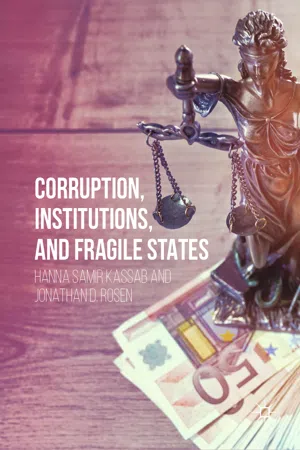
- English
- ePUB (mobile friendly)
- Available on iOS & Android
eBook - ePub
Corruption, Institutions, and Fragile States
About this book
Information
© The Author(s) 2019
Hanna Samir Kassab and Jonathan D. RosenCorruption, Institutions, and Fragile Stateshttps://doi.org/10.1007/978-3-030-04312-4_11. Introduction
Hanna Samir Kassab1 and Jonathan D. Rosen2
(1)
Department of Political Science, East Carolina University, Greenville, NC, USA
(2)
Holy Family University, Philadelphia, PA, USA
Hanna Samir Kassab (Corresponding author)
Jonathan D. Rosen
Fragile states and extractive institutions have a negative impact on underdevelopment , leading to corruption and the inevitable success of organized crime . Building on Daron Acemoglu and James A. Robinson, this work argues that inclusive political institutions are necessary for states to develop. Such institutions provide the confidence for people (both within the state and without) to invest in themselves and in businesses. Such investment hires people and creates tax revenue necessary to build state infrastructure. 1 However, in states and regions where corruption is endemic and institutionalized due to the overwhelming presence of organized crime , how is it possible to have institutional change? Further, if organized crime is pervasive, how will it be possible to convince people to move away from supplying illegal goods given the extravagant profit, and simultaneously, lack of alternatives due to underdevelopment ? 2 This book examines this challenge of institutional change and reform within states and regions that suffer from endemic corruption and underdevelopment , 3 creating fertile soil for organized crime and other non-state actors to challenge the authority, legitimacy, sovereignty and ultimately, the power of state actors.
This book seeks to understand corruption and organized crime in a systemically way, looking at its spread across states, regions, and ultimately continents. Such a range illustrates the idea of systemic reach, a non-state threat that is distributed across state is fundamental to this study. 4 Corruption is carried out by a number of actors. This book focuses on the phenomenon of organized crime and the formation of gang and drug-related violence . This work takes a comprehensive look of the world, understanding the prime mechanisms and environments that encourage and sustain the formation of these groups. If one state becomes a haven for illicit activity, then one could expect corruption to spread to neighboring states as organized criminal networks try to get their product to target markets. Supplier markets are usually located in the underdeveloped and developing world, in countries like Brazil, Colombia, and Mexico. Yet major demand markets are located in more developed , advanced industrialized states like the US and member states of the European Union. Indeed, the USA is the largest consumer market for drugs in the world. 5 For cocaine to enter Chicago, Illinois in the USA from Colombia, or for heroin to arrive from Afghanistan to Paris, France, organized criminals must create illegal supply chains that extend from production line locals to the consumer. In this sense, it is important to note the power of organized criminal networks and corruption in the formulation of these supply chains, and the linkage industries that spin-off from the development of these illicit markets.
Fragile states provide the necessary rich environment for organized crime . This is because fragile states are prone to corruption due to the nature of political institutions as well as underdevelopment to tackle organized crime as well as other non-state threats. 6 Fragile states are those that lack the ability to operate freely to neutralize internal or external threats to sovereignty and autonomy. 7 Threats may come from other states and their militaries, but also from non-state actors like terrorist networks and organized crime . They may be of the non-violent variety (e.g., economic, environmental, or health-related issues). 8 In other words, fragile and weak states lack the capacity to be resilient in face of these dangers. Hanna Samir Kassab argues that resilience is crucial. Resilience is the ability to defeat threats of any variety to survive as a unitary state actor. 9 Weak and fragile units find it difficult to fend off the influence of organized criminal networks due to mechanisms that corrupt the state, its regime and its government. When one state is penetrated by an organized criminal network, its behavior will be determined, not by the state itself, but by the leaders of those organized criminal networks. This actively hurts the autonomy and sovereignty of the state, making it fragile rather than effective, and in extreme cases, could lead to potential state failure. A failed state is one that cannot provide any security or services to its people and its geography is ultimately controlled by members of organized criminal groups or terrorist networks. The centralized authority of that state is completely unable to establish control or dispense justice, and cannot be relied upon to do this effectively given its loss of legitimacy over non-state competitors.
Inevitably associated with fragile states is persistent economic underdevelopment due to extractive political institutions . The relationship between these two phenomena cannot be studied separately. 10 Extractive political institutions are neither designed to distribute wealth equally nor are they able to drive innovation, investment, and reinvestment. These institutions allow for the enrichment of a minority of people at the expense of others. With wealth floating to the top, persistent economic underdevelopment becomes a pertinent issue. Hence, the main desire of this book is to understand the impact that fragile states and extractive institutions have on underdevelopment also noting the impact of corruption in the success of organized crime . Existing research shows that impoverished societies are prone to illegal activity. 11 Moreover, once organized crime penetrates a society, there will be further increases in political instability which strains the ability of the state to survive. In other words, organized crime promotes fragility as “drug production helps weaken states, fuel civil conflicts; drug revenues support insurgents, other armed non-state actors, and corrupt officials.” 12 As a result, economic underdevelopment complicates fragility further by opening the society up to organized crime, which further corrupts the state, etc.
Building on previous work, Jonathan D. Rosen and Hanna S. Kassab contend that economic development may “promote fragility due to a lack of democratic political instability from corruption .” 13 Consequently, this book has two purposes: (1) to describe the difficulty of institutional change given the power of organized criminal groups (2) highlight their power to corrupt states and regions. This topic is of primary importance, as the wealthier these groups become, the more powerful they become to challenge the state, its institutions , and those of surrounding regions. Any attempt at pushback may lead to violent resistance as in the example of the current Mexican state’s effort to neutralize the cartels or Colombia in the 1990s.
This book will take a global look at this phenomenon, illustrating the growing systemic importance of corruption as it affects state survival. It highlights major trends and changes in hotspots around the world such as Central and South America. In these regions, trade in illicit goods is still remarkably robust in the face of state repression. The reason for this is the continued existence of fragile states and extractive institutions . If these mechanisms remain, organized crime will continue to be resilient in the face of repression. Organized crime remains as long as states are easy to penetrate. Crime groups may move from one fragile state to another like in the case of Mexican drug cartels moving to Central America. We will also illustrate major developments in the Middle East and Central Asia. In this region, the divide between terrorism and organized crime is increasingly blurred. Moreover, as the West and Russia continue its fight against Islamic fundamentalism through physical violence , it does little to improve the state’s ability to fight corruption and proclivi...
Table of contents
- Cover
- Front Matter
- 1. Introduction
- 2. Theory of Institutional Change
- 3. Latin America and Lebanon: A Comparative Study of Fragility
- 4. Central Asia and Middle East
- 5. Africa
- 6. Mexico and Central America
- 7. South America
- 8. Russia and the International System
- 9. Conclusion: Police, Judicial, and Prison Reform
- Back Matter
Trusted by 375,005 students
Access to over 1.5 million titles for a fair monthly price.
Study more efficiently using our study tools.
Frequently asked questions
Yes, you can cancel anytime from the Subscription tab in your account settings on the Perlego website. Your subscription will stay active until the end of your current billing period. Learn how to cancel your subscription
No, books cannot be downloaded as external files, such as PDFs, for use outside of Perlego. However, you can download books within the Perlego app for offline reading on mobile or tablet. Learn how to download books offline
Perlego offers two plans: Essential and Complete
- Essential is ideal for learners and professionals who enjoy exploring a wide range of subjects. Access the Essential Library with 800,000+ trusted titles and best-sellers across business, personal growth, and the humanities. Includes unlimited reading time and Standard Read Aloud voice.
- Complete: Perfect for advanced learners and researchers needing full, unrestricted access. Unlock 1.5M+ books across hundreds of subjects, including academic and specialized titles. The Complete Plan also includes advanced features like Premium Read Aloud and Research Assistant.
We are an online textbook subscription service, where you can get access to an entire online library for less than the price of a single book per month. With over 1.5 million books across 990+ topics, we’ve got you covered! Learn about our mission
Look out for the read-aloud symbol on your next book to see if you can listen to it. The read-aloud tool reads text aloud for you, highlighting the text as it is being read. You can pause it, speed it up and slow it down. Learn more about Read Aloud
Yes! You can use the Perlego app on both iOS and Android devices to read anytime, anywhere — even offline. Perfect for commutes or when you’re on the go.
Please note we cannot support devices running on iOS 13 and Android 7 or earlier. Learn more about using the app
Please note we cannot support devices running on iOS 13 and Android 7 or earlier. Learn more about using the app
Yes, you can access Corruption, Institutions, and Fragile States by Hanna Samir Kassab,Jonathan D. Rosen in PDF and/or ePUB format, as well as other popular books in Politics & International Relations & International Relations. We have over 1.5 million books available in our catalogue for you to explore.